ATI TEAS Math Questions: 12 Practice Problems
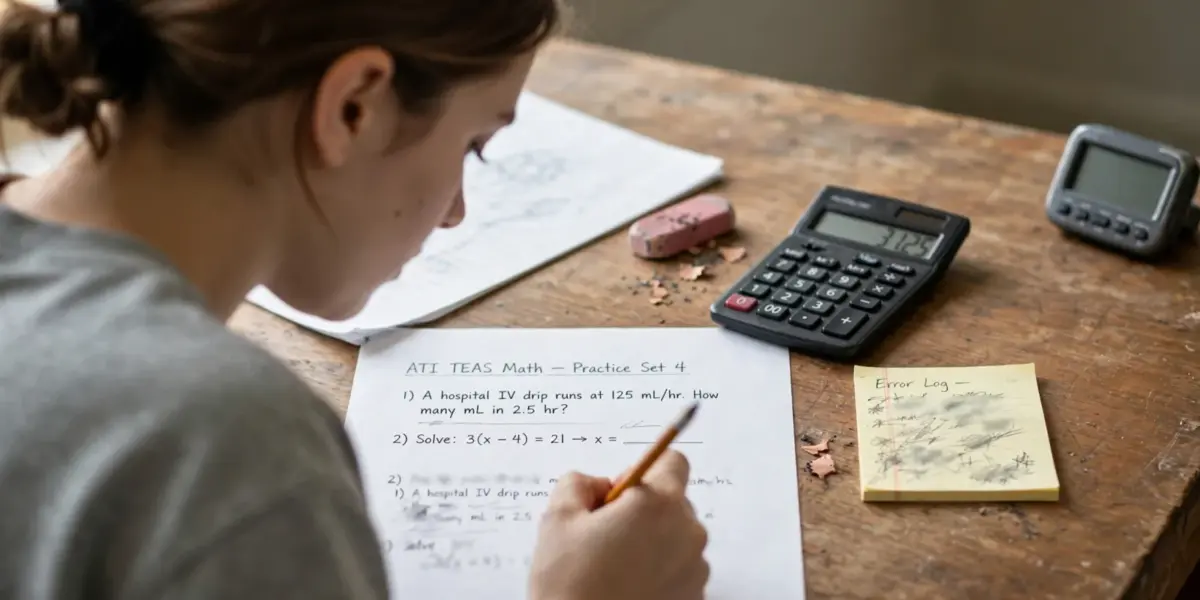
Before opening a formula sheet, find out exactly what causes your dropped points. A short diagnostic set identifies whether your misses come from an underlying concept, a word-problem translation, an arithmetic error, a unit conversion, or a pacing breakdown. Work through the 12 original ATI TEAS math questions below to diagnose those gaps. Every numbered item includes a step-by-step rationale, an explanation of each distractor trap, and a focused next drill.
These questions are modeled on publicly available ATI TEAS Version 7 objectives. Once you finish scoring, you can move into free starter practice and timed simulations on PrepNovat to build a rationale-based review habit that targets your exact weaknesses.
What Math Is on the ATI TEAS?
Exam snapshot: questions, time, and calculator
The current ATI TEAS Exam Details show the math section presents 38 displayed questions in 57 minutes, which includes four unscored items. To understand the scored distribution, review the 2022 ATI TEAS Version 7 Content Outline. It identifies 34 scored math questions: 18 fall under Number and Algebra, and 16 fall under Measurement and Data.
Dividing 57 minutes by 38 questions gives you an approximate 90-second planning estimate per item. Treat this as a practice pace rather than a strict per-question rule. The section clock is fixed, meaning time cannot be carried into another section, and you can only review answers within the active section.
ATI provides an on-screen calculator during the exam, and personal calculators are not permitted. Practice with a standard four-function calculator or computer application rather than relying on a graphing or scientific model.
The two public math domains
The Number and Algebra domain tests fraction, decimal, and percent conversion, and it requires you to handle rational-number operations, comparisons, one-variable equations, real-world percentages, estimation, proportions, rates, and inequalities.
Measurement and Data tests your ability to interpret tables and graphs, calculate basic statistics, define variable relationships, apply geometry formulas, and convert standard and metric units. You will encounter word problems that combine multiple skills, forcing you to extract the correct numbers, set up the operation, and attach the correct units to the final answer.

Take the ATI TEAS Math Diagnostic
Set an 18-minute timer and complete all 12 items plus the optional bonus before checking the answer key. Record every selected option or numeric response on a blank sheet of paper, and practice with a basic four-function calculator to simulate the test environment.
Label any missed questions as you check your work, noting whether the error came from concept knowledge, translation, arithmetic, unit conversion, data interpretation, or pacing. The formats below demonstrate multiple-choice, ordered-response, numeric fill-in, and multiple-select practice, though test day will feature a different format distribution.
Questions 1–7: Number & Algebra
Question 1 Which pair is equivalent to 0.625? A. 5/8 and 62.5% B. 5/8 and 6.25% C. 5/6 and 62.5% D. 5/6 and 625%
Question 2 Place the following values in order from least to greatest:
- 0.58
- 5/8
- 61%
- 0.6
Question 3 Fill in the blank: -3/4 + 1.2 = ____
Question 4 Solve: 2(x + 3) = 18 A. 3 B. 6 C. 9 D. 12
Question 5 A practice bundle costs $45. It is discounted by 20%, and then a $3 service fee is added. What is the total due before tax? A. $9 B. $36 C. $39 D. $48
Question 6 A student completes 18 practice questions in 12 minutes at a constant rate. At that rate, how many questions can the student complete in 30 minutes? A. 27 B. 30 C. 45 D. 54
Question 7 An applicant earns 17, 22, x, and 20 points on four quizzes. The total must be at least 80 points. Which inequality describes the required score x? A. x > 21 B. x >= 21 C. x <= 21 D. x < 21
Questions 8–12: Measurement & Data
Question 8 The table shows questions attempted and answered correctly over three days.
- Monday: 20 attempted, 15 correct
- Tuesday: 24 attempted, 18 correct
- Wednesday: 18 attempted, 15 correct
On which day was the student’s accuracy highest? A. Monday B. Tuesday C. Wednesday D. Accuracy was the same on all three days
Question 9 The data set is: 4, 6, 6, 8, 11. Select all statements that are true. A. The mean is 7. B. The median is 6. C. The mode is 8. D. The range is 7. E. The mean equals the median.
Question 10 A student records practice blocks (x) and correct questions (y).
- 1 block gives 12 correct.
- 2 blocks give 17 correct.
- 3 blocks give 22 correct.
- 4 blocks give 27 correct.
Which equation represents the relationship? A. y = 5x + 7 B. y = 7x + 5 C. y = 5x + 12 D. y = 12x + 5
Question 11 A rectangular study board measures 8.5 inches by 4 inches. What is its area? A. 25 square inches B. 34 square inches C. 42.5 square inches D. 68 square inches
Question 12 Fill in the blank: 2.5 L = ____ mL
Optional Bonus: Estimation Estimate 49.8 + 15.2 + 9.7 to the nearest whole number. A. 65 B. 75 C. 80 D. 74.7
Answers, Distractor Traps, and Next Drills
Verify your correct answers and read the rationale for every option to diagnose specific errors. If you missed a question, follow the designated next drill to repair the underlying concept. Score alternate-format items, like ordered response and multiple select, as fully correct only when your entire response is correct, which models ATI’s stated no-partial-credit treatment of alternate items.
Number & Algebra rationales
Question 1: A 0.625 equals 625/1,000, which simplifies to 5/8. Multiplying 0.625 by 100 gives 62.5%. Option B shifts the percent decimal one place too far, Option C uses an incorrect fraction conversion, and Option D fails on both forms. Next drill: Convert five mixed fractions into decimals and percentages, including values below 1 and greater than 1.
Question 2: 0.58, 0.6, 61%, 5/8 Convert each value to a decimal to get 0.58, 0.60, 0.61, and 0.625. If you placed 61% below 0.6, you made a percent-to-decimal error, while reversing 0.58 and 0.6 reveals place-value confusion. Placing 5/8 near 0.58 means you either read the fraction as 5.8 or skipped conversion entirely. Next drill: Order five sets containing decimals, fractions, and percentages after converting them to a single format.
Question 3: 0.45 Convert negative 3/4 to -0.75, then add 1.20 to reach 0.45. An answer of -0.45 means you combined the magnitudes correctly but chose the wrong sign. Entering 1.95 means you ignored the negative sign entirely, and entering -1.95 means you treated both values as negative. Next drill: Complete ten operations with negative decimals, fractions, and mixed signs.
Question 4: B Divide both sides by 2 to get x + 3 = 9, then subtract 3 to reach x = 6. Choosing A mishandles the coefficient and parentheses, choosing C means you stopped after one inverse operation, and choosing D means you added 3 instead of subtracting it. Next drill: Solve five two-step equations involving parentheses.
Question 5: C Calculate the 20% discount on $45, which is $9. Subtract it to reach the $36 discounted price, then add the $3 fee to reach $39. Choosing A calculates only the discount amount, choosing B finds the pre-fee price, and choosing D adds the fee to the original price without applying the discount. Next drill: Calculate five sequential discount, fee, and tax problems, writing each step down.
Question 6: C Divide 18 by 12 to find a rate of 1.5 questions per minute, then multiply by 30 minutes to get 45. Choosing A uses the wrong time span, choosing B confuses quantities and minutes, and choosing D applies an incorrect scale factor. Next drill: Solve five rate problems while writing the units beside every intermediate step.
Question 7: B Add 17, 22, and 20 to get 59. The condition is 59 + x >= 80, so subtract 59 to solve for x >= 21. Option A is incorrect because “at least” includes equality, while Options C and D reverse the requirement entirely. Next drill: Translate phrases like “at least,” “no more than,” “fewer than,” and “greater than” into inequalities.
Measurement & Data rationales
Question 8: C Monday and Tuesday both have a 75% accuracy rate. Wednesday has 15 correct out of 18 attempted, or approximately 83.3%. Choosing Tuesday confuses a raw correct count with accuracy, and declaring a tie ignores the different attempt rates. Next drill: Complete table questions that distinguish totals, percentages, averages, and rates.
Question 9: A, B, and D The mean is 35 divided by 5, which equals 7, while the median, the middle value, is 6. The range is 11 minus 4, which equals 7. Option C misidentifies the mode (6), and Option E makes a false assumption that mean and median must match. Next drill: Calculate mean, median, mode, and range for five data sets before looking at the question requirements.
Question 10: A The y-value increases by 5 for each one-unit x-change, and the intercept is 7, producing y = 5x + 7. Option B swaps the slope and intercept, Option C treats the first y-value as the intercept, and Option D treats the first y-value as the slope. Next drill: Write the equation for five tables by finding the y-change and intercept.
Question 11: B Multiply 8.5 by 4 to get an area of 34 square inches. Choosing 25 calculates the perimeter instead, choosing 42.5 is an arithmetic error, and choosing 68 doubles the area or applies the wrong formula. Next drill: Practice identifying whether a word problem requires area, perimeter, or volume.
Question 12: 2,500 Multiply 2.5 by 1,000 because each liter contains 1,000 milliliters. An answer of 25 or 250 uses too small a factor, while an answer of 0.25 reverses the direction of the conversion. Next drill: Draw and complete a metric conversion ladder for liters to milliliters, meters to centimeters, and kilograms to grams.
Optional Bonus: B Round the terms to 50, 15, and 10 to get an estimated 75. Option A mishandles one term, Option C rounds too aggressively, and Option D provides the exact total instead of the requested estimate.

Turn Your Score Into a Study Plan
Score bands and the error log
Treat this diagnostic as a mapping exercise. These editorial score bands offer study guidance independent of official ATI score conversions or admissions cut scores.
Scoring 10 to 12 correct suggests you understand the core concepts, so you can review any distractor traps you fell for and move into mixed timed practice. A score of 7 to 9 correct points to a specific domain weakness. Identify whether you missed more items in Number and Algebra or Measurement and Data, then complete targeted drills before your next timed set. Scoring 0 to 6 correct points to untimed concept repair, so review worked examples and complete short practice batches before attempting a full diagnostic again.
Build an error log to track your progress. Set up a simple table with columns for Question Number, ATI Objective, Selected Answer, Error Type, Correct Rule, Next Drill, and Parallel-Retest Result. When you miss a geometry question because you used a perimeter formula instead of an area formula, write that exactly. This log helps you identify the exact reason you missed an item, rather than settling for a vague resolution to “study more math.”
The three-question remediation loop
Use the same remediation loop for every logged error. First, review every option to see the structure of the trap. Second, name the error type explicitly: calculation, formula, translation, or pacing. Third, complete three similar questions focused on that specific objective. Finally, retake a parallel item later in your study session. Add any recurring weakness to your next timed simulation.
Use PrepNovat for targeted retesting
If you need a larger question bank to run this loop, PrepNovat’s TEAS exam prep provides original practice questions, detailed rationales for correct and incorrect choices, timed tests, and full-length simulations.
Instead of searching for random worksheets, rely on domain performance breakdowns to target your practice hours. The platform flags your weak domains as you answer questions, letting you read the explanations for every distractor trap and keeping your study time focused on the objectives costing you points.
ATI TEAS Math Timing and Common Questions
Calculator and section-pacing tactics
Apply calculator and section-pacing tactics during your review, using the 90-second average as a planning benchmark rather than staring at the clock on every item. Some questions take 30 seconds, while multi-step word problems might take two minutes.
Practice with a basic four-function calculator so you build realistic habits. Estimate the answer before calculating and keep units written beside intermediate values to work efficiently within the fixed section time limit.
FAQ: topics, timing, and passing scores
How many math questions are on the ATI TEAS? ATI lists 38 displayed math questions, including four unscored pretest items, and the V7 outline identifies 34 scored math questions.
How much time do you get for the section? You have 57 minutes to complete the math section.
Can you use a calculator? ATI provides an on-screen calculator during the exam. You cannot bring a personal calculator to the testing center or use one during the exam.
What topics does the math section cover? The V7 objectives cover Number and Algebra plus Measurement and Data. Expect questions on conversions, rational-number operations, equations, percentages, proportions, rates, inequalities, tables, statistics, variable relationships, geometry, and metric conversions.
Is there a universal passing score? Check your program’s specific policies because nursing and allied-health schools establish their own minimum scores, attempt limits, and waiting periods.
Are these official ATI TEAS questions? The items above are original practice questions modeled on public objectives rather than official ATI materials.
Continue with timed practice
Continue testing your skills with a timed starter session. Take a practice TEAS exam on PrepNovat, review your domain breakdown, and complete targeted math practice for your recurring errors. Focus on the step-by-step rationales until you stop falling for the distractor traps, then progress to a full-length simulation when you are ready to rehearse real exam pacing.
Ready for more realistic practice? Visit PrepNovat to build your speed, accuracy, and confidence with timed exams, targeted diagnostics, and detailed rationales for every subject.

Natalie
PrepNovat Team