PA Real Estate Exam Practice Test: A Study Plan That Separates State and National Review
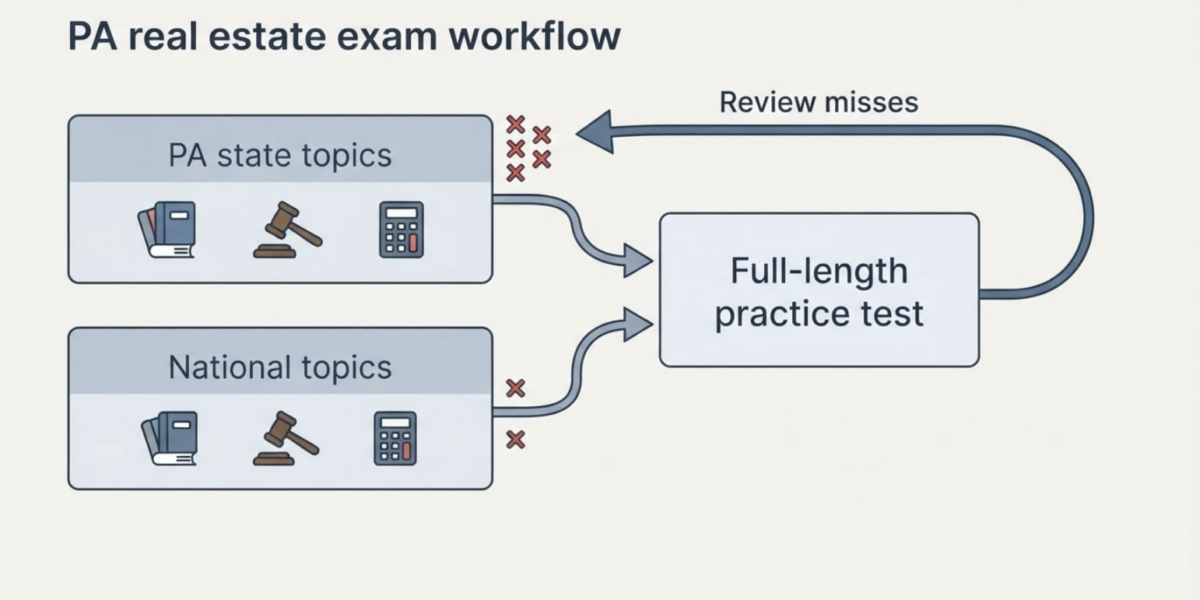
When you sit for the Pennsylvania real estate salesperson licensing exam, you answer questions from two different worlds in one session. The national portion tests general real estate principles that apply across most states, while the Pennsylvania portion tests state-specific law, disclosure rules, and settlement practice. Most candidates grab any pa real estate exam practice test they can find, answer mixed questions until the scores stop moving, and never notice that the two halves need separate study routines.
This guide gives you a complete method you can run with materials you already own: course notes, the state law booklet, and free question sets. You will drill Pennsylvania content on its own, national content on its own, and only then combine both halves in realistic full-length tests. A ready-made question bank can shorten this routine; the last section shows where it fits without replacing the method.
The two halves of the exam, and why mixing them early holds you back
Pennsylvania candidates study the same national framework as licensees in other states: property ownership, land use, contracts, financing, agency relationships, and valuation. Broad but predictable, and most prep materials cover it well.
The state portion is a different animal. It centers on Pennsylvania license law, the rules of the Pennsylvania Real Estate Commission, seller disclosure obligations, and the way settlement and title transfer actually happen in this state. Because the questions are written around Pennsylvania statutes and procedures, national-only study leaves you guessing on a large share of them.
With mixed question sets alone, you cannot tell which half is dragging your score down: a state topic you keep missing hides inside a test full of national questions you already know. Separating the two halves turns every wrong answer into a signal about which study stack needs more work.
Before you start: two stacks of material and one mistake log
Gather what you already have before answering a single question:
- Your pre-license course outline, which lists the topics the exam can cover.
- The candidate handbook from the testing agency that approved you to sit. It is the only authoritative list of what counts as state versus national material.
- Free question sets, your course’s practice quizzes, or old homework banks. They do not need to be polished; they need to be sorted.
Sort everything into two stacks: Pennsylvania state items and national items. Then start a mistake log: every time you miss a question, write the topic, the rule you got wrong, and the correction in your own words. By week two this log becomes your study plan, because it names the exact statute or concept to drill next.
Step 1: Drill the Pennsylvania state portion on its own
Start with the state stack, the portion you are least likely to have studied elsewhere, and work through it in topic chunks: license law first, then agency and disclosure duties, then contracts and settlement procedures, then titles and deeds.
A powerful tool-free technique is writing your own questions. After each reading session, turn five rules into five questions the way an examiner would: take a statute and ask what changes when a fact changes. For the seller disclosure rule, ask what a seller must disclose, what happens if they do not, and which transactions are exempt. Answering your own questions the next day forces recall instead of recognition, and recognition is what quietly fails on exam day.
Your checkpoint: you can answer questions in every state topic chunk without notes, and your state mistake log stops adding new rules.
Step 2: Drill the national portion until the basics are automatic
Once the state stack feels manageable, treat the national stack the same way, with a repeat-until-it-sticks rhythm. National questions tend to test definitions, calculations, and agency scenarios, so split your practice:
- Definitions and concepts: turn terms such as easement, lien, and fiduciary duty into flashcards, one term per card, and shuffle them daily.
- Calculations: practice the math that appears on the exam until the steps are automatic — commission problems, loan-to-value ratios, proration, and closing cost math. Work them by hand with a basic calculator, the same way you will on test day.
- Scenario questions: read agency and contract scenarios carefully and identify the governing rule before you look at the answer choices, because the wrong choices are designed to look correct.
Your checkpoint mirrors the first: every national topic chunk scores consistently, and your mistake log keeps surfacing the same few concepts, so you know exactly what to review tomorrow.
Step 3: Combine both halves into full-length practice tests
This step is the one most candidates skip, and it is what builds test-day stamina. Start combining only when your separate drills are solid: two sessions in a row where you finish on time and your mistakes are genuine slips rather than content gaps.
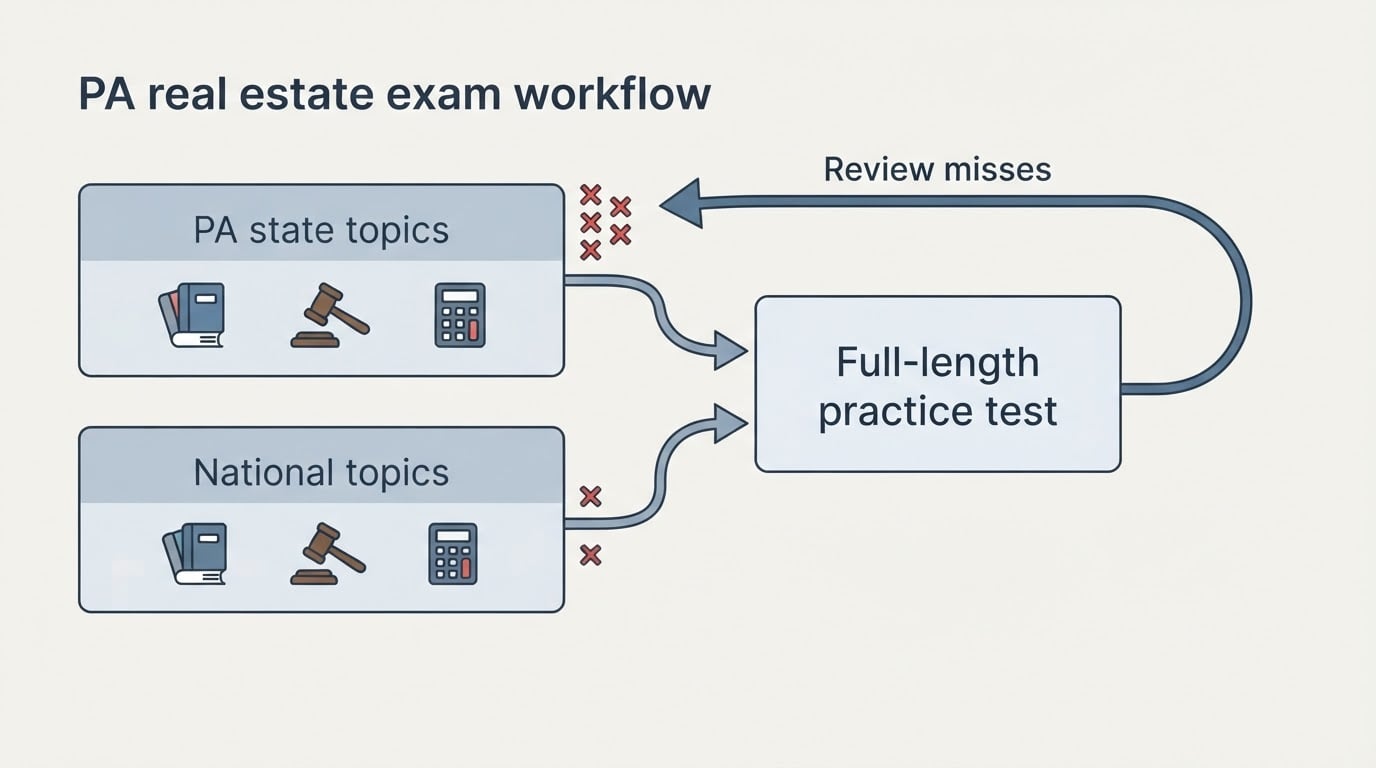
Build a realistic test by drawing questions from both stacks in the mix your candidate handbook describes, then treat it like the real thing:
- Sit in one session with the full time limit and no phone, no notes, and no music.
- Answer every question in order; do not skip around the way you do in casual practice.
- When the timer ends, review every question you missed or flagged, and add each one to your mistake log with the reason you chose wrong.
- Retake a combined test two or three days later and compare the mistake log pages. Improvement shows up as shorter lists, not perfect scores.
Two consecutive combined tests that end on time with no new mistake-log entries is a strong sign you are ready to schedule your exam.
Step 4: Turn exam language into a glossary you actually review
Every licensing exam leans on a shared vocabulary, and Pennsylvania questions assume you know it cold. Rather than reading a glossary once, build your own deck as you study and review it in the final week. Start with the terms below, which appear across both halves of the exam, and add every unfamiliar word you meet.
| Term | Plain-English meaning |
|---|---|
| Agency | The legal relationship where one party (the agent) is authorized to represent another (the principal) in dealings with third parties |
| Fiduciary duty | The obligation to act in the principal’s best interest, with loyalty, care, and full disclosure |
| Easement | The right to use another person’s land for a specific purpose, such as access or utilities |
| Lien | A legal claim against a property as security for a debt |
| Encroachment | A physical intrusion, such as a fence or building, that crosses onto a neighbor’s property |
| Cloud on title | A claim or encumbrance that could impair the owner’s title until it is resolved |
| Escrow | The holding of funds or documents by a neutral third party until the conditions of a sale are met |
| Earnest money | The deposit a buyer puts down to show good faith in a purchase agreement |
| Amortization | Repaying a loan through scheduled payments that cover both principal and interest |
| PITI | The four parts of a typical monthly mortgage payment: principal, interest, taxes, and insurance |
Review the deck like your mistake log: shuffle the cards, say the definition out loud before flipping, and pull any card you stumble on into tomorrow’s pile. By test week, exam language should feel like plain English.
What a realistic practice week looks like
Here is one rhythm that fits the method into a working week. Adjust the days to your schedule, but keep the order: state drills first, national drills second, combined tests last.
- Monday: state portion drill on license law and disclosure, then add five self-written questions.
- Tuesday: state portion drill on contracts and settlement; review Monday’s mistake log.
- Wednesday: national calculations and definitions, working the math by hand.
- Thursday: national scenario questions on agency and contracts; update flashcards.
- Friday: one full combined practice test under real timing.
- Weekend: review both mistake logs, re-drill the top three weak topics, and shuffle the glossary deck.
Where a ready-made question bank fits in
The method above stands on its own, but sourcing and writing questions takes real time, and self-made questions cannot match the wording pressure of professional exam items. If you want a shortcut that keeps the same discipline, a question bank works as the drill engine inside this plan.
PrepNovat’s Real Estate License Prep course holds 800+ practice questions written for prospective licensees, and each answer comes with an explanation of why it is right and why the other options are not. That rationale review is the same habit this guide depends on, automated for you. Use it like any question source in the steps above: drill your weakest portion first, read the explanation for every answer you miss, and save combined full-length tests until your separate drills are consistent.
Real Estate Exam Prep landing page showing navigation, page title, and introductory content about real estate licensing exam preparation.
The mistake most candidates make in the last two weeks
The most common failure pattern is not studying too little; it is abandoning the separation too early. Candidates switch to nothing but full practice tests as the date approaches, and state-portion weaknesses stop improving because they are buried inside mixed tests. If your mistake log shows the same Pennsylvania topic reappearing, drill that topic alone in the final days, no matter how many combined tests you feel you should take.
The second most common mistake is reviewing answers instead of reasoning. Marking a question right and moving on teaches nothing: a question you guessed correctly is still one to log and re-drill. Treat a lucky guess as a miss, and test day holds no surprises.
Your test-week checklist
- Both stacks drilled to the checkpoint: no notes needed, no new mistake-log entries.
- At least two combined full-length tests finished on time.
- Glossary deck shuffled daily, with every stumble card back in the pile.
- Calculator, ID, and exam confirmation packed the night before.
- Pennsylvania state rules reviewed last; they are the freshest material in your memory on exam day.
Work the halves separately, combine them late, and review every answer like an examiner would. That routine is what turns a pa real estate exam practice test from a score report into a pass.

Natalie
PrepNovat Team