How to Prep for the Real Estate Exam Prep Test
Most people who fail their state licensing exam don’t fail because they didn’t study. They fail because they studied the wrong way, reading textbooks cover to cover instead of practicing under real exam conditions. If you’re searching for a real estate exam prep test that actually mirrors what you’ll face on test day, you’re already on the right track.
The fastest way to prep for the real estate exam is to combine a large, realistic question bank with timed practice tests that force you to manage pacing the way you will in the testing center. Add detailed rationales for every answer choice, correct and incorrect, and you start understanding the underlying real estate law and math instead of just memorizing flashcards. That combination is what separates people who pass on their first attempt from people who need a second try.
In this guide, you’ll get a straightforward plan for building a study routine, choosing practice questions that match your state’s exam format, and using full-length timed tests to build real confidence before you walk into the exam room.
What to know before you start studying
Before you open a single practice question, figure out exactly what your state tests. Every state licensing exam pulls from the same core: real estate principles, practices, and math, plus a state-specific portion covering your state’s laws and regulations. The national portion usually runs 80 to 100 questions, and the state portion adds another 30 to 50, depending on where you’re testing. Skipping this step is why so many candidates waste weeks studying content that never shows up on their actual exam.
Check your state’s real estate commission website for the current exam outline before you commit to a prep real estate exam plan or compare real estate exam prep course options. Some states, like Texas and Florida, publish a full content breakdown with percentages per topic. Others give you less detail, so you’ll need to lean on your prep course’s coverage of both national and state law. Either way, don’t guess. A mismatched study plan is the single biggest reason people re-study material they already knew and ignore the sections that actually trip them up.
Know the format, not just the content
Format matters as much as content. Most states use computer-based testing with multiple-choice questions, a countdown timer, and no ability to go back and change answers once you submit a section. Some allow a basic calculator, others provide one on-screen. Some allow scratch paper, others don’t. These small differences change how you should practice.
| Exam Element | Typical Range |
|---|---|
| National portion questions | 80-100 |
| State portion questions | 30-50 |
| Time allowed | 2.5-4 hours total |
| Passing score | 60-75% (varies by state) |
| Retake wait period | 24 hours to 30 days |
The candidates who pass on the first try are the ones who practice under the same conditions they’ll face in the testing center, not the ones who read the most.
Set a realistic timeline
Most people preparing for a real estate licensing exam prep schedule need two to four weeks of focused daily practice, not months of casual review. Cramming a single weekend rarely works because the math questions (commission splits, prorations, loan calculations) require repetition to become automatic. On the other hand, dragging prep out over several months often backfires too, since you’ll forget early material before test day arrives.
Gather these before you start:
- Your state’s official exam content outline or candidate handbook
- A calculator matching what’s allowed at your testing center
- A real estate license practice exam bank with at least a few hundred questions, plus sample questions with answers to review
- A calendar blocked out for daily 45 to 60 minute study sessions
- Your pre-licensing coursework notes for quick topic review
Think of this prep phase like assembling a toolkit, not memorizing a script. Real estate exams test whether you can apply concepts to scenarios you haven’t seen before, agency relationships, fair housing violations, contract contingencies. That’s a different skill than recalling definitions, and it’s exactly why practice questions with rationales matter more than rereading your textbook one more time. Once you know your format, timeline, and materials, you’re ready to find out where you actually stand.
Step 1. Take a diagnostic practice exam
Start your prep with a full-length diagnostic practice exam, not a handful of random questions. Pull one from your prep course that covers both the national and state portions, set a timer, and treat it exactly like test day. No phone, no notes, no pausing to look things up. This single test tells you more about where you stand than a week of passive reading ever will.
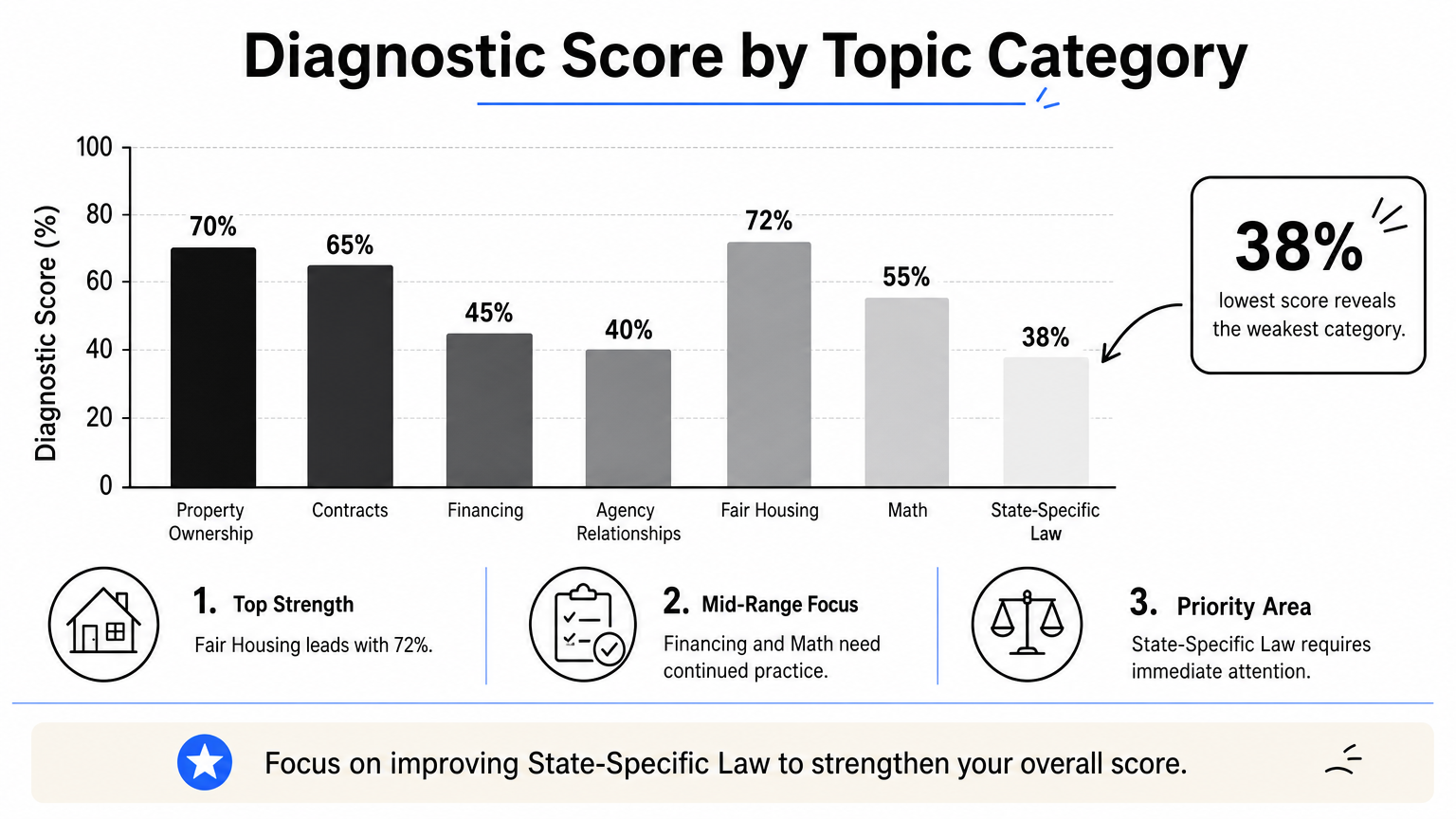
Grade it honestly and break the results down by topic, not just by overall score. A 68% overall score hides the fact that you got every agency question wrong but nailed every math question. That distinction matters because it tells you where to spend your limited study hours. Most real estate license exam questions cluster into recognizable categories, so a good diagnostic report should show you performance across each one:
| Topic Category | Typical Weight | Your Score Here |
|---|---|---|
| Property ownership and land use | 8-12% | ___ |
| Contracts | 10-15% | ___ |
| Financing | 8-10% | ___ |
| Agency relationships | 10-12% | ___ |
| Fair housing and disclosures | 6-10% | ___ |
| Math (commissions, prorations, loans) | 10-15% | ___ |
| State-specific law | 20-30% | ___ |
A diagnostic test isn’t about proving you’re ready. It’s about finding out exactly what’s not ready yet.
Resist the urge to skip this step because it feels discouraging. Scoring 55% on your first diagnostic doesn’t predict your exam-day result, it just shows you the gap between where you are now and where you need to land. Testing early, before you’ve reviewed anything, gives you an honest baseline instead of an inflated one that comes from studying the material right before you test yourself.
Use this diagnostic to answer one question: which three or four categories dragged your score down the most? Write them down. That short list becomes the backbone of the study plan you’ll build next, and it keeps you from wasting time re-reviewing content you already know cold.
Step 2. Build a study plan around your weak spots
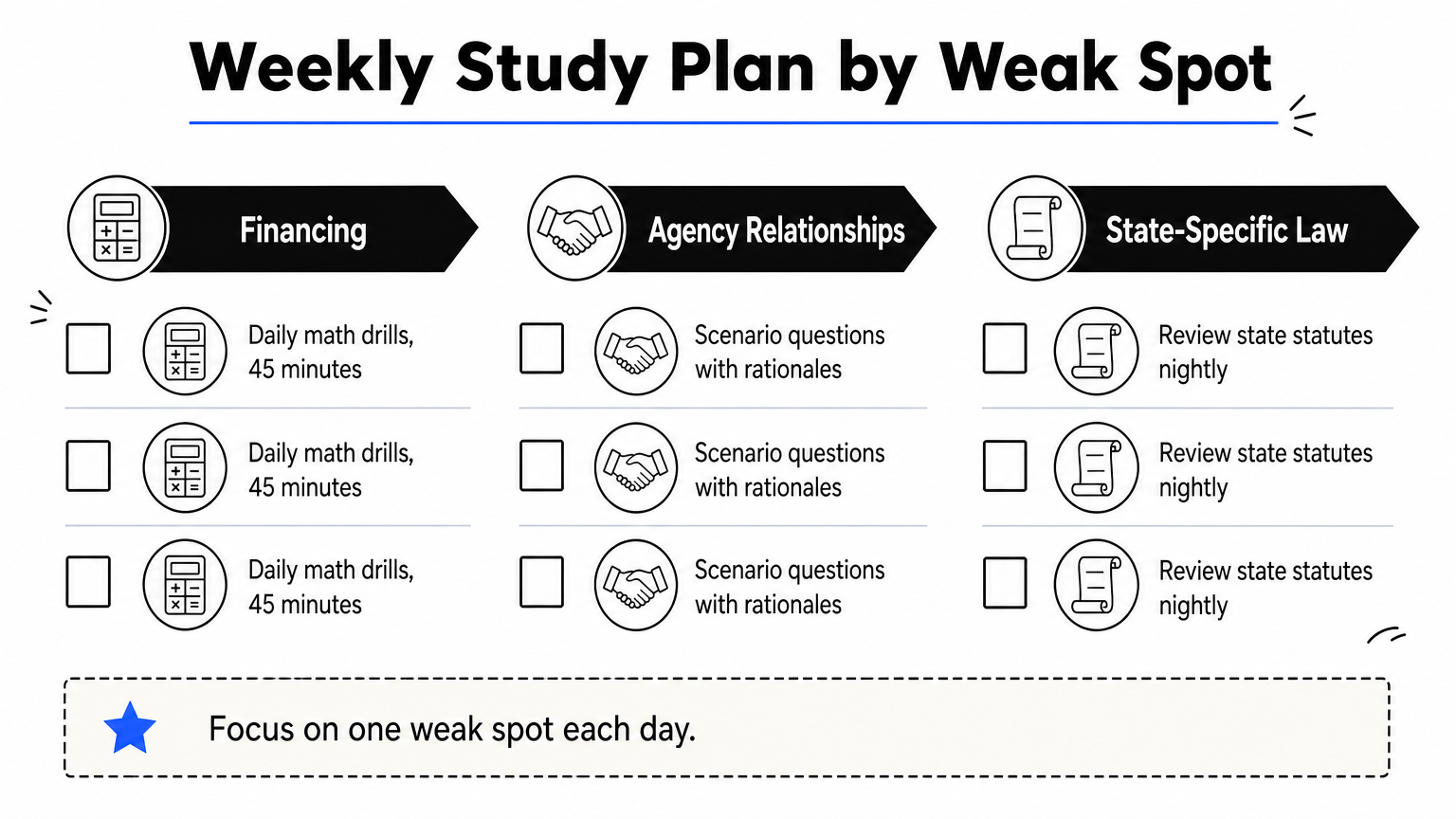
Take the three or four categories you flagged on your diagnostic and turn them into a weekly schedule. Weak-spot targeting beats generic review because it puts your limited study hours where they actually move your score. If financing and state-specific law dragged you down, those two topics should eat up 60% of your study time, not get the same 15 minutes you give topics you already know cold.
Allocate time by score gap, not by comfort
Many candidates gravitate toward topics they already understand because it feels productive to answer questions correctly. Resist that pull. A prep exam real estate plan built around comfort instead of data just reinforces what you already know while your weak areas stay weak.
Studying what you’re already good at feels productive, but it doesn’t move your score. Only studying your weak spots does.
Build a weekly schedule you can actually follow
Break your remaining prep time into short, focused blocks tied to specific topics. Here’s a sample week for someone weak in financing, agency, and state law:
| Day | Focus | Time |
|---|---|---|
| Mon | Financing math drills | 45 min |
| Tue | Agency relationships | 45 min |
| Wed | State-specific law | 60 min |
| Thu | Financing + timed quiz | 45 min |
| Fri | Agency + state law mix | 45 min |
| Sat | Full-topic review quiz | 60 min |
| Sun | Rest or light review | 20 min |
Repeat this rotation, adjusting the weighting as scores improve. Retake a short quiz in each weak category every few days so you can see actual movement, not just a feeling that you’re improving.
Once two of your weak categories climb above 75% on quizzes, swap one of their blocks for your next-weakest topic. This keeps your study plan dynamic instead of static, which matters because a plan built on day one data goes stale fast once you start closing gaps. Your goal isn’t to study everything equally. It’s to systematically eliminate the categories that would otherwise sink your score on exam day.
Step 3. Drill practice questions with rationales daily
Once your weekly schedule is running, the daily habit that actually moves your score is answering practice questions and reading every rationale, not just the ones you missed. Daily drilling with rationales built into each question turns a wrong answer into a lesson about why the correct choice works and why the other three don’t. PrepNovat’s real estate practice test questions include exactly this kind of explanation for every answer choice, so a 20-minute session teaches you the underlying rule instead of just marking a score.
Why rationales matter more than answer keys
A plain answer key tells you what’s right. A rationale tells you why, and that distinction is what makes the concept stick when you see it phrased differently on exam day. Real estate exams love to rephrase the same rule across three or four questions, so understanding the reasoning behind a correct answer about agency disclosure, for example, prepares you for every variation of that question, not just the one you already saw.
Memorizing an answer gets you through one question. Understanding the rationale gets you through the ten variations of it that show up later.
Set a daily question quota
Aim for a fixed number of questions every day rather than an open-ended study session that fizzles out after ten minutes.
- Weekdays: 40-60 questions split across your weak categories
- Weekends: one 100-question mixed set covering all topics
- Read every rationale, even for questions you answered correctly
- Flag any rationale you had to reread twice, and revisit those flagged items in three days
Track how much time you spend on rationales
Don’t rush past the explanation just to hit your quota faster. If you’re answering 50 questions but skimming rationales in five seconds, you’re drilling volume without building understanding. Slow down on missed questions and on any correct answer you weren’t fully sure about, since a lucky guess today is a wrong answer on exam day if you never learn why it worked.
Step 4. Simulate full timed exams before test day
Daily drills build knowledge, but full timed simulations build stamina and pacing, which is a different skill entirely. In your final one to two weeks, shift from short question sets to complete practice exams that mirror the real thing: same number of questions, same time limit, same no-notes rule. Sitting through a full 2.5 to 4 hour test for the first time on actual exam day is a bad plan, since fatigue and time pressure change how you think in ways short drills never expose.

Passing the real exam has less to do with knowing the material and everything to do with proving you can perform under the same pressure you’ll face in the testing center.
Schedule your simulation like real exam day
Run at least three full timed practice tests before your appointment, spaced a few days apart so you have time to review and adjust between each one. Treat every simulation seriously:
- Take it at the same time of day as your scheduled exam appointment
- Use only the calculator and scratch materials your testing center allows
- Sit at a desk, not on a couch, with your phone in another room
- Complete the national and state portions back to back, exactly as you will on test day
PrepNovat’s full-length timed practice tests and mock exams replicate this structure automatically, so you’re not guessing at pacing on your own.
Review results like a diagnostic, not a scorecard
After each simulation, don’t just note the score and move on. Grade it the same way you graded your original diagnostic: break performance down by category, flag any topic that slipped, and read every rationale for missed questions again. Simulations close to test day often reveal small gaps that daily drills missed, usually in categories you thought you’d already fixed. Timing matters here too. If you’re consistently running out of time on the state portion, that’s a pacing problem, not a knowledge problem, and it means you need to practice moving faster on questions you already know instead of studying more content.
Ready for exam day
By now you have a plan that looks nothing like passive reading: a diagnostic to find your weak spots, a weekly schedule built around those gaps, daily drills that teach you the reasoning behind every answer, and full timed simulations that build real stamina. That sequence is what separates candidates who walk out confident from candidates who freeze up when the timer starts.
Candidates who treat their real estate exam prep test like a real dress rehearsal, not a study session, walk into the testing center already knowing how the pacing feels and what their weak spots used to be. You don’t need to reread another textbook chapter. You need more reps under real conditions, with rationales that explain the why behind every answer choice.
If you want a question bank built exactly for that kind of practice, start with our complete real estate exam prep guide and put this plan to work today.

Natalie
PrepNovat Team