SHRM-CP Question Types: Knowledge And Situational Judgment
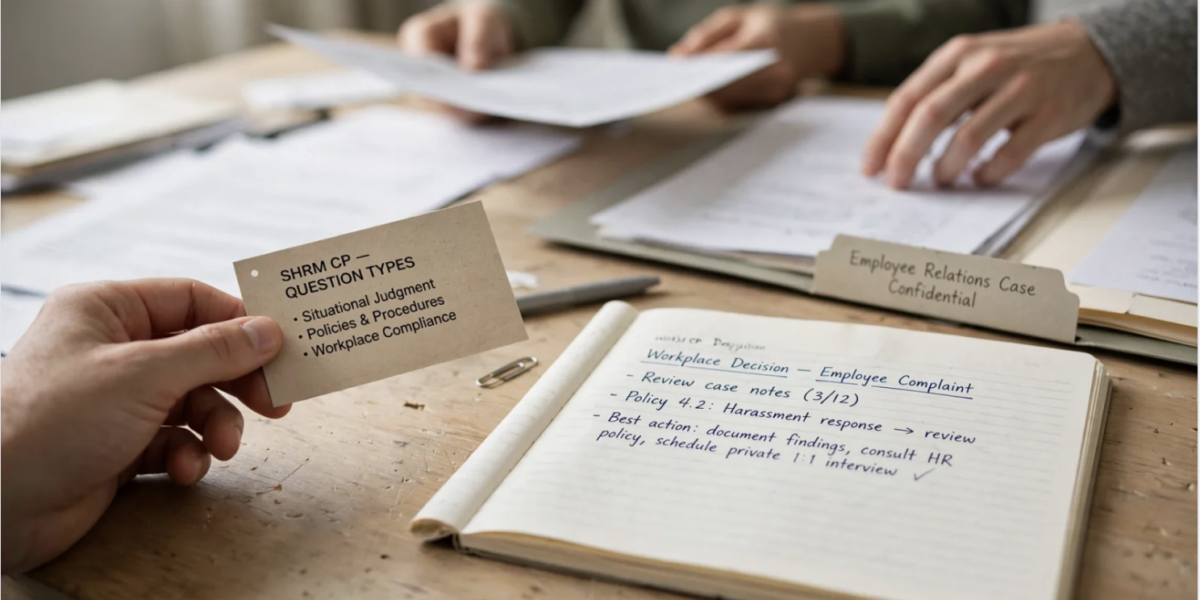
The SHRM-CP exam uses two broad formats: stand-alone knowledge questions and scenario-based situational-judgment questions. For study purposes, the knowledge questions break into two sub-categories. You will encounter HR-specific Knowledge Items, Foundational Knowledge Items, and Situational Judgment Items. Understanding the difference between these three SHRM-CP question types prevents you from overanalyzing a basic definition or applying rigid memorization to a complex workplace scenario.
SHRM-CP Question Types At A Glance
Your study plan needs to account for both the official exam structure and the practical reality of answering questions under time pressure. The testing body describes the SHRM-CP exam format as containing stand-alone knowledge-based items and scenario-based situational-judgment items.
The 2026 SHRM Certification Handbook divides the stand-alone knowledge category into HR-specific Knowledge Items and Foundational Knowledge Items. This gives you three distinct labels to track in your error log: KI, FKI, and SJI.
| Item Type | Approximate Exam Share | Mental Task |
|---|---|---|
| HR-Specific Knowledge (KI) | 50% | Recall an HR concept and apply it to a specific functional area. |
| Situational Judgment (SJI) | 40% | Choose the most effective action for a realistic workplace scenario. |
| Foundational Knowledge (FKI) | 10% | Identify the concept behind a behavioral competency. |
The exam contains 134 total multiple-choice questions, which typically include 80 stand-alone knowledge questions and 54 situational-judgment items. The percentages above reflect published blueprint proportions, so your individual exam form may vary slightly from this exact mix.
At PrepNovat, we recommend using mixed practice sessions to build your recognition skills. Facing a randomized bank of questions teaches you to identify the item type before solving it, which helps you use detailed rationales to understand why one reasoning mode works better than another for a specific prompt.

HR-Specific Knowledge Items
HR-specific KIs require precise understanding and application of functional HR information rather than word-for-word memorization of a glossary.
These questions draw from three HR knowledge domains and 14 functional areas. The People domain includes HR Strategy, Talent Acquisition, Employee Engagement and Retention, Learning and Development, and Total Rewards. Moving to the Organization domain, you will find topics covering the Structure of the HR Function, Organizational Effectiveness and Development, Workforce Management, Employee and Labor Relations, and Technology Management. Finally, the Workplace domain focuses on Managing a Global Workforce, Risk Management, Corporate Social Responsibility, and U.S. Employment Law and Regulations.
A typical question stem asks about a practice’s primary purpose, the relevant HR function, or the most appropriate metric for a specific process. You must identify the domain, name the functional area, retrieve the governing concept, and reject answers that are related but incomplete.
Review this original example focusing on Total Rewards:
Which HR functional area most directly addresses the design and implementation of compensation and benefits packages used to attract and retain employees? A. Talent Acquisition B. Total Rewards C. Workforce Management D. Employee & Labor Relations
The correct answer is B because this stand-alone functional-area question uses adjacent HR topics as distractors. While Talent Acquisition and Workforce Management both relate to staffing and retaining employees, the specific wording points directly to compensation and benefits, which defines the Total Rewards functional area. Proper SHRM-CP test preparation involves learning the exact boundaries between these related concepts.
Foundational Knowledge Items
Foundational Knowledge Items present stand-alone questions about the concepts underlying behavioral competencies, separating them from both HR functional-area questions and full workplace scenarios.
The 2026 SHRM Body of Applied Skills and Knowledge organizes eight behavioral competencies into three clusters: Leadership (Leadership and Navigation, Ethical Practice, and Inclusive Mindset), Interpersonal (Relationship Management and Communication), and Business (Business Acumen, Consultation, and Analytical Aptitude). Older study materials may refer to nine competencies or use legacy terminology, so base your review on the current Inclusive Mindset framework.
An FKI may ask which behavior or approach best reflects a specific competency without providing a lengthy narrative. Treat every competency as a three-part study note:
- Concept: Define the competency in one sentence.
- Behavior: Describe what this concept looks like as an observable workplace action.
- Contrast: Identify a tempting alternative behavior that would be less effective.
Consider this original example focused on Communication:
A manager asks HR to approve a policy change but provides incomplete information. Which response best demonstrates effective communication? A. Approve the change quickly to preserve momentum. B. Ask clarifying questions, confirm understanding, and explain the next steps. C. Send the request to all employees for immediate feedback. D. Wait for the manager to resolve the information gap.
The correct answer is B because the item tests a foundational concept rather than asking you to manage a complex stakeholder conflict. Option B demonstrates active listening and clear messaging, while Option D remains overly passive and Option A ignores the information gap entirely.

Situational Judgment Items
SJIs present realistic workplace scenarios where you must read the facts and decide what the HR professional should do first, which action would be most effective, or which response best addresses the situation.
This format requires a shift from recall reasoning to best-action reasoning, recognizing that several choices may be workable in real life. You might read an option and think your own manager would handle it exactly that way, but the exam scores responses on a standardized model rather than local corporate culture. SHRM explicitly advises candidates to use general HR best practices rather than relying on their own organization’s habits.
Processing these scenarios systematically requires a practical framework. Start by restating the central issue and identifying the desired outcome, making sure to separate the established facts from your own assumptions. Next, map the scenario to the relevant competency or proficiency expectation, then rank the options by effectiveness and timing before comparing the top two choices.
You should consistently eliminate answers that are punitive, overly passive, premature, unsupported by the text, or too quick to impose a final solution without gathering facts.
Review this original Rebuilding Trust scenario:
An employee survey shows low trust after a reorganization. A senior leader wants HR to announce a mandatory morale event the next day. What should HR do first? A. Announce the event immediately to show that leadership is taking action. B. Review the survey data and gather targeted input to identify the main causes before recommending a response. C. Reject the survey because the response rate was not perfect. D. Require managers to submit written explanations for the low-trust results.
The correct answer is B. Option A is premature and attempts to solve a complex trust issue with an unrelated event, while Option C is dismissive and Option D is punitive. This makes Option B the strongest first step because it uses the available information, clarifies the root problem, and supports a targeted response.
Field-Test Questions And Exam Timing
Your exam session includes 24 unscored field-test questions mixed randomly with scored questions throughout the test.
Since you cannot reliably identify a field-test item while testing, attempting to guess which questions are unscored wastes time and mental energy. Treat every displayed item with the same attention and apply your standard reasoning process to each one.
The testing period is divided into two independently timed 110-minute sections, and unused time from the first section does not transfer to the second. To plan your pacing, divide the total 220 testing minutes by the 134 total displayed questions, providing an estimate of roughly 98.5 seconds per item.
The testing organization outlines the exam options and fees alongside appointment details and gives candidates 3 hours and 40 minutes to answer 134 questions, making average pacing a useful preparation heuristic for your study plan. Because the exam includes both knowledge items and situational-judgment items, build practice around switching between formats without overanalyzing either one. Use explanations of the exam topics as a study aid, but manage your time well enough to answer every question.

How To Practice Switching Reasoning Modes
Reading about a taxonomy only helps if you turn it into a repeatable practice loop, which makes identifying the question type before looking at the options a highly reliable way to improve your score.
First, classify the item on your screen as a stand-alone KI, a stand-alone FKI, or an SJI.
When facing knowledge items and foundational concepts, use recall mode to retrieve the principle from memory before reading the choices closely. Choose the most precise answer and use the distractors to define the boundary between related concepts. Missing a KI usually indicates a gap in your functional area vocabulary.
For situational judgment items, shift into best-action mode by identifying the core issue, the required objective, the stakeholders, and the best sequence of events. After ranking the actions, remember that missing an SJI often means you jumped to a solution prematurely or picked a reasonable action instead of the most effective one.
Review every option after completing a question to understand the full context. Record why the keyed response works, why the strongest distractor fails, and what specific error led you away from the right choice.
Maintain an error log with the following fields:
- Item type (KI, FKI, or SJI)
- Domain or competency
- Error category (knowledge gap, concept confusion, misread scenario, or pacing)
- The correct principle
- The reason the distractor was tempting
- Follow-up practice needed
PrepNovat builds this workflow directly into our platform by offering mixed question banks, full rationale reviews for every answer choice, timed full-length simulations, and domain performance breakdowns. When candidates evaluate practice question alternatives, they often realize that answering hundreds of questions in a row without categorized feedback reinforces bad habits.
The most effective study loop involves completing a mixed set of questions and reviewing all rationales thoroughly. From there, you can target your weakest item type or content area for focused reading and repeat the process under timed conditions.
SHRM-CP Question Types: Quick Answers
Are There Two Or Three Question Types?
The testing body outlines two broad formats: stand-alone knowledge items and scenario-based situational-judgment items. For practical study planning, the stand-alone knowledge format splits into HR-specific Knowledge Items and Foundational Knowledge Items. Tracking your progress across these three useful study categories helps you isolate your specific weaknesses.
What Do Knowledge, Foundational, And SJI Items Test?
HR-specific KIs test your understanding of HR concepts across 14 functional areas, while FKIs examine the concepts behind behavioral competencies without using lengthy scenarios. Finally, SJIs present realistic workplace situations that ask you to select the most effective action among several plausible choices.
Are All Questions Scored, And How Should I Practice?
Every exam includes 24 unscored field-test questions mixed randomly with the scored items, meaning you should treat every item as a live, scored question. Practice by separating recall-based questions from best-action scenarios initially, then combine them into mixed timed sets and review every rationale once you understand the distinct reasoning modes. Keep in mind that performance on free preview questions published by the testing body represents an introductory benchmark, so rely on full practice exams to gauge your certification readiness.
Stop guessing which reasoning mode to apply by starting a mixed practice set with PrepNovat today. You can identify whether your main hurdle is functional HR knowledge, behavioral concepts, situational judgment, or pacing. Review the rationale for every option, pinpoint your exact reasoning gap, and build your next study block around realistic, timed simulations at PrepNovat.

Natalie
PrepNovat Team