How to Pass the ATI TEAS 7: A Study Guide for Nursing Applicants
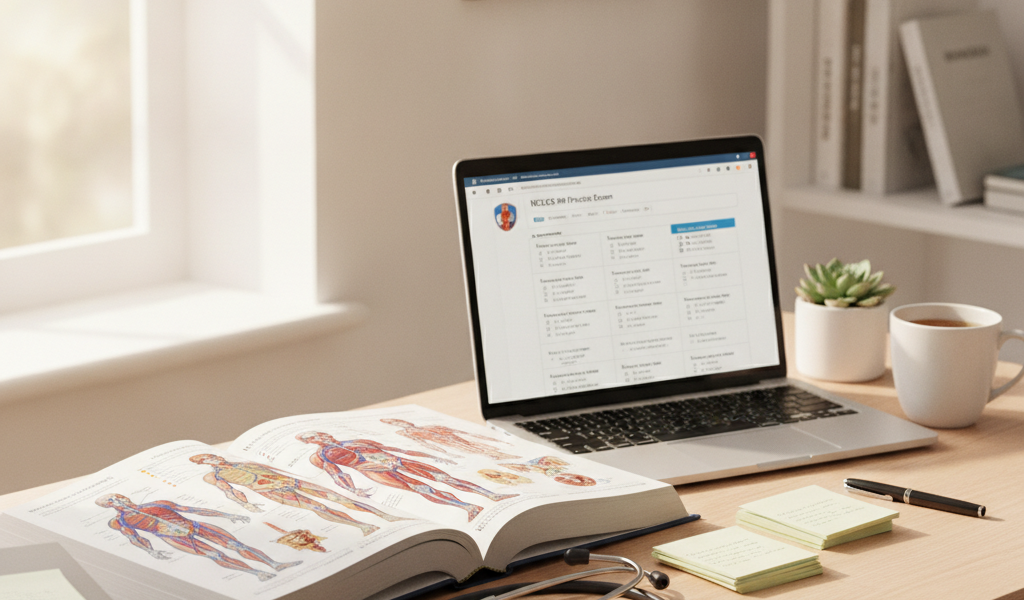
You’ve met the prerequisites, written the personal statement, and submitted your nursing school applications. One thing stands between you and your acceptance letter: the ATI TEAS exam. For thousands of nursing applicants every year, the TEAS is the gatekeeper — and nursing programs treat it like one. A competitive TEAS score can tip an admissions decision in your favor. A weak one can send you back to the applicant pool.
The good news: the TEAS tests material you’ve already learned. It’s not a trick. It’s a measurement of academic readiness, and readiness is something you can build with the right preparation. Here’s how to approach each section, how to allocate your study time, and how to walk into test day with the score you need.
What the ATI TEAS 7 Tests
The TEAS (Test of Essential Academic Skills) is now on Version 7, released in 2022. It consists of 170 multiple-choice questions across four sections. You have 209 minutes total. Here’s the breakdown:
| Section | Questions | Time (min) | Weight |
|---|---|---|---|
| Reading | 45 | 55 | 26% |
| Mathematics | 38 | 57 | 22% |
| Science | 50 | 60 | 29% |
| English & Language Usage | 37 | 37 | 22% |
Twenty of the 170 questions are unscored pretest items — but you won’t know which ones, so treat every question as if it counts.
The Science Section Is the One That Matters Most
Let’s be direct: the Science section carries the most weight (29%) and covers the broadest content. If you dominate Science, you can absorb a weaker performance elsewhere. If you struggle here, you’ll need near-perfect scores in the other three sections to compensate.
The TEAS 7 Science section covers:
- Human Anatomy & Physiology (18 questions) — the largest subcategory. Expect questions on every major body system: cardiovascular, respiratory, nervous, digestive, musculoskeletal, endocrine, reproductive, urinary, and immune.
- Biology (9 questions) — macromolecules, cell structure, DNA/RNA, protein synthesis, mitosis vs. meiosis, and genetics.
- Chemistry (9 questions) — atomic structure, bonding, states of matter, acids and bases, and basic chemical reactions.
- Scientific Reasoning (9 questions) — experimental design, variables, controls, interpreting graphs and data.
- Unscored pretest items (5 questions) — mixed among the above.
Your priority list, in order:
- Anatomy & Physiology — know every system, its major structures, and their functions. The TEAS asks application-level questions: given a symptom, which organ or system is affected?
- Biology — DNA replication, transcription, translation. These three processes trip up more test-takers than any other topic.
- Chemistry — focus on the concepts that intersect with physiology: pH and buffer systems, electrolytes, enzyme function.
- Scientific Reasoning — the easiest points on the test if you’ve taken a lab science course. Know how to identify the independent variable, dependent variable, and control group.
How to Study for Each Section
Reading (45 questions, 55 minutes)
The TEAS Reading section tests your ability to extract key ideas, identify the author’s purpose, follow a logical argument, and integrate information from multiple sources — including charts, graphs, and maps.
Strategy: Time yourself aggressively. You have roughly 73 seconds per question. Practice locating the main idea of a passage in your first read, not on a re-read. For data interpretation questions, scan the graphic before reading the question — you’ll answer faster.
Mathematics (38 questions, 57 minutes)
Covers algebra (equations, inequalities, word problems), measurement and data (charts, tables, statistics), and basic arithmetic. A four-function calculator is provided on-screen — don’t bring your own.
Strategy: If math isn’t your strength, focus on the high-frequency topics: percentages, ratios and proportions, basic algebra (solving for x), and interpreting tables/graphs. These four areas account for the majority of math questions. Master them and you’ve done enough.
English & Language Usage (37 questions, 37 minutes)
Tests grammar, punctuation, sentence structure, and vocabulary in context. You need to know subject-verb agreement, pronoun-antecedent agreement, comma rules, and commonly confused words (affect/effect, their/there/they’re).
Strategy: This section gives you exactly 60 seconds per question — the tightest pace on the test. Trust your ear. For most grammar questions, reading the sentence aloud in your head will surface the error. For vocabulary in context, the surrounding sentence almost always contains a clue.
Practice Testing Is Non-Negotiable
You can read a TEAS prep book cover to cover and still underperform on test day. Why? Because knowing the content is different from applying it under time pressure with 169 other questions bearing down on you.
At minimum, take three full-length simulated TEAS exams before your test date:
- First simulation: Week 1 — establish your baseline by section.
- Second simulation: Midway through prep — test whether your study plan is working. Adjust based on results.
- Third simulation: Three to five days before test day — final confidence check. Simulate real conditions: no phone, no interruptions, strict timing.
Between simulations, drill your weak areas with focused practice questions. Twenty minutes of targeted practice every day is more effective than a four-hour cram session once a week.
PrepNovat’s ATI TEAS exam prep simulators replicate the TEAS 7 format, question difficulty, and time constraints — with full performance breakdowns so you can see exactly where you’re gaining ground and where you still need work.
Start PrepNovat’s ATI TEAS Exam Prep →
What’s a Competitive TEAS Score?
Every nursing program sets its own TEAS cutoff, but here’s a general guide:
- Below 60% (Developmental): Most programs consider this below the minimum. Retake after significant additional prep.
- 60–70% (Basic): May meet minimum requirements for some programs, but not competitive ones.
- 70–80% (Proficient): Solid score for many BSN and ADN programs.
- 80–90% (Advanced): Competitive for nearly all programs.
- Above 90% (Exemplary): A standout score that can offset a lower GPA.
If you’re targeting a competitive nursing program, aim for at least 80%. If your program publishes its average admitted TEAS score, aim for the 75th percentile of that range.
Test-Day Preparation
- Sleep matters more than last-minute review. Research consistently shows that sleep deprivation impairs reasoning, reading comprehension, and working memory — the exact skills the TEAS tests. A full night of sleep before test day is worth more than three extra hours of cramming.
- Arrive early. For in-person testing, arrive 30 minutes before your scheduled time. You’ll need your ID and your ATI testing ID.
- Pack snacks and water. You get one 10-minute break. Use it — eat something, hydrate, and reset mentally.
- Use your scratch paper. The test center provides scratch paper and a pencil. For math problems, write out the steps. For science questions with multiple variables, sketch a quick diagram. Externalizing your thinking reduces careless errors.
Frequently Asked Questions
How many times can you take the TEAS?
You can take the TEAS up to three times in a 12-month period, with at least 30 days between attempts. However, many nursing programs only accept your first or first two attempts — check your program’s specific policy before retaking.
What’s the difference between TEAS 6 and TEAS 7?
TEAS 7, launched in 2022, increased the emphasis on application-level questions (versus straight recall), added more chemistry and biology content to the Science section, and updated the Reading section to include more data interpretation. It’s widely considered slightly more challenging than TEAS 6.
Is the TEAS harder than the HESI?
Both are nursing entrance exams, but they differ in focus. The TEAS emphasizes science breadth and reading comprehension. The HESI A2 is more modular and tests grammar and vocabulary more heavily. Many applicants find the TEAS science section the hardest of any nursing entrance exam.
Can I use a calculator on the TEAS?
Yes — a four-function calculator is provided on-screen for the Mathematics section. You cannot bring your own calculator. The calculator is not available for the Science or Reading sections.
How soon should I start studying for the TEAS?
Most successful test-takers study for 6 to 8 weeks at 10 to 15 hours per week. If you’re strong in science, you may be ready in 4 to 6 weeks. If you need to rebuild foundational science knowledge, allow 10 to 12 weeks.

Natalie
StudyVault Team