How to Pass the CompTIA A+ Core 1 Exam on Your First Try
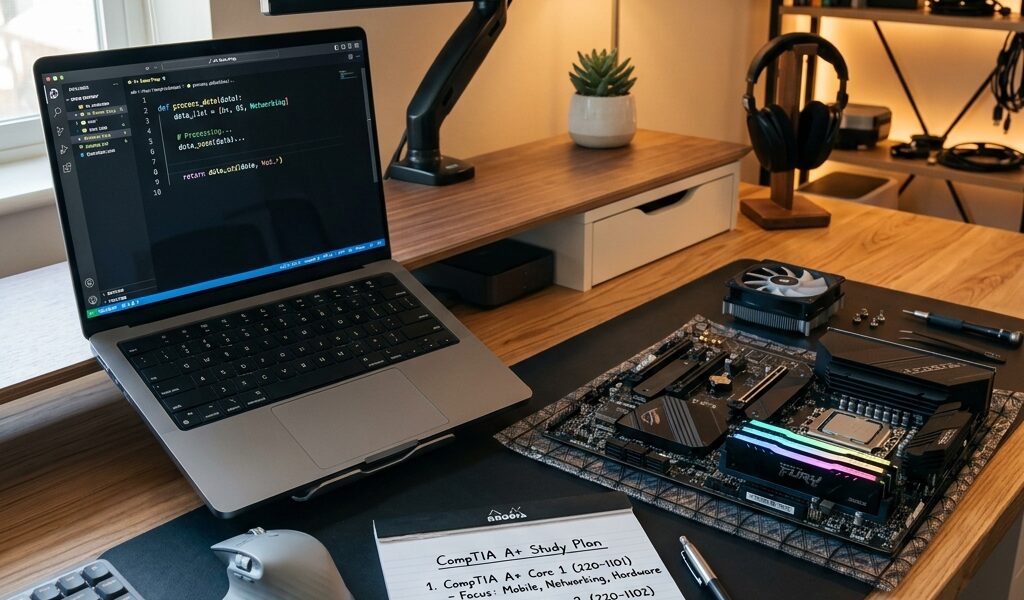
You bought the book. You watched a few videos. But every time you sit down to study, you’re not sure if you’re moving forward or just staying busy.
That’s the trap. The CompTIA A+ Core 1 (220-1101) covers mobile devices, networking, hardware, virtualization, and cloud computing — five domains that don’t feel connected until you see how they fit together. Studying them in random order feels like memorizing parts of five different puzzles.
The exam isn’t designed to trick you. It’s designed to test whether you can think like a technician — not just whether you can recite port numbers.
Here’s how to prepare so you walk in ready.
What the CompTIA A+ Core 1 Actually Tests
Before you open another study resource, know what you’re walking into.
The Core 1 exam gives you 90 minutes for a maximum of 90 questions. Most are multiple-choice, but expect several performance-based questions (PBQs) that ask you to configure a network, troubleshoot a simulated issue, or build a RAID array.
The five domains and their weight:
| Domain | Exam Weight |
|---|---|
| Mobile Devices | 15% |
| Networking | 20% |
| Hardware | 25% |
| Virtualization & Cloud Computing | 11% |
| Hardware & Network Troubleshooting | 29% |
Notice what’s heaviest: troubleshooting and hardware make up more than half the exam. If your study plan is 80% memorizing port numbers and cable types, you’re underprepared for the questions that actually carry the most weight.
Key insight: The PBQs alone can decide your result. A single PBQ can be worth as much as 10 regular questions. Practice them under timed conditions.
The 4-Week Study Plan That Prioritizes What Matters
Four weeks is tight, but it’s enough if every session has a purpose.
Week 1 — Hardware fundamentals. Motherboards, CPUs, RAM, storage, power supplies, and peripherals. This is your highest-weighted domain. If you don’t have a spare desktop to open up, watch teardown videos and diagram the components yourself. The PBQs will ask you to identify parts and assemble a system — you can’t fake hands-on knowledge.
Week 2 — Networking and mobile devices. Port numbers and protocols, but also subnetting basics, wireless standards, and mobile device hardware. This is where most self-studiers drift. Stay focused: for every protocol you memorize, ask yourself what problem does this solve in a real network?
Week 3 — Virtualization, cloud, and troubleshooting methodology. The cloud section is only 11%, but it appears in PBQs. Learn the CompTIA troubleshooting model cold — it’s the framework the exam uses to score your thinking.
Week 4 — Full practice exams and PBQ drills. Take at least three full-length practice tests. After each one, don’t just check your score. Categorize every wrong answer: did you not know the fact, or did you know it but apply it wrong? The second kind of mistake is more dangerous — it means your studying is working, but your test-taking isn’t.
Why Most People Fail (and How to Avoid It)
Mistake 1: Studying everything equally. The exam weights are public. Hardware is worth 25%. Cloud computing is 11%. Spending equal time on both is a math error.
Mistake 2: Avoiding PBQ practice. Performance-based questions feel intimidating, so people skip them during prep. Then they freeze on test day. Our CompTIA certification prep course includes 1,200+ practice questions with simulated PBQs — so by the time you see the real thing, the interface and pacing feel familiar.Mistake 3: Cramming without self-testing. Re-reading notes tricks your brain into thinking you know the material. Self-testing reveals what you actually know. Every study session should end with 10-15 practice questions on the topic you just reviewed.
Mistake 4: No exam-day strategy. Flag and skip questions you’re unsure about. Answer the ones you know first, then return. A question you hesitate on for four minutes costs you three questions you could have answered correctly in the same time.
The Best Practice Is Realistic Practice
The CompTIA A+ is a performance exam disguised as a multiple-choice test. The PBQs don’t ask you to pick a definition — they ask you to do something.
That’s why reading alone isn’t enough. You need to answer questions that look and feel like the real exam, see explanations for every answer (right and wrong), and track which domains are your weakest so you stop wasting time on topics you’ve already mastered.
PrepNovat’s CompTIA A+ Core 1 Prep course gives you 1,200+ questions across all five domains, detailed rationales for every answer, and performance-based simulations that match the exam interface.
Ready to get certified? Start practicing free with PrepNovat’s CompTIA A+ question bank.
FAQ: CompTIA A+ Core 1
How hard is the CompTIA A+ Core 1 exam?
It’s not a memorization test — it’s a thinking test. Candidates who treat it as a vocabulary quiz tend to fail. Candidates who practice applying concepts in realistic scenarios tend to pass. The pass rate for first-timers is estimated around 60-70%, but structured practice with PBQs pushes that number significantly higher.
How many practice questions should I complete before test day?
At least 500. PrepNovat’s course includes 1,200+ questions, and students who complete 80% of the question bank report noticeably higher confidence on test day. More important than the count: make sure at least a third of your practice involves performance-based simulations.
Can I pass with just free resources?
You can learn concepts from free videos and documentation, but free resources rarely include the realistic PBQs that determine your score. A paid prep platform closes that gap.

Natalie
StudyVault Team