HESI A2 Math Practice Exam: Sample Questions and Answers
Math is where most nursing school hopefuls lose points on the HESI A2, not because the content is hard, but because it’s been years since anyone asked you to solve a dosage conversion or a ratio problem without a calculator app open. A HESI A2 math practice exam shows you exactly what to expect: fractions, percentages, ratios, conversions, and word problems styled like the real thing, not generic middle school arithmetic.
If you’re searching for a hesi a2 math practice test with actual sample questions and answers explained, you’re in the right place. This article walks through real-style practice questions across the topics HESI actually tests, then breaks down why each answer is correct, so you understand the concept instead of just memorizing one problem.
Below, you’ll find a set of sample questions covering the core math skills nursing programs expect, along with detailed answer rationales for each one. We’ll also point you toward where to find a full timed practice test that mirrors real exam pacing, so you walk into test day already comfortable with the format, the pressure, and the type of thinking the HESI A2 rewards.
Why the HESI A2 math score matters for nursing school
Nursing programs treat the HESI A2 math score as a gatekeeper, not a formality. Admissions committees use it to predict whether you can handle dosage calculations, IV drip rates, and lab value conversions once you’re working with real patients. A student who guesses through fractions on a practice test is a student who might miscalculate a medication dose during clinicals, and schools know it. That’s why math often carries as much weight as the reading or science sections, even though it looks like the easiest part of the exam on paper.
Getting familiar with a hesi a2 practice math test early matters because most programs set a hard cutoff, not a suggestion. Many nursing schools require a minimum math score of 75-80% just to be considered, and some competitive programs push that closer to 90%. Miss the cutoff and your application gets filtered out before an admissions officer ever reads your personal statement.
A weak math score doesn’t just lower your composite, it can disqualify your entire application before anyone reads the rest of it.
Beyond admissions, the math section reflects skills you’ll use daily as a nurse. Consider how often these calculations show up in actual clinical work:
| Skill tested on HESI A2 | Real-world nursing use |
|---|---|
| Ratio and proportion | Calculating drug dosages by weight |
| Percentages | Interpreting lab result changes |
| Fractions | Measuring partial doses or IV fluids |
| Unit conversion | Converting mg to mcg, or lbs to kg |
| Military time | Reading medication administration schedules |
Program directors aren’t testing abstract math for its own sake. They’re screening for the exact reasoning you’ll need at the bedside, which is why a rushed or half-hearted approach to practice questions tends to show up later in clinical performance reviews, not just on the exam printout. Scoring well here also gives you a buffer if another section, like reading comprehension or anatomy, ends up being your weaker spot.
What math topics appear on the HESI A2 exam
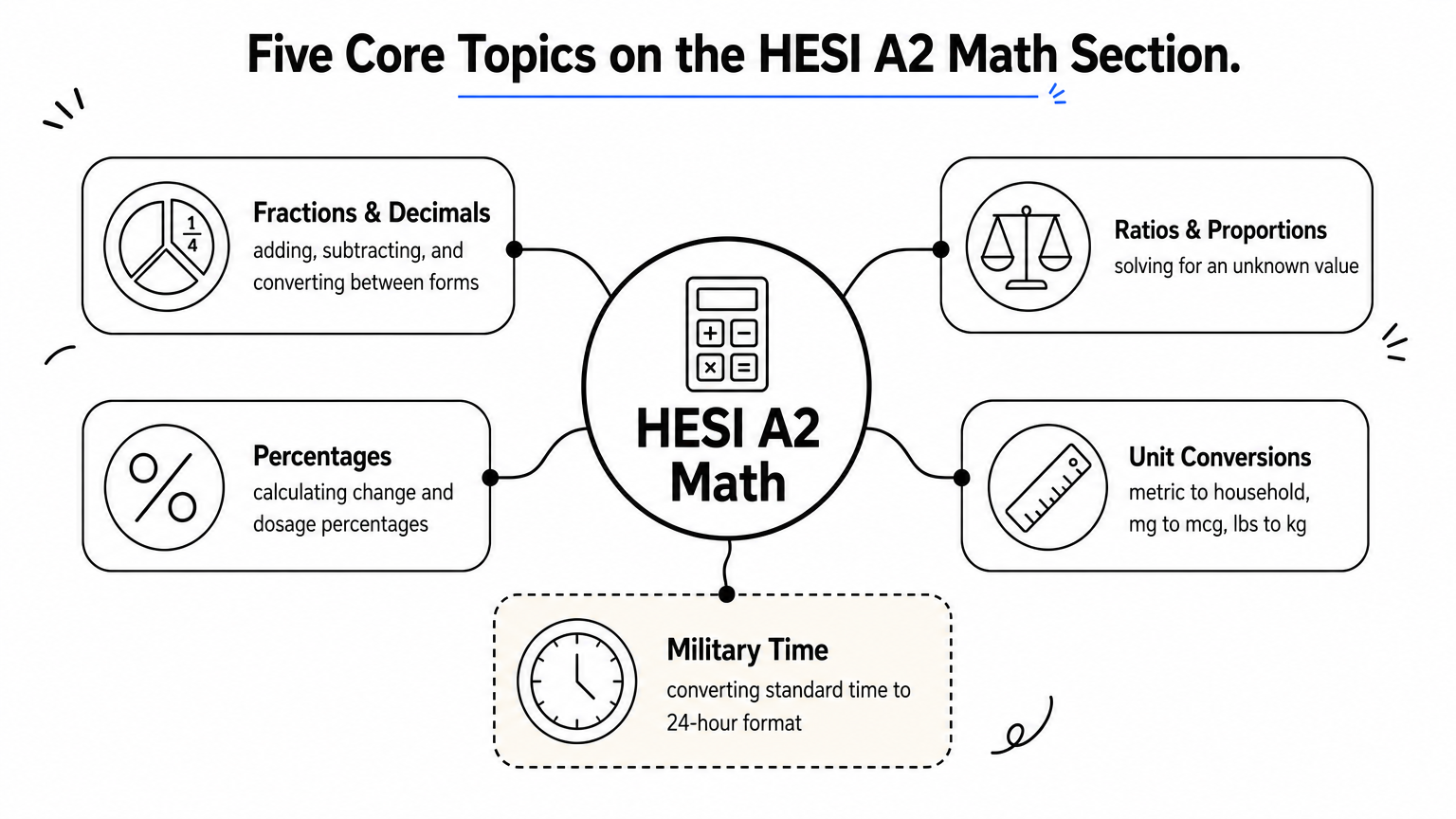
The HESI A2 exam math section covers a narrow but specific set of skills, so once you have the exam topics explained with study tips, prep gets a lot less overwhelming. Most versions of the test pull from five core areas: basic operations, fractions and decimals, ratios and proportions, percentages, and measurement conversions (including military time and metric-to-household unit conversions common in dosage calculations). You won’t see algebra or geometry here. HESI sticks to arithmetic-heavy problems dressed up as clinical scenarios, like calculating how many milliliters of medication a patient needs based on their weight.
If you can convert fractions to decimals and set up a proportion without hesitating, you’ve already covered most of what the HESI A2 math section tests.
Here’s a quick breakdown of what typically shows up:
- Fractions and decimals: adding, subtracting, multiplying, and converting between the two
- Ratios and proportions: setting up and solving for an unknown value
- Percentages: calculating percentage change, discounts, or dosage percentages
- Unit conversions: metric to household units, mg to mcg, lbs to kg
- Military time: reading and converting standard time to 24-hour format
- Roman numerals: occasionally tested, since older medication charts still use them
Every hesi a2 practice test math section you take should hit each of these categories, not just the ones that feel comfortable. Skipping the ones you dislike, usually conversions or Roman numerals, is exactly how students lose easy points on test day.
How to prepare for the HESI A2 math exam
Start by diagnosing where you actually stand before you build a study plan. Take one math practice for HESI A2 test session cold, no review beforehand, and score it honestly. That baseline tells you whether you need three days on conversions or three weeks rebuilding your fraction skills from scratch.
Guessing at your weak spots wastes more study time than any single hard topic ever will.
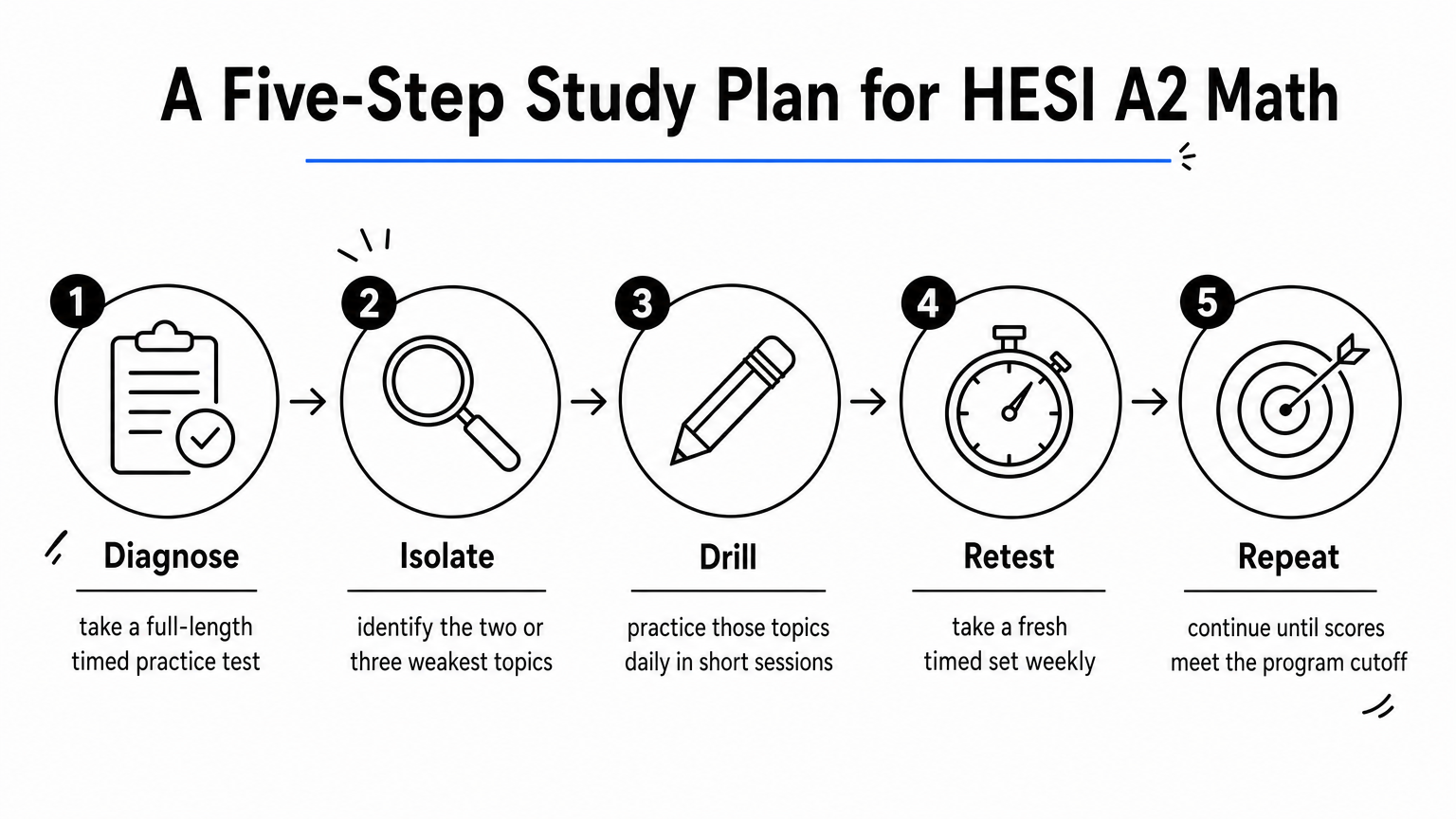
Once you know your gaps, work backward from them instead of restudying everything evenly. A focused plan looks something like this:
- Diagnose with a full-length timed practice test
- Isolate the two or three topics where you missed the most points
- Drill those topics daily in short 20-30 minute sessions
- Retest weekly with a fresh timed set to track improvement
- Repeat until your weak areas score at or above your program’s cutoff
Repetition matters here, but so does simulating real conditions. Practicing untimed, with a calculator, teaches you nothing about the pressure of the actual exam. The HESI A2 entrance exam gives you a set time per section, and running out of time on conversions because you double-checked every fraction problem is a common, avoidable mistake.
Specificity beats generic review every time. PrepNovat’s TEAS and nursing exam practice tests include full-length, timed sets built to mirror real HESI pacing, with rationales explaining every wrong answer choice, not just the right one, so you fix the reasoning error instead of just memorizing a corrected answer.
Sample HESI A2 math practice questions with answers
Working through real HESI A2 math practice exam questions teaches you more than any review sheet, because you see exactly how HESI phrases a problem and where the trap answer choices hide. Below are five sample questions pulled from the core topics covered above, each with the correct answer and a short rationale explaining the reasoning, not just the final number, in the same format as our ATI TEAS math practice problems.

-
Convert 3/8 to a decimal.
Answer: 0.375. Divide 3 by 8. Students often round too early and land on 0.37, which won’t match the answer key on a real exam. -
A patient weighs 154 lbs. Convert this to kilograms.
Answer: 70 kg. Divide by 2.2 (154 ÷ 2.2 = 70). This exact conversion shows up constantly in dosage-by-weight problems. -
If 2:5 = x:20, solve for x.
Answer: 8. Cross-multiply (2 × 20 = 5x), then divide (40 ÷ 5 = 8). Ratio problems almost always resolve with cross-multiplication. -
A medication order increases from 50 mg to 65 mg. What is the percentage increase?
Answer: 30%. Subtract to find the change (15), divide by the original (15 ÷ 50), then multiply by 100. -
Convert 4:45 PM to military time.
Answer: 1645. Add 12 to the PM hour and keep the minutes unchanged.
Every correct answer on the HESI A2 comes from a repeatable process, not a lucky guess, so drill the process until it’s automatic.
Notice that none of these questions require advanced math, just accuracy under time pressure. That’s the entire point of a hesi a2 practice test math section: confirming you can execute basic calculations correctly, every time, without a calculator bailing you out.
Building confidence before exam day
Confidence on test day comes from repetition, not luck. Once you’ve worked through enough HESI A2 math practice exam questions to spot patterns instantly, the real test stops feeling unpredictable. You already know how HESI phrases ratio problems, where the rounding traps hide in decimal conversions, and how fast you need to move through military time questions to finish on schedule.
Don’t wait until a week before your exam to start this process. Give yourself enough time to diagnose weak spots, drill them, and retest until your scores sit comfortably above your program’s cutoff. That margin matters when nerves show up on the actual test day.
Getting there takes realistic practice under real conditions, not another generic worksheet. If you want full-length, timed tests with detailed rationales, start with PrepNovat’s HESI A2 practice test and walk into your exam already knowing exactly what to expect.

Natalie
PrepNovat Team