How to Get Your GED Online: Steps, Requirements, Cost and Scams to Avoid
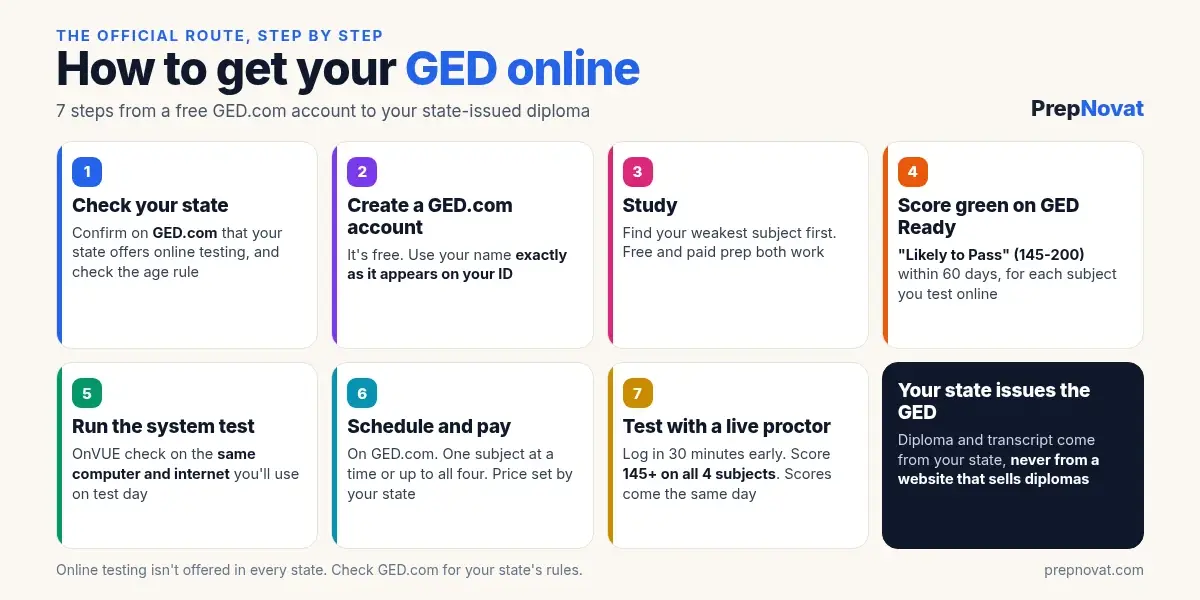
You can get your GED online in most U.S. states. You still have to earn it the official way: register on GED.com, prove you’re ready on the official practice test, and pass four proctored subject tests while a live proctor watches you on webcam. A website that sells an “online GED diploma” without that process is not giving you a GED.
This guide covers the whole process: who qualifies, the steps, the online testing requirements, cost, timing and how to spot a scam. For study strategy, read our guide on how to pass the GED test online instead.
Key takeaways
- You can take the official GED test online from home if your state offers online testing and you score “green” on the GED Ready practice test for that subject within the last 60 days.
- Online testing isn’t offered in Connecticut, Florida, Hawaii, New York, West Virginia or Wyoming, and it’s limited in eight more states. Iowa and Maine don’t offer the GED at all.
- The price depends on your state. Some states make the test free or discounted for people who qualify. No legitimate GED is “free and instant” online.
- You need 145 or higher on each of the four subjects. Your state awards the credential, not a website.
How do you get your GED online?
To get your GED online, create a free GED.com account, check that your state offers online testing, and score “green” on the official GED Ready practice test for each subject. Then schedule and pass the four online proctored subject tests, scoring at least 145 on each, from a private room at home.
What “online” does and doesn’t mean
Studying online is fully legitimate. So is registering, scheduling and paying in your GED.com account, which is how everyone does it, even people who test at a center. Taking the official test online is legitimate too, as long as it’s GED Testing Service’s online proctored test, delivered through Pearson VUE’s OnVUE software in a state that allows it. What doesn’t exist is a GED you earn by taking a quick quiz on a random website. GED Testing Service says plainly that a true GED credential is recognized by state authorities, and “if the state isn’t awarding you the GED credential, you’re paying for something other than the GED test.”
Who can take the GED online?
GED Testing Service’s policy manual sets the baseline: you must be at least 16 years old and not currently enrolled in an accredited high school. If you’re under 18, your state reviews your registration and requires a signed parent or guardian consent, plus any other documents it asks for.
If you want to get your GED online, your state’s rules matter even more. On GED.com’s state table (checked October 2026):
- No online testing: Connecticut, Florida, Hawaii, New York, West Virginia and Wyoming. You can still test in person at a center.
- Limited online testing: Indiana, Kansas, Massachusetts, Montana, New Jersey, Pennsylvania, South Carolina and Utah. Restrictions apply, and your GED.com account shows the details.
- Higher minimum age for online testing: 18+ in California, Maryland, Mississippi, Nevada, New Hampshire, Oklahoma, Pennsylvania and Washington, D.C.; 17+ in Kentucky, Minnesota, Tennessee and Wisconsin. Most other states that offer online testing list 16+.
- No GED at all: Iowa and Maine. Both use the HiSET exam for their high school equivalency diploma instead.
You must also be physically in the United States during the online test, and states with residency rules ask you to confirm you live there. Rules change, so treat GED.com as the final word.
How to get your GED online in 7 steps
- Check your state’s rules on GED.com. The state online testing table shows whether your state offers online testing, the minimum age, and any free or discounted testing.
- Create your free GED.com account. Enter your first, middle and last name exactly as they appear on your government-issued ID, then choose your testing state. Your account is where you study, buy practice tests, schedule and see your scores.
- Find your starting point and study. A short practice set in each subject shows which one needs the most work. The preparation section below covers the study side.
- Score “green” on GED Ready. GED Ready is the official practice test, about half the length of the real test. A green result (“Likely to Pass,” 145 to 200) within the last 60 days unlocks online scheduling for that subject.
- Run the OnVUE system test. Do it on the same computer and internet connection you’ll use on test day. If the check fails, fix the problem or book that subject at a test center instead.
- Schedule and pay on GED.com. Choose online proctoring, pick your subjects and a time, and pay by credit or debit card. Online appointments run 24 hours a day.
- Test, then get your credential. Log in 30 minutes early, complete check-in, and take the test while the proctor watches. Scores come the same day. After you pass all four subjects, your state issues your diploma and transcript.
You can test one subject at a time. Passing scores on the current GED test don’t expire under GED Testing Service policy, although states can set their own rules.
Online GED testing requirements
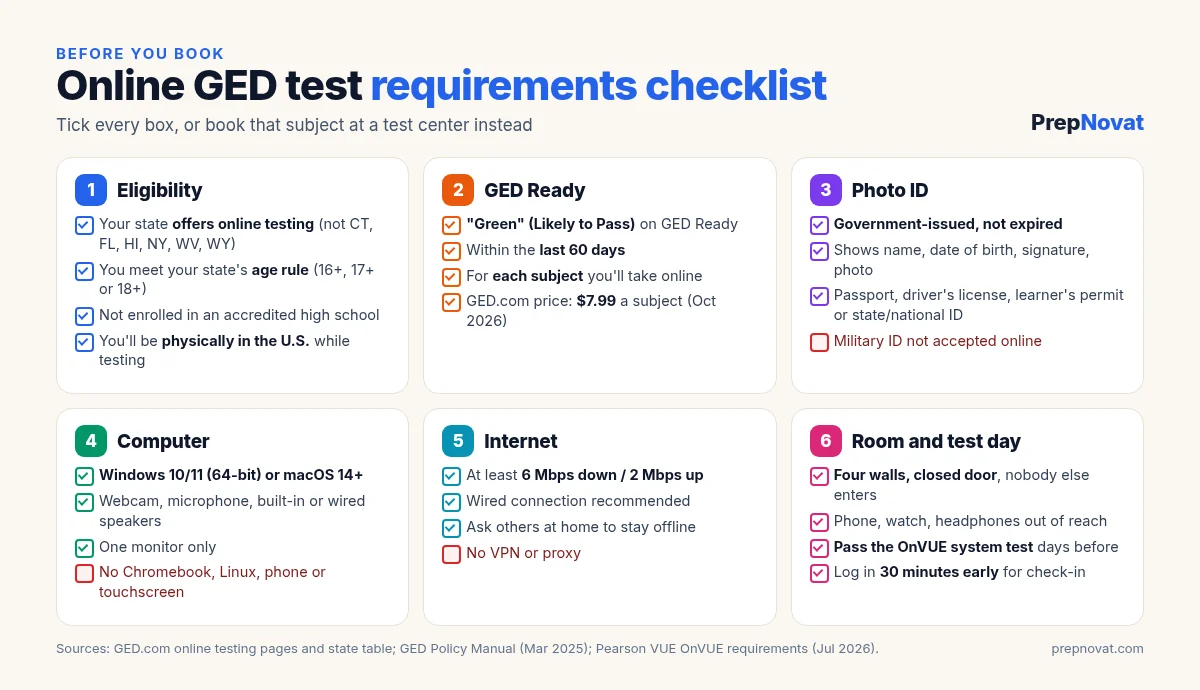
GED.com lists four things you need before you can test from home:
- A computer, webcam and reliable internet. Run the system test to confirm your setup works.
- A private workspace. A room with four walls, a closed door and no distractions.
- A government-issued ID. It must be current (not expired) and show your name, date of birth, signature and photo. Accepted IDs are a passport, driver’s license, learner’s permit, or national or state ID card. Military IDs aren’t accepted for online testing. Test-takers under 18 may use a valid student ID but need a parent or guardian with a valid ID at check-in.
- A green GED Ready score for each subject you want to take online, from the last 60 days.
Pearson VUE’s OnVUE requirements (July 2026) add the technical detail: a Windows 10 or 11 (64-bit) or macOS 14+ computer, one monitor, a working microphone and speakers, and at least 6 Mbps down and 2 Mbps up. Chromebooks, Linux, phones and keyboardless tablets won’t work. Use a wired connection if you can, and no VPN. The system test is the real judge, so run it days before you book.
The exam rules are strict. Phones, headphones and watches must be out of reach, no one may enter the room, and you can’t leave the webcam view or talk out loud. There’s no physical calculator or scratch paper, but you get an onscreen calculator, scratch pad and whiteboard. Breaking a rule can get your test revoked and your fee lost. For a walkthrough of check-in and what to do if your connection drops, see our GED online proctored exam guide.
Online vs. test center: which is right for you?
Both give you the same official test and passing score. The differences are access, retakes and risk.
| Factor | Online from home | Test center |
|---|---|---|
| GED Ready “green” required | Yes, within the last 60 days, for each subject | Not required by GED Testing Service policy |
| Availability | Not offered in 6 states; limited in 8 | All states that offer the GED |
| Appointment times | Around the clock (24 hours a day) | During the center’s opening hours |
| Equipment | Your own computer, webcam, mic and internet | Provided by the center |
| Calculator | Onscreen calculator only | Onscreen calculator, or your own TI-30XS |
| Retakes after a fail | One retake right away; after your second attempt, a 60-day wait before each retake | Two retakes with no wait; after that, a 60-day wait before each retake |
| Discounted retakes | Not offered on the online test | Offered (check your state’s details) |
| If your tech fails | Counts as a no-show, and you can lose your fee | The center runs the equipment |
| Price | Set by your state; GED.com lists it separately | Set by your state; GED.com lists it separately |
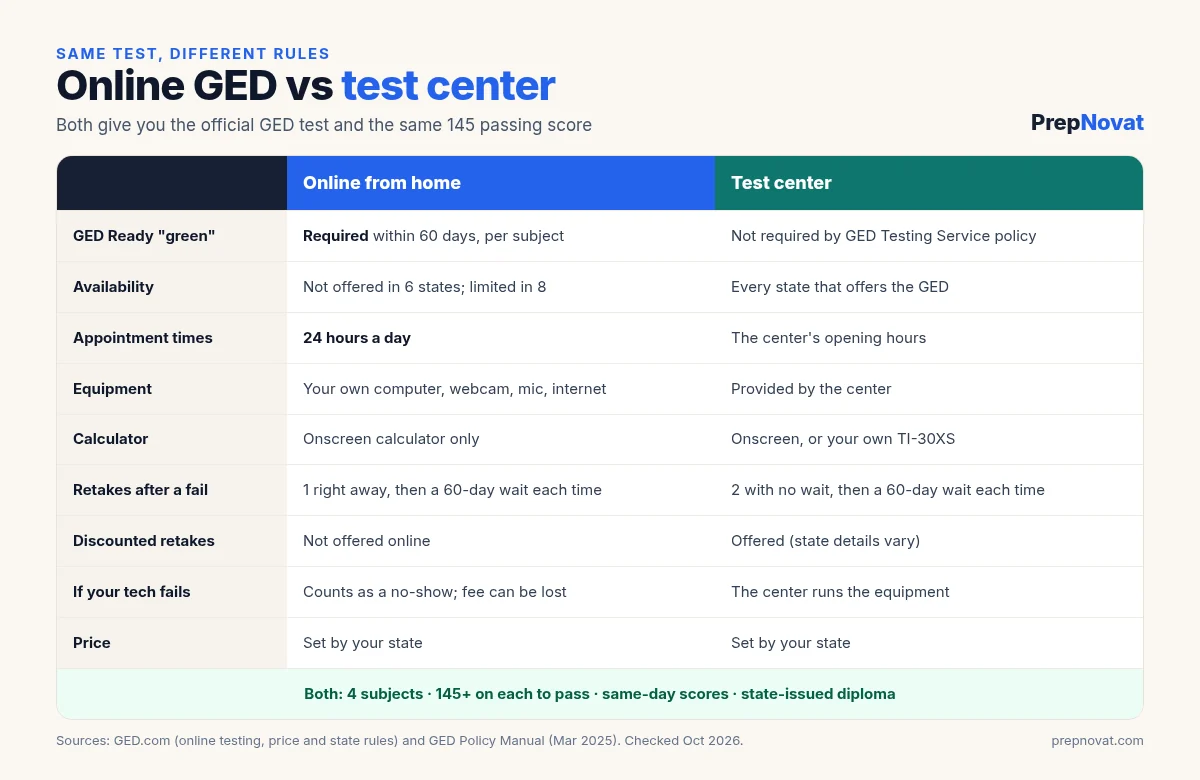
If you fail a subject at a test center and retake it online, it counts as a new first attempt with no discount. Online suits you if you have a quiet room, a solid connection and a green score. A test center is safer if your internet is shaky or your home is busy.
How much does it cost to get your GED online?
There is no single national price. Each state sets its own fees, and GED.com shows the online and test-center prices separately once you pick your state on the Price and State Rules page. Be wary of any article that quotes one price for everyone.
- The four subject tests. You pay per subject, so you can spread the cost out.
- GED Ready. $7.99 per subject or $25.99 for all four on GED.com (October 2026). Some adult education programs and vouchers cover it.
- Retakes. Discounts apply to test-center retakes, not online ones.
- Free or discounted testing. GED.com lists testing as free in Alaska, Connecticut, Kentucky, Nebraska, New Mexico, New York, Pennsylvania, Texas, Virginia and West Virginia, and discounted in Arkansas, Washington, D.C., Illinois, Maryland, Minnesota, North Dakota and Ohio. Conditions usually apply, so ask a local adult education program. Connecticut, New York and West Virginia don’t offer online testing.
- Employer programs. Some companies pay for GED prep and testing through GEDWorks. Your GED.com account shows whether your employer takes part.
Cancel or reschedule an online appointment before it starts and you get a full refund or pay no fee. Miss it, including because your own tech fails, and you lose the fee.
Can you get your GED online for free?
Partly, depending on where you live:
- Studying can be free. A GED.com account is free and includes study materials. Local adult education programs often run free or low-cost classes, and GED.com’s class finder lists them. Our free GED study guide shows how to build a plan from free tools, and you can try 20 free GED practice questions to find your weakest subject.
- The test can be free in some states if you meet the conditions. Elsewhere, you pay your state’s fee.
- A free or instant “GED” from a website is not real. Only your state awards the credential, and only after you pass the official test.
How long does it take to get your GED online?
GED.com puts the average at about 2 to 4 months. Many people study one subject for about three weeks and then take that test. Others study all four subjects for about three months and test together.
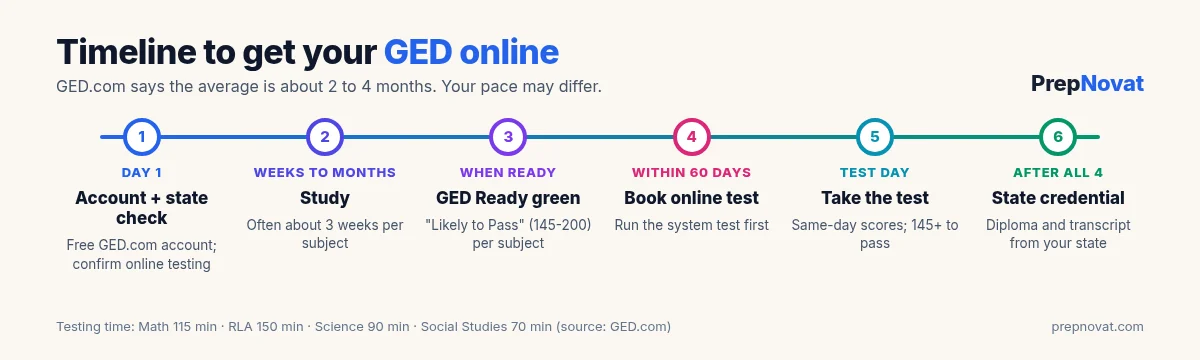
The tests themselves take about 7 hours in total if you add up all four subjects:
- Mathematical Reasoning: 115 minutes
- Reasoning Through Language Arts: 150 minutes, including a 45-minute essay and a 10-minute break
- Science: 90 minutes
- Social Studies: 70 minutes
Mind the 60-day GED Ready window: wait too long after a green score and you’ll need a new one to book online. Scores come back the same day, so after your last test you only wait for your state to issue the credential.
Online GED scams: red flags to watch for
In 2016 the FTC charged two operators of fake online “high schools” that sold certificates for $135 to $349. According to the FTC, they used terms like “GED” and “GED online” to push their sites higher in search results, and the 2017 settlements banned them from selling diplomas. Searching “how to get my GED online” can put these sites in front of you, so learn the warning signs.
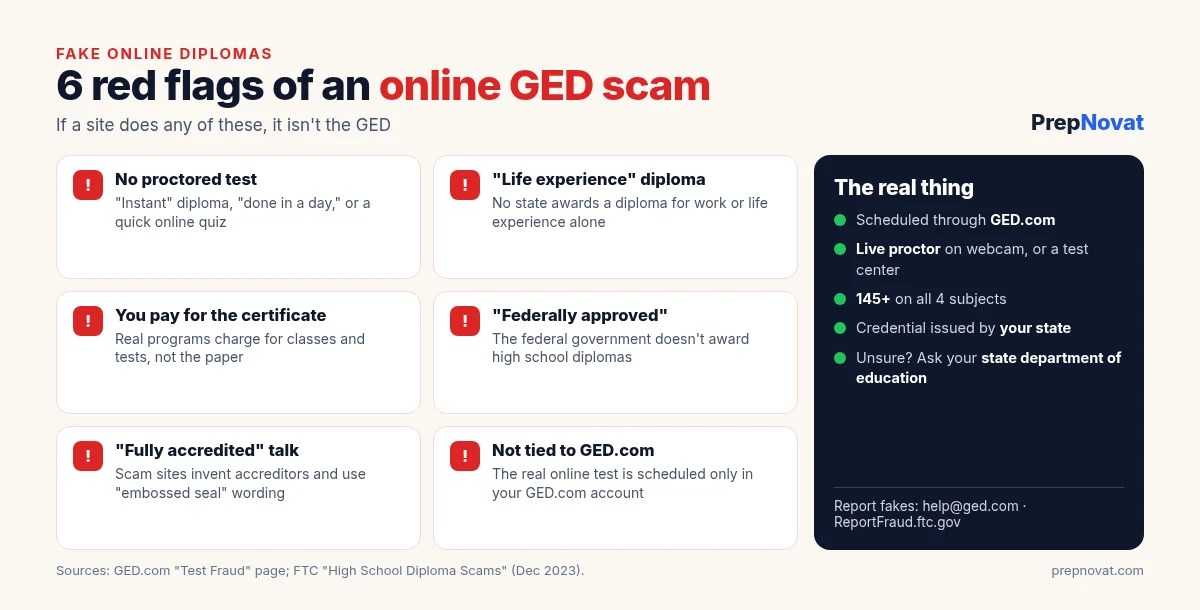
Based on GED.com’s test fraud page and the FTC’s guidance on diploma scams, walk away if a site:
- Promises a diploma with no proctored test, “instantly” or “done in a day.” Real equivalency tests are given at set times, not on demand.
- Offers a diploma based on “life experience” or work history. The FTC says no state awards a diploma for work experience alone.
- Charges for the diploma certificate itself. You pay for classes and tests, not for the paper.
- Claims federal government approval. The federal government doesn’t award high school diplomas. States approve equivalency tests.
- Leans on “fully accredited” or “embossed seal” wording. GED.com names fake accreditors such as the “Universal Accreditation Association for Online Distance Learning.”
- Isn’t connected to your GED.com account. The real online test is scheduled only through GED.com, and only for people who are eligible.
To check a program, contact your state’s department of education. Report fakes to GED Testing Service at help@ged.com or to the FTC at ReportFraud.ftc.gov.
How to prepare for the online GED
You need a green GED Ready score before you can book, so preparation is the first gate to get your GED online. A simple sequence:
- Diagnose. Take a short practice set in every subject. Start with 20 free GED practice questions, or browse all our free practice tests.
- Study your weakest subject first, one subject at a time. Our guide on how to pass the GED test online has a week-by-week plan, and the GED essay prompts guide covers the 45-minute RLA essay.
- Drill with rationales. Read why each wrong answer is wrong. The GED Exam bank has 2,000+ questions across all four subjects.
- Take GED Ready when your practice scores are steady, not on day one.
Try 20 free GED practice questions
Find your weakest subject before you pay for GED Ready. Answer 20 free GED-style questions with rationales across Math, Reasoning Through Language Arts, Science and Social Studies. It is a sample of the question style, not the full bank. When you want volume, the GED Exam bank has 2,000+ questions from $49. Exams, not courses.
Try 20 free GED practice questions See the GED Exam bank from $49
Frequently asked questions
Can I take the GED online in every state?
No. As of October 2026, GED.com lists no online testing in Connecticut, Florida, Hawaii, New York, West Virginia and Wyoming, and limited online testing in Indiana, Kansas, Massachusetts, Montana, New Jersey, Pennsylvania, South Carolina and Utah. Iowa and Maine use the HiSET exam instead of the GED.
Is an online GED legit?
Yes, if it’s the official online proctored GED test, scheduled through GED.com and passed with 145 or higher in all four subjects. Your state then awards the credential. A diploma sold by a website without that test is not a GED.
How much does it cost to get your GED online?
It depends on your state. GED.com shows the exact online and test-center prices once you select your state. Some states offer free or discounted testing to people who qualify, and GED Ready costs $7.99 per subject.
Can I get my GED online for free?
You can study for free, and some states make the test free for people who qualify. Nobody can legitimately give you a free GED online without the official proctored test. Ask a local adult education program about classes and vouchers.
How long does it take to get your GED online?
About 2 to 4 months on average, according to GED.com. The four tests add up to about 7 hours, which you can spread out one subject at a time, and scores arrive the same day.
What happens if I fail a subject on the online GED?
You can retake it online once right away. After your second attempt, you wait 60 days before each new one. You don’t need a new GED Ready score, and you only retake the subjects you didn’t pass.
Work toward a green GED Ready score
Start with 20 free GED questions to see where you stand, then drill your weakest subject in the full GED Exam bank: 2,000+ questions with rationales, from $49 / $129 / $199. PrepNovat is independent practice and is not affiliated with GED Testing Service.
Try 20 free GED practice questions See GED Exam plans Create a free account
GED practice hub · How to pass the GED test online · GED essay prompts

PrepNovat Team
StudyVault Team