Mnemonics: 8 Types, Exam Examples and How to Make Your Own
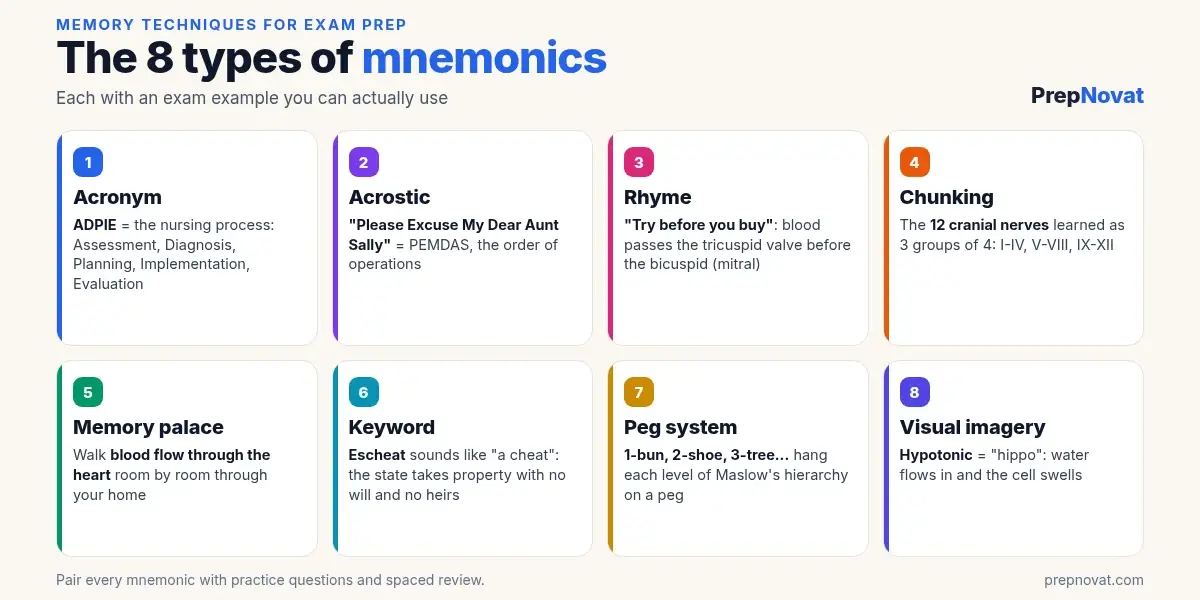
If you have ever used “Please Excuse My Dear Aunt Sally” to get the order of operations right, you have already used a mnemonic (say it “nih-MON-ik”).
Below are the eight main types, each with a worked example from real exam content, plus a six-step method for building your own and an honest look at where mnemonics fall short.
Key takeaways
- A mnemonic links hard-to-remember information to a cue that is easy to recall: a word, sentence, rhyme, image or place.
- The 8 main types are acronyms, acrostics, rhymes, chunking, the method of loci, the keyword method, the peg system and visual imagery.
- Mnemonics work best for lists, sequences and terminology. They don’t build understanding on their own.
- Pair them with practice questions and spaced review, the two study techniques with the strongest research support.
What is a mnemonic?
A mnemonic is a memory technique that links information you need to learn to something easier to recall, such as a word, a sentence, a rhyme, an image or a familiar place. Common types include acronyms, acrostics, chunking and the memory palace. Mnemonics help most with lists, sequences and terminology.
Why do mnemonics work?
Mnemonics borrow structure from things your brain already holds well. Psychologist Francis Bellezza described good mnemonic devices as cueing structures: they are easy to build, each cue points to one item, and they let you work back from the cue to the answer (Bellezza, 1981).
In practice, a mnemonic organizes (five loose terms become one word), connects (abstract terms attach to something concrete) and cues recall (under pressure, the first letter or the room gives you a starting point). What it does not do is explain anything. You still need to understand what is on the list.
The 8 main types of mnemonics (with exam examples)
1. Acronyms
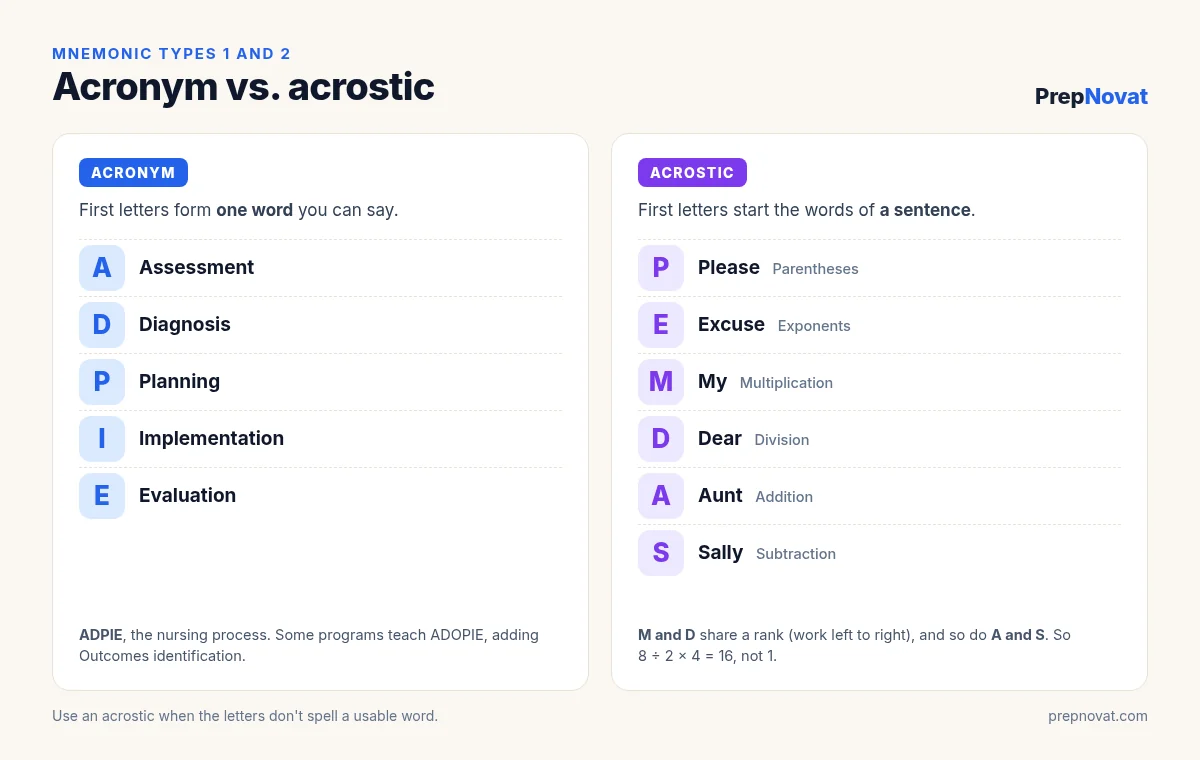
An acronym takes the first letter of each item and makes a word (or a pronounceable string) out of them.
Worked example: ADPIE (the nursing process). Assessment, Diagnosis, Planning, Implementation, Evaluation. The American Nurses Association describes the process as assessment, diagnosis, outcomes/planning, implementation and evaluation, so some programs teach it as ADOPIE, with “O” for outcomes identification. Use whichever version your program uses.
Worked example: OIL RIG (redox chemistry). Oxidation Is Loss, Reduction Is Gain (of electrons). “LEO the lion says GER” encodes the same rule.
Worked example: ABCs (prioritization). Airway, Breathing, Circulation. Nursing students use it to decide which problem comes first. One caution: for adult CPR in cardiac arrest, the American Heart Association changed the sequence to C-A-B (compressions first) in its 2010 guidelines. Know which context a question is asking about.
Best for: short lists of 3 to 7 items, especially when order matters.
2. Acrostics
An acrostic turns the first letters into a sentence, useful when the letters don’t spell anything.
Worked example: order of operations. PEMDAS is the acronym; “Please Excuse My Dear Aunt Sally” is the acrostic: Parentheses, Exponents, Multiplication, Division, Addition, Subtraction. Here is the part many students forget: multiplication and division are the same rank, worked left to right, and so are addition and subtraction. So 8 ÷ 2 × 4 = 16, not 1. The mnemonic gives you the order of the levels, not a strict six-step sequence.
Worked example: cranial nerve function. “Some Say Marry Money, But My Brother Says Big Brains Matter More” tells you whether each of the 12 cranial nerves, in order, is Sensory, Motor or Both (I sensory, II sensory, III motor, IV motor, V both, VI motor, VII both, VIII sensory, IX both, X both, XI motor, XII motor).
Worked example: biological classification. “Dear King Philip Came Over For Good Soup”: Domain, Kingdom, Phylum, Class, Order, Family, Genus, Species. (Watch out for versions that drop Domain. The “D” is there for a reason.)
Best for: longer ordered lists where an acronym would be unpronounceable.
3. Rhymes and songs
Rhythm and rhyme give a phrase a shape that is hard to scramble: if a word is wrong, the line stops sounding right.
Worked example: blood glucose signs. “Hot and dry, sugar high; cold and clammy, need some candy.” It is a common nursing-school rule of thumb: warm, dry skin points toward hyperglycemia, and cool, clammy skin toward hypoglycemia. Treat it as a memory hook, not a diagnosis. The real answer always comes from checking the glucose.
Worked example: heart valves. “Try before you buy”: blood passes the tricuspid valve (right side) before the bicuspid, or mitral, valve (left side).
Best for: rules and contrasts you need to recall fast.
4. Chunking
Chunking groups many separate items into a few meaningful units. Short-term memory is tight. George Miller’s classic “seven, plus or minus two” (Miller, 1956) was later revised down to roughly four chunks when other strategies are blocked (Cowan, 2001). So the move is to make each chunk carry more.
Worked example: the 12 cranial nerves. Twelve names in a row is a lot. Three groups of four is manageable:
- I-IV: olfactory, optic, oculomotor, trochlear (smell, sight, two that move the eye)
- V-VIII: trigeminal, abducens, facial, vestibulocochlear (face, eye movement, hearing and balance)
- IX-XII: glossopharyngeal, vagus, accessory, hypoglossal (throat, organs, neck, tongue)
Learn one chunk cold, then add the next.
Best for: long lists, numbers, codes and anything you can group by meaning.
5. Method of loci (the memory palace)
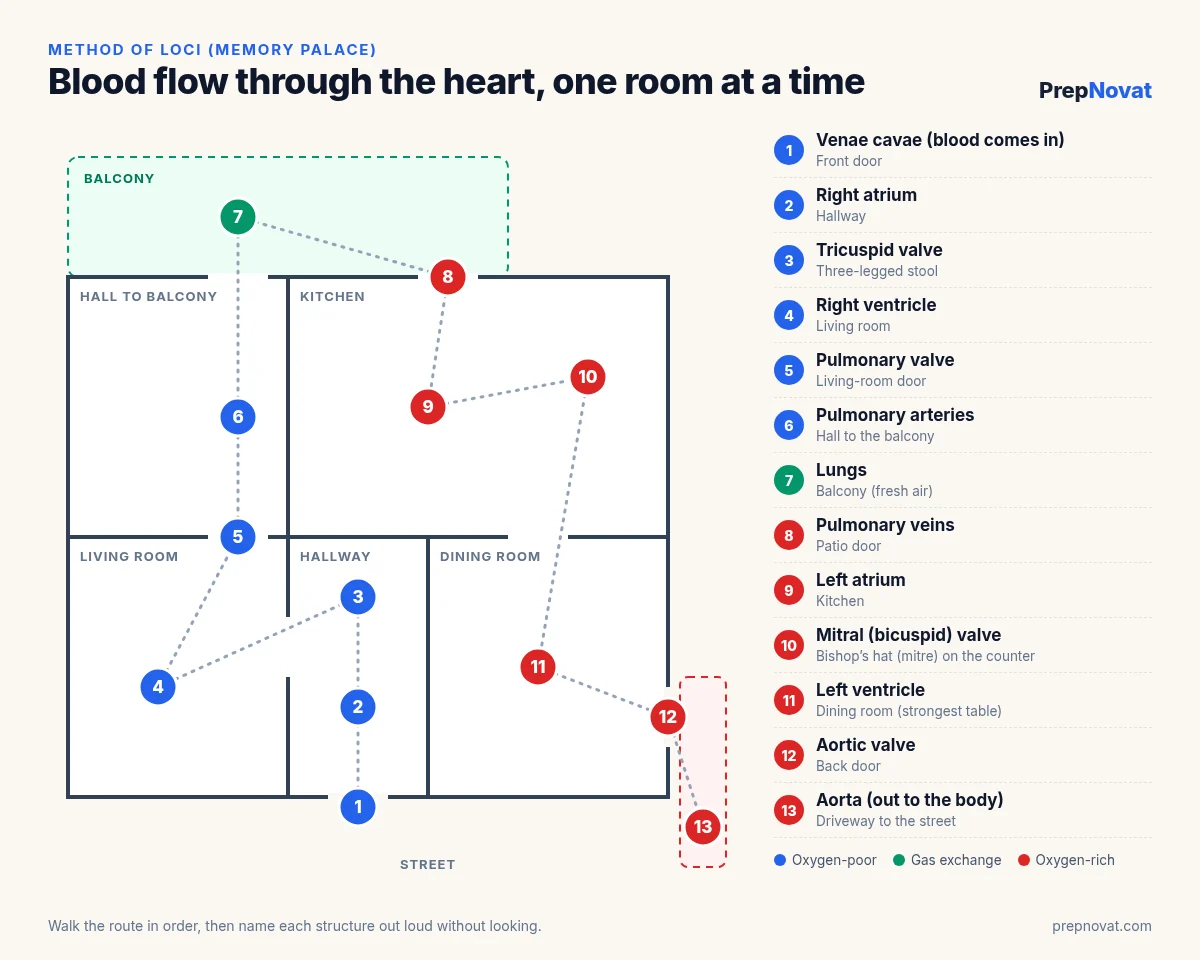
The method of loci places each item at a spot along a route you already know well, such as your home. To recall, you walk the route in your head and “see” each item where you left it. In a well-known study, people with no memory training practiced the method for about six weeks and recalled far more words afterward, with brain-network changes that resembled those of memory champions (Dresler et al., 2017). Keep in mind that the study used word lists, not exam content.
Worked example: blood flow through the heart. Walk through your home:
- Front door: the superior and inferior venae cavae bring blood in.
- Hallway: right atrium.
- Three-legged stool in the hallway: tricuspid valve.
- Living room: right ventricle.
- Living-room door: pulmonary valve.
- Hall to the balcony: pulmonary arteries.
- Balcony (fresh air): lungs.
- Back in through the patio door: pulmonary veins.
- Kitchen: left atrium.
- Bishop’s hat (a mitre) on the counter: mitral valve.
- Dining room (the strongest table in the house): left ventricle.
- Back door: aortic valve.
- Driveway out to the street: aorta, out to the body.
Best for: long sequences you will reuse. Setup takes time.
6. The keyword method
The keyword method links an unfamiliar term to a familiar word that sounds like it, then joins the two with an image. It was first tested on foreign-language vocabulary (Atkinson & Raugh, 1975).
Worked example: escheat (real estate). Escheat is the state’s right to take ownership of property when someone dies with no will and no heirs. Keyword: “a cheat.” Picture the state as a card cheat sweeping an empty house into its pocket because nobody showed up to claim it.
Know the limits. A major review rated the keyword mnemonic low utility: it is hard to apply to many materials, and its benefits showed up mostly at short retention intervals (Dunlosky et al., 2013). Use it for stubborn vocabulary, then lock the term in with self-testing.
Best for: terminology and vocabulary with no obvious meaning to you.
7. The peg system
The peg system uses pre-learned “pegs,” usually number rhymes (one-bun, two-shoe, three-tree, four-door, five-hive), and hangs each item on its peg with an image. You can jump straight to item four without reciting one to three.
Worked example: Maslow’s hierarchy of needs, which shows up in nursing prioritization questions:
- Bun: a hamburger bun = physiological needs (food, water, oxygen).
- Shoe: a steel-toe safety boot = safety.
- Tree: a family tree = love and belonging.
- Door: a door with your name on it = esteem.
- Hive: bees finishing their hive = self-actualization.
Best for: numbered lists when you need to recall items by position.
8. Visual imagery
Sometimes one vivid, slightly absurd picture does all the work.
Worked example: tonicity. In a hypotonic solution, water moves into the cell, so the cell swells and may burst. Picture a hippo: “hypo, the cell gets as big as a hippo.” In a hypertonic solution, water moves out and the cell shrinks.
Best for: single concepts, contrasts and cause-and-effect relationships.
Which type of mnemonic should you use?
| What you need to remember | Try this type | Example |
|---|---|---|
| A short ordered list (3-7 items) | Acronym | ADPIE, OIL RIG |
| A list whose letters don’t spell anything | Acrostic | “Please Excuse My Dear Aunt Sally” |
| A rule or contrast | Rhyme | “Try before you buy” |
| A long list or a number | Chunking | Cranial nerves in groups of four |
| A long sequence you will reuse | Method of loci | Blood flow through the heart |
| An unfamiliar term | Keyword | Escheat = “a cheat” |
| A numbered list you recall by position | Peg system | Maslow’s hierarchy |
| One concept or a cause and effect | Visual imagery | Hypotonic “hippo” cell |
How to make your own mnemonic in 6 steps
Ready-made mnemonics are fine; in one older classroom study, supplied mnemonics helped more than ones students built themselves (Miller, 1967). When no good one exists, build your own:
- Understand the material first. A mnemonic for a list you don’t understand is just noise.
- Write the list in the order you need it.
- Pick the type that fits (see the table above).
- Make it vivid and personal. Funny, strange or personally meaningful cues tend to be easier to recall than bland ones.
- Test it from both ends. Can you go from the cue to the full list, and from the list back to the cue? If you can only recite the phrase, you haven’t learned the content.
- Use it in questions, spaced out over the next days.
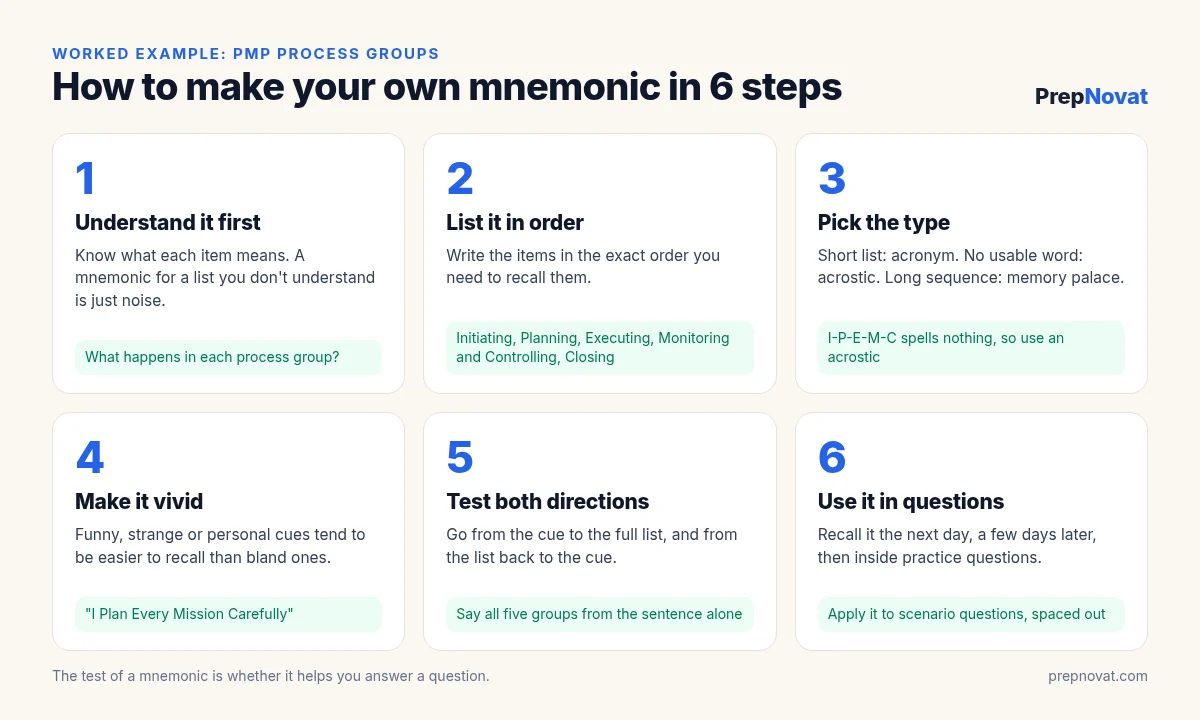
Worked example: PMP process groups. The list: Initiating, Planning, Executing, Monitoring and Controlling, Closing. The letters I-P-E-M-C don’t spell a word, so use an acrostic: “I Plan Every Mission Carefully.” Before you rely on it, make sure you can say what happens in each group. Also check the current exam: PMI’s PMP exam content outline is organized by domains (People, Process, Business Environment), so the process groups are a framework to know, not the structure of the test itself. Our PMP study plan shows how to fit this kind of review into a weekly schedule.
Put your mnemonics to the test
A mnemonic only counts if it holds up inside a question. Try 20 free practice questions with rationales for TEAS, HESI, NCLEX, GED, PMP and more. It is a sample of the question style, not the full bank. When the fit is clear, the full Exam bank starts at $49. Exams, not courses.
When mnemonics don’t work
Mnemonics do one job: make arbitrary information stick. They go wrong in predictable ways.
- They don’t build understanding. Knowing ADPIE won’t tell you which action comes first in a scenario. Exams like the NCLEX now test clinical judgment through the NCSBN Clinical Judgment Measurement Model, which goes far beyond reciting a list.
- Too many start to collide. The 1967 study suggested mnemonics may lose effectiveness as one student uses more of them. Save them for lists that truly resist memorizing.
- Setup time is real. A memory palace takes time to build. Researcher Adam Putnam’s review notes that time cost and fit with the material limit how useful mnemonics are in real classrooms (Putnam, 2015).
- Some fade fast without review. The keyword method’s benefits appear mostly at short delays (Dunlosky et al., 2013).
Pair mnemonics with retrieval practice and spacing
Putnam suggests treating mnemonics as a retrieval aid, not as your core learning strategy. The two techniques with the strongest research support are practice testing and spreading study out over time (Dunlosky et al., 2013). In one well-known experiment, students who took practice tests remembered more a week later than students who reread the material (Roediger & Karpicke, 2006), and a large review found that spaced study beats cramming for long-term recall (Cepeda et al., 2006).
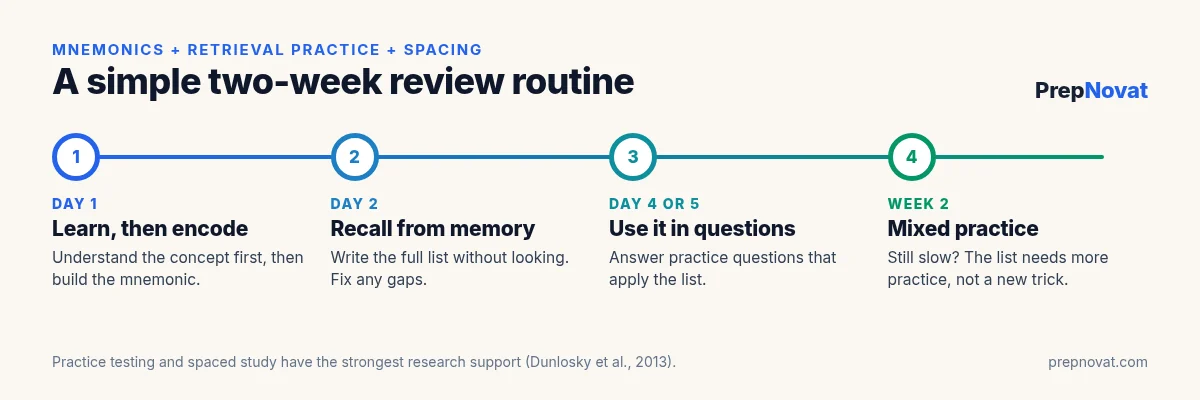
A simple routine: Day 1, learn the concept and build the mnemonic. Day 2, write the list from memory and fix gaps. Day 4 or 5, answer practice questions that use the list. Week 2, mixed practice; if you still reach for the mnemonic slowly, that list needs more practice, not a new trick. Short timed blocks help, and our Pomodoro guide for exam prep has schedules from 15 to 50 minutes.
Mnemonics for specific exams
- TEAS and HESI A2: sequences and terms in science (blood flow, cranial nerves, tonicity) and order of operations in math. Start with the TEAS test prep hub or the HESI A2 prep hub.
- NCLEX: ADPIE, ABCs and Maslow help you frame prioritization, but questions test judgment in context. The NCLEX study plan shows where practice questions fit.
- GED, SAT and ACT: order of operations, “rise over run,” and grammar lists like FANBOYS: the coordinating conjunctions for, and, nor, but, or, yet, so.
- PMP: process groups and other frameworks, always applied to scenarios.
- CompTIA A+: the OSI model’s seven layers, bottom to top (Physical, Data Link, Network, Transport, Session, Presentation, Application), with “Please Do Not Throw Sausage Pizza Away.”
- Real estate: dense legal vocabulary (escheat and friends) is a good fit for the keyword method.
Frequently asked questions
What is a mnemonic in simple terms?
A mnemonic is a memory shortcut: a word, sentence, rhyme, image or mental route that links information to something easier to recall. “HOMES” for the five Great Lakes (Huron, Ontario, Michigan, Erie, Superior) is a classic example.
What are the main types of mnemonics?
The main types are acronyms, acrostics, rhymes and songs, chunking, the method of loci (memory palace), the keyword method, the peg system, and visual imagery. Many good mnemonics combine two of them, such as chunking plus an acrostic.
What is the difference between an acronym and an acrostic?
An acronym is a single word made from first letters (OIL RIG, ADPIE). An acrostic is a sentence whose words start with those letters (“Please Excuse My Dear Aunt Sally” for PEMDAS). Use an acrostic when the letters don’t form a usable word.
Do mnemonics actually work?
Research shows mnemonics can improve recall of lists, terms and other arbitrary facts, especially when they are well designed (Levin, 1993; Putnam, 2015). They are weaker for understanding concepts, and some types fade quickly without review. They work best combined with practice testing and spaced study.
Is it better to make your own mnemonic or use an existing one?
Either can work. An accurate, well-known mnemonic saves time, and one older classroom study found supplied mnemonics helped more than self-made ones. Build your own when no good one exists or the standard one doesn’t stick, and check that it matches what your program teaches.
How do I stop forgetting the mnemonic itself?
Practice recalling it instead of rereading it: write the full list from the cue the next day, again a few days later, and inside practice questions. If the mnemonic is harder than the list, simplify it or switch types.
Memorized it? Now check it.
Pick your exam, answer 20 free questions, and see which facts actually stuck. Then open the full Exam bank from $49 / $129 / $199.
Try 20 free practice questions Explore Exams Create a free account

PrepNovat Team
StudyVault Team