Nursing Entrance Exam Quizlet Practice: Flashcards + Real Tests
Try 20 free questions → Exam bank from $49 / $129 / $199. Exams, not courses.
You typed nursing entrance exam practice test quizlet into Google because you need study material fast, and flashcards feel like the quickest way to memorize anatomy terms, math conversions, and grammar rules before test day. Quizlet decks are everywhere, and plenty of them look promising until you start clicking through and find outdated content, missing answer explanations, or questions that don’t match your actual exam version.
Here’s the honest answer: Quizlet works well for quick recall drills, like memorizing bone names or metric conversions, but it falls short when you need full-length, timed practice that mirrors real TEAS or HESI pacing and pressure. Relying on flashcards alone leaves gaps in the reasoning skills these exams actually test.
This guide walks you through exactly how to use Quizlet strategically, which decks are worth your time, and where you’ll need to supplement with a structured practice test bank to build real exam confidence. We’ll also point out where detailed answer rationales matter more than raw memorization, especially for tricky sections like Science and Anatomy & Physiology, so you walk into your entrance exam prepared instead of guessing.
Why nursing students turn to Quizlet for exam prep
Nearly every nursing student searching for entrance exam help lands on Quizlet at some point, and it’s easy to see why. The platform is free, mobile-friendly, and stacked with thousands of decks tagged TEAS, HESI A2, or ATI, so you can start reviewing terms during a lunch break without signing up for anything expensive. For students juggling prerequisite coursework, a part-time job, and exam prep all at once, that low barrier to entry feels like exactly what you need, and it’s a big part of why so many people type “nursing entrance exam practice test quizlet” into Google in the first place.
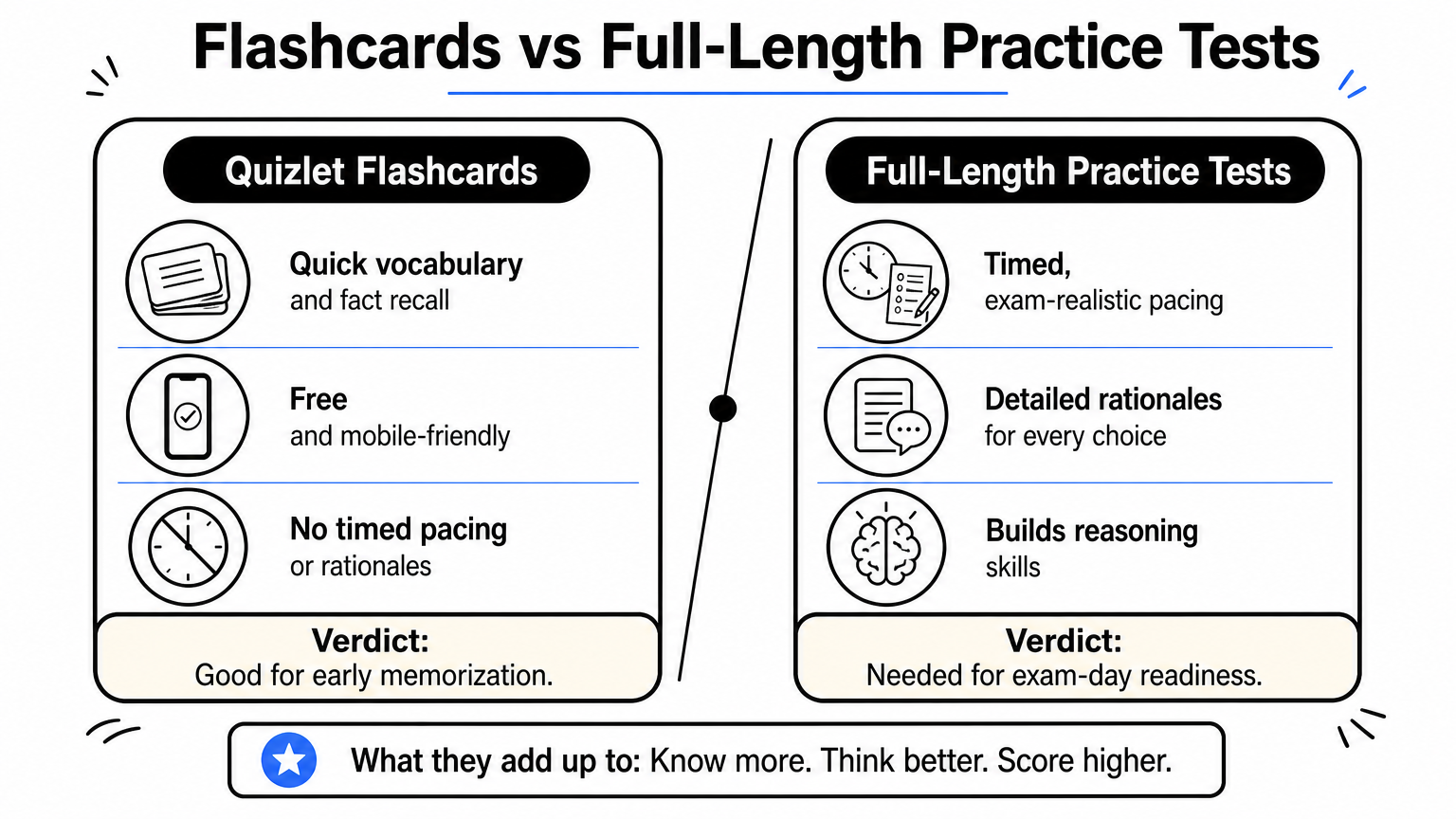
Free flashcards you can access anywhere
Convenience drives most of the appeal. Quizlet’s flashcard format breaks intimidating topics like the metric system, cell structures, or grammar rules into small, digestible chunks you can review between classes. Student-made study sets covering vocabulary, math formulas, and anatomy terms are easy to find, often created by someone who sat the same exam last semester. That peer-created feel makes the material approachable, and repetition through flashcards genuinely helps you lock in facts like bone names or unit conversions before you move on to harder practice.
Where crowdsourced decks fall short
Popularity doesn’t guarantee accuracy. Quizlet sets are built by individual students, not exam content experts, so you’ll run into decks with outdated question formats, typos in answer choices, or terminology that doesn’t match your specific exam version, whether that’s TEAS 7, HESI A2, or the PSB. Worse, most decks hand you a single correct answer with zero explanation, which means you memorize the “what” without ever learning the “why.” That gap matters most in Science and Anatomy & Physiology sections, where entrance exams test reasoning, not just recall of a term you saw on a flashcard twice.
Flashcards teach you what the answer is; only detailed rationales teach you why the other three choices are wrong.
The right role for Quizlet in your study plan
Used correctly, Quizlet fits into the early stage of prep, the phase where you’re building vocabulary and memorizing static facts before you move into applied practice. Think of it as a warm-up, not your main workout. Once the terminology sticks, you need timed, full-length practice with rationales for every answer choice to build the reasoning skills and pacing that flashcards can’t replicate. That’s the gap a structured resource like PrepNovat’s free practice TEAS exam questions are built to fill, pairing a realistic question bank with explanations for both correct and incorrect answers.
| Study method | Good for | Falls short on |
|---|---|---|
| Quizlet flashcards | Quick vocabulary and fact recall | Timed pacing, answer reasoning, exam-specific accuracy |
| Full-length practice tests | Realistic simulation, detailed rationales | Passive, quick-hit review sessions |
Neither approach alone gets you fully ready. Combining both, flashcards for memorization and full practice tests for reasoning under time pressure, is what actually moves the needle on test day.
Step 1. Identify your exact nursing entrance exam
Before you search for a single Quizlet deck, nail down exactly which exam your program requires. Nursing schools don’t all use the same test, and the differences matter more than most students realize. Searching generic terms like “nursing entrance exam practice test quizlet” pulls in decks for TEAS, HESI, PSB, and even old ATI versions all mixed together, and studying the wrong content wastes hours you don’t have.
Confirm the test name and version with your school
Contact your program’s admissions office or check your acceptance packet for the specific exam name and version number. Exam versions change more often than students expect. TEAS 6 and TEAS 7, for example, have different question counts and slightly different content weighting, so a deck built for the old version can teach you outdated math conversions or grammar rules that no longer appear on your test, which is why it helps to review what it takes to pass the ATI TEAS 7 before you build a plan.
Studying the wrong exam version wastes more time than studying nothing at all.
Know the major exam types before you search
Once you have the exact name, understand what that exam actually covers. Here’s a quick breakdown of the exams nursing applicants most commonly face:
| Exam | Common users | Core sections |
|---|---|---|
| TEAS (ATI) | Most RN and LPN programs | Reading, Math, Science, English & Language Usage |
| HESI A2 | Many BSN and community college programs | Math, Reading, Vocabulary, Grammar, Anatomy & Physiology |
| PSB-RN | Select nursing schools | Academic Aptitude, Spelling, Reading, Info in Tables/Graphs |
Notice how section weighting differs between exams. HESI leans harder on Anatomy & Physiology, while TEAS splits time more evenly across four broad categories. Studying HESI-specific anatomy flashcards when your school requires TEAS means you’re prepping the wrong ratio of content entirely, so it’s worth comparing the HESI and the TEAS side by side before you choose your materials.
Write down your exam’s exact section list
Once you’ve confirmed the exam and version, list every section it tests, in order, before you touch a single flashcard. This becomes your filter for every Quizlet deck you consider in Step 2. If your programs accept more than one exam, our free TEAS, HESI A2, and NLN PAX practice tests (20 questions each, with rationales) show how each exam’s questions feel before you choose.
- Exam name and version (example: TEAS 7, not just “TEAS”)
- Full list of tested sections
- Approximate number of questions per section
- Time limit for the overall test
Getting this list right up front saves you from the single biggest time-waster in Quizlet-based prep: reviewing content that has nothing to do with your actual exam.
Step 2. Find and vet quality Quizlet study sets
Once you know your exact exam and section list, searching gets a lot more targeted. Typing “nursing entrance exam practice test quizlet” into the site’s own search bar still returns hundreds of decks, so you need a quick vetting process before you commit study hours to any of them. Not every deck labeled TEAS or HESI actually matches your version, and a mislabeled set can quietly teach you the wrong math formulas or grammar rules.
Search with the right filters
Start narrow, then widen only if you don’t find enough decks. Use your exact exam name and version in the search bar, then filter results by the number of terms and recent activity:
- Search “TEAS 7 vocabulary” or “HESI A2 anatomy” instead of generic terms
- Sort by most studied or most recently created sets
- Open the creator’s profile to see if they’ve built other exam-specific decks
- Skip sets with fewer than 20 terms; they’re usually incomplete
Check for red flags before you commit
Before you start memorizing, skim through 10 to 15 cards and look for warning signs. Outdated terminology and typos in the correct answer are the two most common problems, and both will cost you on test day if you don’t catch them early.
If a deck can’t tell you why an answer is wrong, it can’t teach you how to reason through a new question.
Watch for these specific issues as you review:
| Red flag | Why it matters |
|---|---|
| No answer explanations | You memorize facts without learning the reasoning tested on exam day |
| Last updated years ago | Content may not match your current exam version |
| Mismatched question format | Deck doesn’t reflect how questions actually appear on the real test |
| Comments flagging errors | Other students already caught mistakes you’d otherwise miss |
Cross-check content against your section list
Finally, pull out the section list you wrote in Step 1 and match it against the deck’s content. If your exam devotes a full section to Anatomy & Physiology, a deck that’s 80% vocabulary and 20% anatomy won’t balance your study time correctly. Section-by-section matching keeps you from over-studying topics you already know while neglecting the ones that actually make up a large chunk of your score. Save two or three decks per section rather than relying on one, since combining sets from different creators catches gaps that any single deck might miss.
Step 3. Study using Quizlet’s learn and test modes
Once you’ve saved a handful of vetted decks, stop just flipping through flashcards randomly and switch to Quizlet’s structured study tools. Learn mode and Test mode exist specifically to push you past passive recognition into active recall, which is the skill your entrance exam actually measures. Flipping cards feels productive, but Quizlet’s own study modes force you to produce answers instead of just recognizing them, and that shift matters when you’re prepping for something like nursing entrance exam practice test quizlet searches that mix vocabulary with applied reasoning.
Use Learn mode to build recall, not recognition
Learn mode cycles through your deck using adaptive repetition, showing you terms more often when you get them wrong and less often once you’ve proven you know them. Set it up correctly before you rely on it for a full study session:
- Select “Written” answer format instead of multiple choice when possible; typing the answer builds stronger recall than picking from options
- Turn on “Study starred terms” for a second pass focused only on cards you missed
- Set session length to 15 to 20 minutes so fatigue doesn’t tank your accuracy
- Repeat each deck across three or four separate sessions spread over a week, not one long cram
Spacing sessions out this way mimics how your brain actually consolidates information, and it beats a single marathon review every time.
Use Test mode to simulate quiz-style pressure
Once a deck feels familiar, switch to Test mode, which generates a mixed quiz from your terms using multiple choice, true/false, and written formats together. This is the closest Quizlet gets to exam-style pressure, and it exposes gaps that flashcard flipping hides completely.
If you can only recognize an answer in a flashcard but can’t produce it under quiz conditions, you don’t know it yet.
Score each Test mode attempt and log the result somewhere simple, a notes app or spreadsheet works fine. Watching your score climb across attempts on the same deck tells you when it’s time to move to a new set of terms instead of over-studying material you’ve already mastered.
Know where these modes stop helping
Both modes are excellent for isolated recall, but neither replicates the pacing pressure of answering 50 mixed science questions back to back under a countdown clock. That gap is exactly why Learn and Test modes belong in your early prep weeks, with full-length timed practice taking over as test day approaches.
Step 4. Pinpoint and drill your weak subjects
By now you’ve run a few Test mode sessions and logged scores, which means you already have raw data on where you’re losing points. Most students skip this step and keep reviewing everything evenly, but that wastes time on sections you’ve already mastered while your weakest area stays weak. Nursing entrance exams reward targeted drilling, not broad review, so use your Quizlet scores to build a priority list before you touch another deck.

Turn your scores into a priority list
Grab the scores you logged in Step 3 and sort them from lowest to highest. Any section scoring below 70% deserves daily attention; anything above 90% only needs a light weekly refresher to stay sharp. Build a simple table like this to keep yourself honest:
| Section | Test mode score | Priority level |
|---|---|---|
| Anatomy & Physiology | 58% | High, drill daily |
| Reading Comprehension | 74% | Medium, drill every other day |
| Grammar & Vocabulary | 92% | Low, weekly refresher only |
Sorting your weak spots this way keeps your study time proportional to your actual gaps instead of your comfort zone.
Drill weak sections with focused, short sessions
Once you know which sections need work, create a dedicated Quizlet deck pulling only the terms you missed across your previous sessions. Fifteen focused minutes on your weakest section beats an hour of unfocused review across everything.
- Isolate missed terms into a single “weak spots” deck
- Run Learn mode on written answer format only
- Retest after 48 hours, not immediately, to check real retention
- Retire terms once you answer them correctly three sessions in a row
A weak section only gets stronger when you drill it on its own, not when it hides inside a full deck you already know.
Recognize when Quizlet can’t fix the gap
Here’s where flashcards hit a ceiling. If you keep missing Anatomy & Physiology or Science questions even after drilling vocabulary, the problem usually isn’t memorization, it’s reasoning through unfamiliar question stems, and a study strategy built for the TEAS science section targets that directly. That’s a conceptual gap, and no amount of flashcard repetition closes it. This is exactly where a resource offering rationales for every answer choice, like PrepNovat’s practice tests, earns its place in your prep, because it shows you why the wrong choices are wrong, not just which term you forgot.
Step 5. Simulate real exam conditions before test day
Drilling weak sections fixes gaps, but it doesn’t prepare you for the stamina and pacing a real entrance exam demands. Quizlet sessions run 15 to 20 minutes; your actual TEAS or HESI runs two to three hours with mixed sections back to back. Skipping this step means walking into test day having never felt what 150 questions under a countdown clock actually feels like, and that shock alone costs points.
Build a full-length timed test block
Schedule at least two full-length, timed practice tests in the two weeks before your exam, ideally slotted into a 6-week TEAS 7 study plan. Use the exact time limits and question counts from your section list in Step 1, and sit through the entire block without pausing, checking your phone, or splitting it across days. Full-length simulation exposes pacing problems that isolated flashcard drills never surface, like running out of time on Science because you spent too long second-guessing Reading questions. This is exactly the gap a structured resource like PrepNovat’s timed practice tests is built to close, since it mirrors real exam length and pacing instead of quick-hit review.
You don’t find your pacing problems by studying flashcards. You find them by running the clock.
Replicate exam-day logistics
Treat your practice run like the real thing, not a casual study session. Small logistical mismatches, like studying at a noisy kitchen table when your testing center is silent, add unnecessary friction on the actual day.
- Take the test at the same time of day as your scheduled exam
- Sit at a desk, not on a couch, with no phone nearby
- Use scratch paper only if your testing center allows it
- Time your breaks exactly as the real exam permits
- Complete every section in the required order, no skipping ahead
Review your simulation like a coach, not a grader
After each full-length run, don’t just note your overall score and move on. Go question by question through everything you missed and read the rationale for every wrong answer, not just the correct one, so you understand the reasoning gap rather than memorizing one more fact, especially for TEAS exam science questions that hinge on interpretation. Comparing rationale-based review after two simulated tests against your earlier Quizlet-only scores usually shows the clearest jump, because reasoning under pressure is a different skill than recognizing a flashcard term.
Turning practice into exam-day confidence
Quizlet earns its place in your prep, but only for the first mile of the race. It’s the tool that gets terminology and formulas into your head fast and free. The rest of the race, the reasoning, pacing, and stamina your entrance exam actually grades you on, needs full-length timed practice with answer rationales that explain why wrong choices fail, not just which term to memorize. Students who search for nursing entrance exam practice test quizlet usually want a shortcut, but the real shortcut is combining flashcards early with structured, exam-realistic testing as your date approaches.
You’ve now got a five-step system: identify your exact exam, vet your decks, drill with Learn and Test modes, target weak sections, then simulate the real thing under a clock. Don’t stop at recall. If you’re ready to close the reasoning gap flashcards can’t touch, start with PrepNovat’s nursing ATI TEAS exam prep course and see the difference full rationales make.

Natalie
PrepNovat Team