Real Estate Exam Prep Test: How to Study and Pass
You’ve got a test date on the calendar and a stack of vocabulary terms that all start to blur together after an hour of studying. A real estate exam prep test is the fastest way to find out what you actually know before the state finds out for you, and most candidates who fail the first time say the same thing afterward: they studied the material but never practiced under real exam conditions.
Passing on your first attempt comes down to two things: knowing the content and knowing how to perform under a timer. That means working through exam-realistic practice questions, reading the rationale behind every wrong answer, and running full-length timed tests that match the pacing you’ll face on exam day.
This guide walks through how to build a study plan for real estate license exam prep, which topics trip up most candidates, and how to use practice questions and timed simulations to build both knowledge and confidence. We’ll also cover how a large question bank with detailed answer explanations, like the one PrepNovat offers, can turn passive studying into targeted, measurable progress.
What’s actually on the real estate exam
Most states split the exam into two distinct parts: a national portion covering real estate principles and practices that apply everywhere, and a state-specific portion covering local laws, licensing rules, and disclosure requirements unique to where you’re getting licensed. Candidates often assume the state section will be the harder one because it’s less familiar, but the national portion usually carries more weight and more questions, which means your real estate exam prep test strategy needs to prioritize accordingly.
The national portion
The national section tests broad concepts that show up in nearly every state’s exam: property ownership, land use controls, valuation and appraisal, financing, contracts, transfer of title, and agency relationships. Math shows up here too, things like prorations, loan-to-value ratios, and commission splits, and it’s the section where candidates lose the most points simply because they didn’t practice enough calculation problems under time pressure.
The national portion decides most of your score, so don’t let unfamiliar state rules distract you from mastering it first.
The state-specific portion
The state portion is shorter but unforgiving because it tests memorized specifics: license law, required disclosures, escrow rules, and the makeup of your state’s real estate commission. You can’t reason your way through these questions the way you sometimes can on the national side. If you get a fact wrong, you get the question wrong, full stop. This is exactly why exam prep real estate courses that only cover general principles leave candidates exposed on test day, and why a state-focused plan like the one behind the Pennsylvania real estate exam practice test separates state and national review.
How the content typically breaks down
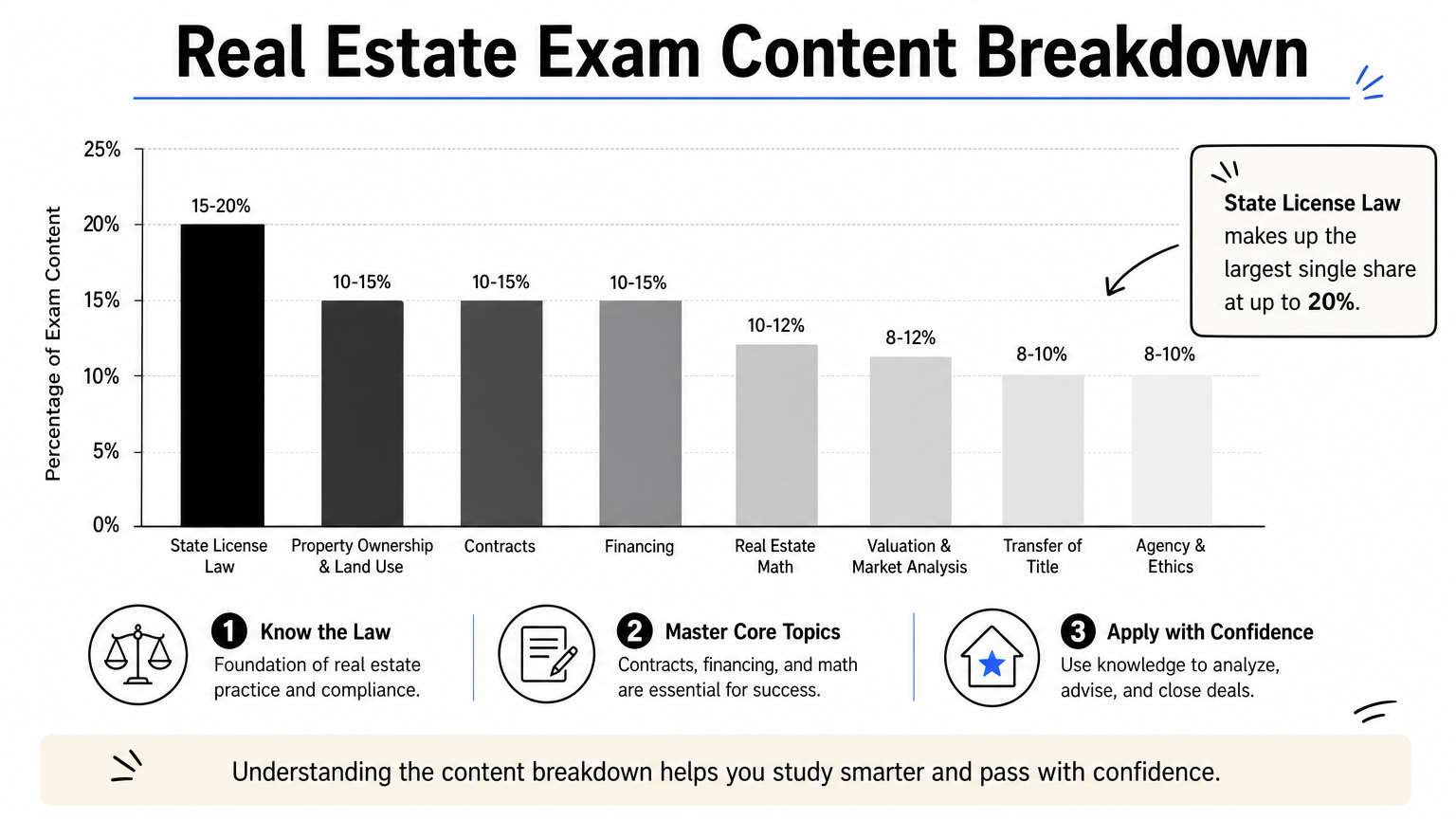
While exact weighting varies by state and exam vendor (Pearson VUE and PSI administer most state exams), the categories below reflect what candidates commonly report seeing across licensing exams.
| Content Area | Approx. Share of Exam | What It Covers |
|---|---|---|
| Property Ownership & Land Use | 10-15% | Estates, easements, zoning, deed restrictions |
| Contracts | 10-15% | Listing agreements, purchase contracts, options |
| Financing | 10-15% | Loan types, qualifying ratios, foreclosure |
| Valuation & Market Analysis | 8-12% | Appraisal methods, CMAs, depreciation |
| Transfer of Title | 8-10% | Deeds, closing, recording requirements |
| Real Estate Math | 10-12% | Prorations, commissions, area calculations |
| Agency & Ethics | 8-10% | Fiduciary duties, fair housing, disclosure |
| State License Law | 15-20% | Licensing requirements, commission authority, discipline |
Because the split between national and state content is so consistent, treating them as one undifferentiated pile of flashcards is a mistake. When you prep for real estate exam day, budget separate study blocks for each portion and track your accuracy on both independently, not just your overall score. A question bank that tags questions by category, the way PrepNovat’s real estate track does, makes it much easier to spot which of these eight areas is dragging your average down before you sit for the real thing.
Step 1. Confirm your exam format and requirements
Before you open a single practice question, find out exactly what your state requires, because the details vary more than most candidates expect. Real estate licensing exam prep looks different in Texas than it does in Ohio, and studying the wrong version of the exam wastes weeks you don’t have. Every state real estate commission publishes a candidate handbook that spells out the number of questions, the time limit, the passing score, and whether your state uses Pearson VUE, PSI, or another vendor to administer the test.

Pull your state’s candidate handbook
Go to your state real estate commission’s website and download the current candidate information bulletin. Most states update these yearly, so don’t rely on a PDF a friend sent you two years ago. Confirm these five details before you build a study calendar:
- Total number of questions on the national and state-specific portions
- Time allowed for each portion (often 2.5 to 4 hours combined)
- Minimum passing score, usually a scaled score around 70-75%
- Whether the exam is computer-based and where your nearest test center is
- Any prerequisite coursework hours you must complete before scheduling
Studying the wrong exam blueprint is the fastest way to waste a study plan you can’t afford to repeat.
Match your prep to the actual format
Once you know the structure, line up your prep for real estate exam materials against it, comparing study tools and prep course options before you commit to one. If your state allots 90 seconds per question, your practice sessions need that same pacing baked in from day one, not just during a final review week. Registering for the exam early also matters, since testing centers fill up fast in the weeks before license renewal deadlines, and a delayed test date often means a delayed start date at your brokerage.
Understanding these mechanics upfront changes how you approach every study session that follows. Verify your state’s exact question count and passing threshold at your official state real estate commission website, and cross-check it against whatever practice platform you choose, since a mismatch between the two undermines your confidence right when you need it most.
Step 2. Study the core content categories
Once you know the blueprint, work through each content area on purpose instead of hoping general review covers everything. Cramming financing formulas the night before you tackle agency law leaves both topics half-learned, and half-learned material is exactly what falls apart under a timer. Real estate exam prep questions organized by category let you measure progress area by area instead of guessing where you stand, especially when they sit inside a 4–6 week study plan for the license exam.
Build category-by-category mastery
Break your study calendar into blocks that match the eight categories from the exam breakdown table above, spending more time on the higher-weighted sections like state license law and contracts. A simple weekly rotation works better than trying to review everything at once:
- Week 1: Property ownership, land use, and transfer of title
- Week 2: Contracts and agency relationships
- Week 3: Financing and real estate math
- Week 4: Valuation, ethics, and your state’s license law
Repeat weak categories in week 5 instead of moving on just because the calendar says you should.
Use rationale-based learning to fix weak spots
Getting a question right by luck teaches you nothing, and getting it wrong without an explanation teaches you even less. This is where exam prep real estate candidates often shortchange themselves by using flashcard apps that only show a correct answer with no reasoning behind it. Read the rationale for every option, not just the one you picked, because the explanation for why the other three answers are wrong usually reveals a rule you’d otherwise miss on exam day, and worked examples with full answer breakdowns show what that review should look like.
You don’t learn from the questions you get right, you learn from understanding why the wrong answers are wrong.
PrepNovat’s real estate practice questions tag every item by category and pair each one with a full explanation for every answer choice, so you can spot a pattern, like consistently missing prorations, before it costs you points on the real thing. That kind of targeted feedback turns study time into measurable progress instead of just hours logged.
Step 3. Drill practice questions by topic
Once you’ve mapped out the eight content areas, stop taking mixed-topic quizzes and start drilling one category at a time until your accuracy holds steady above 80%. Scattershot review feels productive, but it hides weak spots behind the topics you already know well. Running a real estate exam prep test by category, rather than jumping between financing one minute and agency law the next, forces you to notice patterns you’d otherwise miss, like consistently misreading proration dates or mixing up fee simple and life estate definitions.

Isolate one category at a time
Setting your practice tool to filter by topic, the way PrepNovat’s question bank does, lets you run focused sets of 20 to 30 questions on nothing but contracts, or nothing but valuation math, until the pattern of your mistakes becomes obvious. A simple drill routine looks like this:
- Pick one category from the exam breakdown table
- Answer 20-30 questions without a timer running
- Read every rationale, right answers included
- Log your score and repeat the category the next day if you scored below 75%
- Move to the next category only after two consecutive passes above 80%
Fixing one weak category at a time beats reviewing everything once and hoping it sticks.
Track accuracy, not just completion
Finishing a set of questions means nothing if you’re not recording how many you got right and why. Keep a simple log, a spreadsheet works fine, with one row per session listing the category, your score, and the specific rule you missed. Reviewing this log weekly shows you whether prep for real estate exam day should focus more on real estate math or on license law, instead of relying on a gut feeling about which topics feel harder. Grouping practice this way also builds the kind of category-specific confidence that a generic study guide can’t give you, because you’re not just recognizing terms, you’re proving to yourself you can apply them correctly under exam-style questions before you ever see the real thing.
Step 4. Take timed, full-length practice exams
Once your category accuracy holds steady above 80%, stop drilling in isolation and start running full-length real estate exam prep test simulations under a real clock, using mock exams built for real estate licensing. Category drills teach you the content, but they don’t teach you how to manage attention and fatigue over three or four hours of continuous testing. A candidate who knows every topic cold can still run out of time on the last 20 questions because they never practiced pacing themselves across the whole exam, not just a single section.
Knowing the material and finishing the exam on time are two different skills, and only one of them gets tested in isolated drills.
Simulate real exam-day pacing
Schedule your practice test the same way you’d schedule the real thing: same time of day, same break structure, no phone within reach. Mirror the actual format as closely as you can:
- Set the same time limit your state allows for both portions combined
- Take the national and state-specific sections back to back, not on separate days
- Use scratch paper only if your test center allows it
- Avoid pausing to look up a rule mid-question, since you won’t get that option on exam day
- Score yourself immediately after and log the result next to your category drill scores
Review the miss pattern, not just the score
A single overall score tells you almost nothing useful. After each timed run, go back through every missed question and note whether the error came from a content gap or a timing mistake, like rushing the last ten questions because you spent too long on math earlier. PrepNovat’s full-length timed practice tests replicate this pacing directly and pair the results with the same category tagging you used in your drills, so you can see whether your real estate license exam prep still has a specific weak spot or whether the issue was simply running out of time. Run at least three full-length simulations in your final two weeks, spaced a few days apart, so you can act on what each one reveals before the next attempt.
Ready to sit for your exam
Passing your licensing exam isn’t about luck or last-minute cramming. It comes down to knowing your state’s exact format, working through every content category on purpose, and proving to yourself under a timer that you can perform when it counts. Candidates who skip straight to full-length tests without drilling weak categories first usually relearn that lesson the hard way, with a score report instead of a passing certificate.
Running a real real estate exam prep test routine, category drills followed by timed simulations, gives you the two things a generic study guide can’t: proof you understand the material and proof you can finish on time. That combination is what separates candidates who pass on the first attempt from those scheduling a retake.
If you’re ready to turn study time into measurable progress, start with these free real estate exam practice questions and build your plan around the categories where your score actually needs the work.

Natalie
PrepNovat Team