Real Estate Exam Test Prep: How to Pass on Your First Try
You’ve got a test date circled on your calendar and a stack of study material that feels bigger every time you open it. Real estate exam test prep shouldn’t mean guessing which topics matter or hoping you remember enough vocabulary to survive 100+ questions under a timer. Most candidates fail because they memorized facts instead of learning why an answer is right, and that gap shows up fast under exam pressure.
If you’re searching for a real estate prep exam that actually mirrors what you’ll face on test day, the answer is practice questions with full explanations, timed simulations, and enough volume to cover every section your state tests. That combination builds both knowledge and pacing, which is what separates a pass from a retake.
This guide walks through exactly how to structure your prep, what to prioritize in your final weeks, and how to use free real estate exam prep questions to gauge where you stand before committing to a full course. You’ll also see how a pass guarantee and detailed answer rationales, the kind PrepNovat builds its practice tests around, can shorten your study timeline and get you into the exam room ready instead of hoping for the best.
What to expect before you start studying
Before you open a single practice question, understand what you’re actually walking into. The real estate licensing exam is a computer-based test split into two portions: a national section covering broad real estate principles and practices, and a state-specific section covering local laws, license law, and regulations unique to where you’re testing. Most states require you to pass both portions in the same sitting, though a few let you retake only the section you failed. Knowing this upfront changes how you allocate study time, since cramming national content while ignoring your state law section is one of the most common reasons candidates fail on their first attempt.
How the exam is scored and timed
Expect somewhere between 100 and 150 scored questions total, split across the two portions, with a time limit that usually runs three to four hours combined. That works out to roughly a minute or slightly less per question, which feels generous until you hit a math problem that requires two steps of calculation. Pass thresholds typically sit between 70% and 75%, though the exact number varies by state and by which vendor administers the test in your area. Pearson VUE and PSI run most state exams, and each has its own candidate handbook with the specific breakdown of topics and question counts.
Pass rates hover around 60% nationally on the first attempt, which means nearly four in ten candidates walk in underprepared.
What actually shows up on test day
Most states pull questions from a similar pool of core topics, even though the exact weighting shifts. Here’s what you’ll typically see across both portions:
| Topic Area | Typical Weight | Common Trouble Spot |
|---|---|---|
| Property ownership and land use | 10-15% | Easements, encumbrances |
| Contracts | 15-20% | Contingencies, contract validity |
| Financing | 10-15% | Loan types, amortization math |
| Real estate calculations | 10-15% | Commission splits, prorations |
| Agency and fiduciary duties | 10-12% | Disclosure requirements |
| State-specific license law | 20-25% | Licensing renewal, disciplinary actions |
These percentages shift depending on your state, so pull your own candidate handbook before you assume these numbers apply to you.
Set realistic expectations for how long prep takes
Studying for the real estate exam test prep process usually takes between 30 and 80 hours, spread across two to six weeks depending on how much time you can dedicate daily. Candidates working full-time while studying tend to need closer to six weeks, since consistent short sessions beat occasional marathon cram sessions for retention. Anyone who’s completed their pre-license coursework recently will move faster through review, while someone returning to the material after a long gap should budget extra time for vocabulary refreshers.
One more thing worth knowing before you dive in: this exam rewards recognition, not recall. You won’t need to write essays or construct arguments. You’ll need to spot the correct answer among four options that are often deliberately similar, which is a different skill than the one you built in your pre-license classroom. That’s exactly why practice questions with detailed rationales matter more here than flashcards or textbook re-reading, and it’s the foundation the next seven steps build on.
Step 1. Check your state’s exam requirements
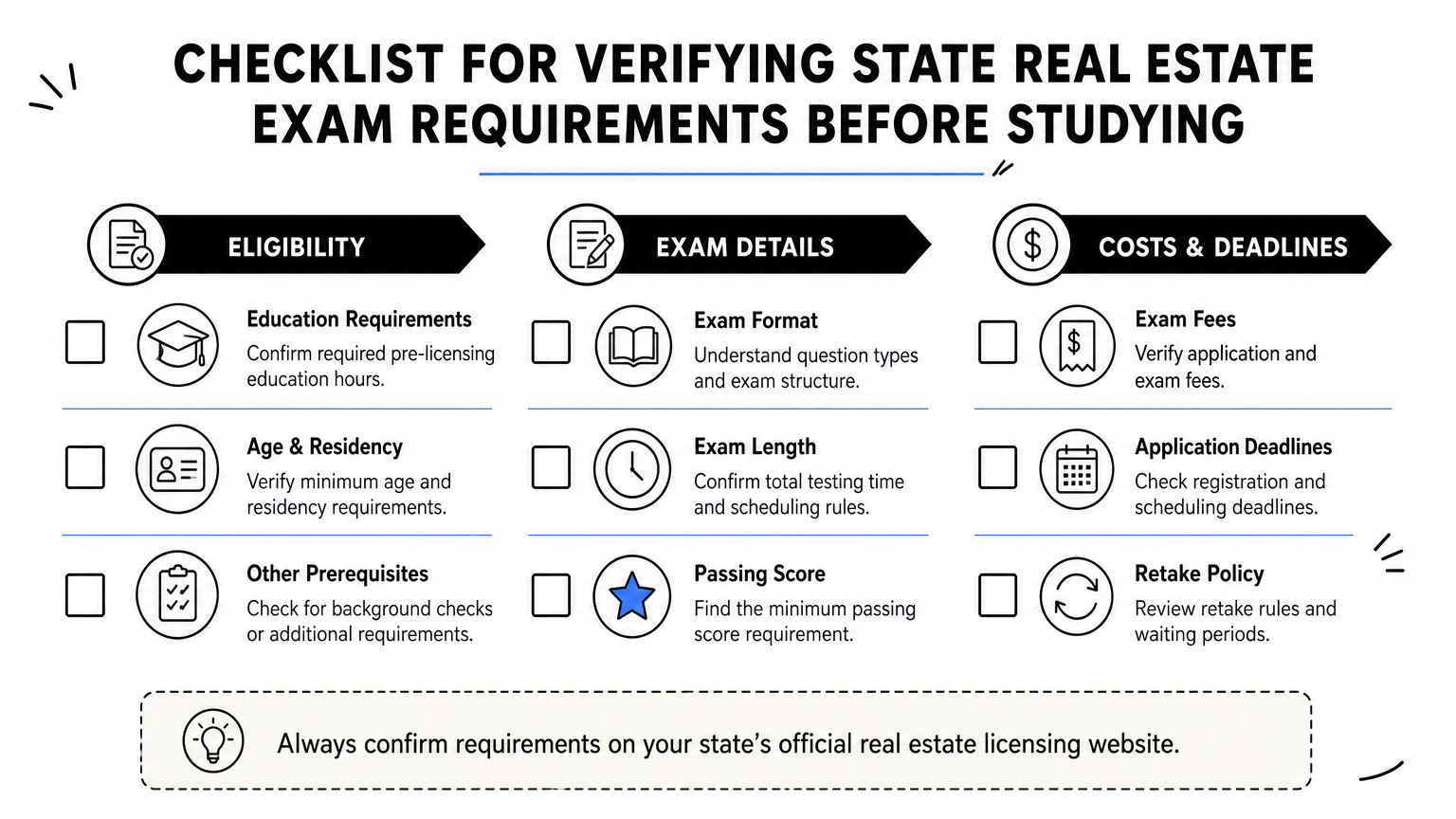
Every state licenses real estate agents differently, so the first real move in any real estate exam test prep plan is pulling your specific candidate handbook, not a generic study guide, as any breakdown of how to study and pass the real estate exam prep test will tell you. Requirements vary on pre-license education hours, whether you need a background check before scheduling, how long your exam eligibility window stays open, and which testing vendor administers your exam. Skipping this step means you might study the wrong state law section entirely, since license law questions carry some of the heaviest weight on the exam, and a state plan like the Pennsylvania real estate exam practice test study plan shows how the state and national halves should be reviewed separately.
Find your official requirements
Start with your state’s real estate commission website, since third-party sites often list outdated fee schedules or expired coursework requirements. Search "[your state] real estate commission candidate handbook" and download the PDF directly rather than relying on a summary blog post.
- Confirm your required pre-license education hours (these range from 40 to 180+ depending on the state)
- Check whether your state requires fingerprinting or a background check before you’re eligible to test
- Note your exam eligibility window, since some states only give you 6-12 months to test after finishing coursework
- Identify your testing vendor, usually Pearson VUE or PSI, and register through their official portal
- Download the exact content outline, which lists every topic and its question count
Your state’s candidate handbook is the only document that tells you exactly what you’re being tested on, so treat it as your syllabus, not a formality.
Why this step gets skipped and why it shouldn’t
Candidates often skip straight to buying real estate exam prep materials because studying feels more productive than paperwork. But generic national-content courses sometimes underweight state-specific law, and that’s the section most first-time test takers underestimate. If your state requires knowledge of specific disclosure forms, agency relationship disclosures, or license renewal cycles unique to your jurisdiction, no amount of national principles review will cover that gap.
Budget an hour for this step before you touch a single practice question. Cross-reference your state’s content outline against whatever prep course or question bank you’re considering, and make sure state-specific questions make up a meaningful share of the practice material, not an afterthought tacked onto national content. This groundwork also tells you which sections deserve extra practice questions once you start Step 2, since a course that undersells your state law portion will leave you guessing on test day.
Step 2. Choose the right prep course or question bank
Once you know exactly what your state tests, the next move is picking a question bank that actually matches that content outline instead of a generic national course. Not every prep tool is built the same, and when you start comparing real estate exam prep study tools, the difference between a best real estate exam prep resource and a mediocre one usually comes down to three things: question volume, answer explanations, and how closely the format mirrors your actual exam.
What separates a strong question bank from a weak one
A thin question bank with 200 questions will run out of new material before you’ve built real pattern recognition, which is why it pays to weigh the top online test prep course picks against each other first. Look for a bank with thousands of questions covering both national and state-specific content, and check that every question comes with a rationale explaining why the correct answer is right and why the other three are wrong. That second part matters more than most candidates realize, since understanding the wrong answers is what helps you eliminate distractors on questions you’ve never seen before.
- Question volume: aim for at least 1,000+ practice questions per exam track
- Rationale depth: explanations for every answer choice, not just the correct one
- Format match: full-length timed tests, not just isolated flashcards
- State coverage: a dedicated section for your state’s license law, not a bolt-on
- Guarantee: a pass guarantee signals the provider trusts its own material
If a prep course can’t explain why the wrong answers are wrong, it’s teaching memorization, not the reasoning skill your exam actually tests.
Test before you commit
Before paying for a full course, run a free real estate exam prep sample first. Most reputable providers, including PrepNovat’s free real estate practice test with 1,000+ questions, offer free trial questions so you can gauge the difficulty and explanation quality before registering. Take 20 to 30 sample questions and check two things: did the rationales teach you something you didn’t already know, and did the difficulty feel close to what your candidate handbook describes. If both answers are yes, you’ve likely found a real estate exam prep free trial worth converting into a full subscription. If the explanations feel thin or the questions feel too easy, keep looking before you commit real study hours to the wrong tool.
Step 3. Build a realistic study schedule
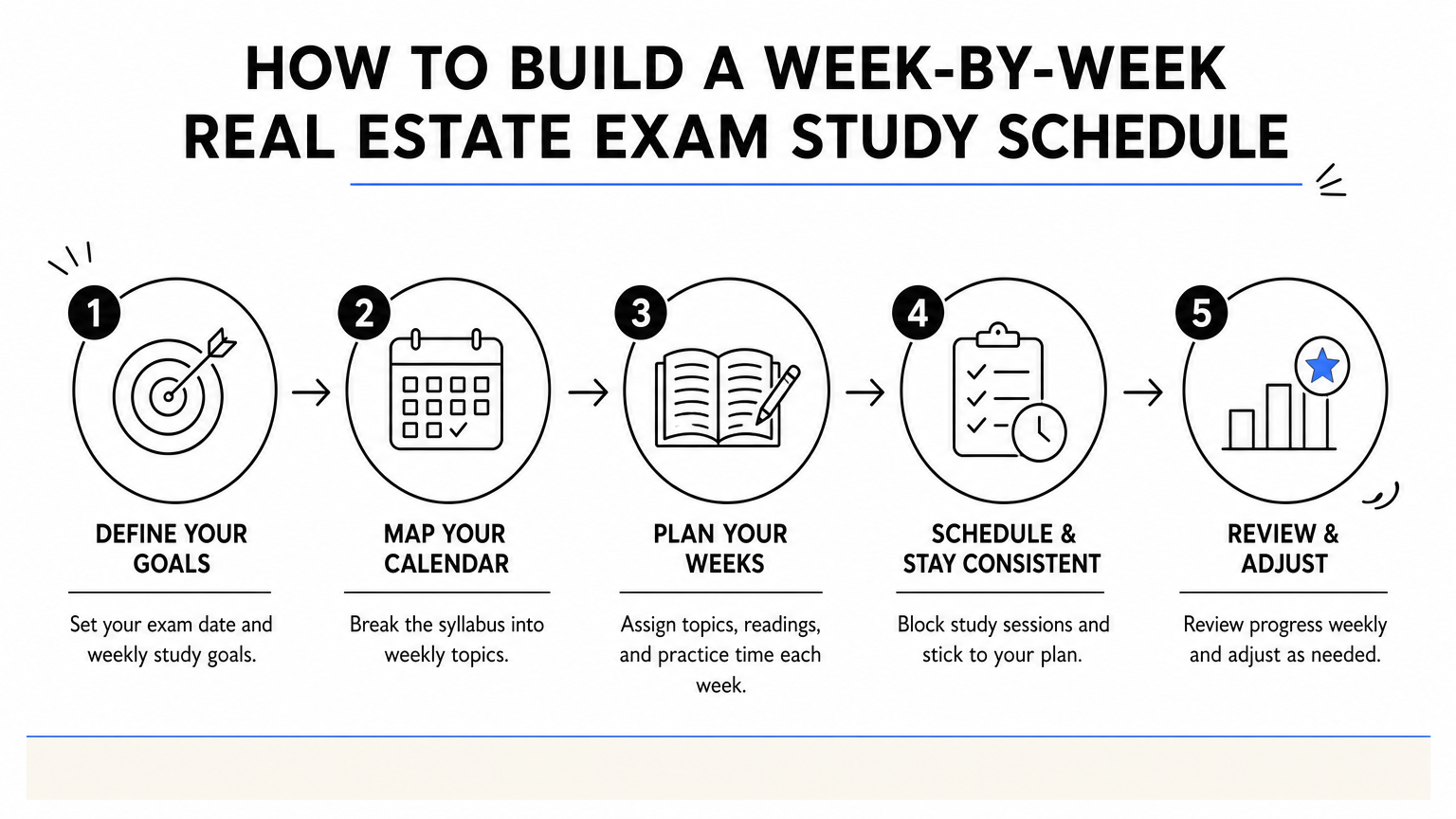
Once you’ve picked a question bank, the next job is turning that resource into a schedule you’ll actually follow. Open a calendar and count backward from your exam date, blocking out two to six weeks depending on how many hours you can realistically commit each day. Real estate exam test prep works best in short, consistent sessions rather than weekend cram marathons, since spaced repetition helps vocabulary and math formulas stick in long-term memory instead of fading by test day.
Split your time by topic weight
Divide your study hours to match the content outline you pulled in Step 1, not evenly across every topic. If contracts and state license law carry the heaviest weight on your exam, they deserve the most practice questions and review sessions, not an equal slice alongside lower-weight topics like property ownership basics.
- Week 1-2: national principles, contracts, and agency relationships
- Week 3-4: financing, real estate calculations, and property ownership
- Week 5: state-specific license law and disclosure requirements
- Final week: full-length timed practice exams and missed-question review
A schedule built around your state’s content outline beats a generic study calendar every time, because it puts your limited hours where the exam actually spends its points.
Protect daily study blocks like appointments
Set a fixed time each day, even if it’s only 45 minutes, and treat it the same way you’d treat a work meeting you can’t skip. Candidates studying around a full-time job tend to succeed with shorter daily sessions rather than trying to find one long uninterrupted block that rarely materializes. Track your progress with a simple log noting which topics you covered and your practice test scores, since that record shows you exactly where to spend more time as the exam gets closer.
Anyone searching for free exam prep for real estate materials to test their schedule before committing to a paid plan should build in a checkpoint around the halfway mark. Run a timed practice section, compare your score against your state’s pass threshold, and adjust your remaining weeks accordingly. Falling short at the midpoint isn’t a reason to panic, it’s a signal to shift more hours toward your weakest topic before moving into the vocabulary and math-heavy work covered next.
Step 4. Master key vocabulary and real estate math
Vocabulary and math trip up more candidates than any other part of the exam, mostly because both reward precision over general understanding. Real estate exam test prep at this stage means drilling terms until you recognize them instantly, not just define them correctly when you have time to think. The exam loves near-identical terms like "easement" versus "encroachment," or "lien" versus "encumbrance," and it will test whether you can tell them apart under a timer.
Build a vocabulary system that sticks
Grab your state’s content outline again and pull every bolded or repeated term, since those are the words your exam vendor considers testable. Group them by category rather than studying an alphabetical glossary, since related terms reinforce each other better than a random list.
- Ownership and title: fee simple, life estate, easement, encroachment, encumbrance
- Contracts: contingency, consideration, novation, assignment
- Agency: fiduciary duty, dual agency, disclosure, subagency
- Financing: amortization, escrow, lien, points
Run these through flashcards for a week, but don’t stop there, and work in real estate exam sample questions with answers that show each term in use. Answer practice questions that use the term in context, since that’s the format you’ll actually face on exam day.
Practice the math formulas until they’re automatic
Calculations show up less often than vocabulary, but they cost more time per question and candidates consistently underestimate how much practice they need. Commission splits, loan-to-value ratios, prorations, and property tax calculations all follow fixed formulas, so memorize the formula first, then drill enough problems that you stop needing to recall the steps.
Commission owed to agent = Sale price x Commission rate x Agent's split
Example: $300,000 x 6% x 50% = $9,000
Math questions don’t test whether you understand real estate, they test whether you can execute a formula correctly in under a minute, so speed matters as much as accuracy.
Work through at least 50 math problems before moving to full practice tests, and time yourself on each one. If a proration or amortization problem takes you more than 90 seconds, that’s a sign to drill that specific formula again rather than moving on and hoping it clicks later. Candidates who skip this step often pass every other section but lose points here simply because they never built speed, not because the concept was too hard to learn.
Once vocabulary recognition and math speed both feel solid, you’re ready for the next step: proving it under real exam conditions.
Step 5. Take full-length timed practice exams
Once vocabulary and math feel automatic, stop drilling isolated questions and start taking full-length timed practice exams that mirror the real thing from start to finish. Isolated question sets teach recognition, but they don’t teach pacing, and pacing is exactly what breaks candidates who know the material but run out of time on the last twenty questions. This is where real estate exam test prep shifts from learning content to rehearsing performance under pressure.

Simulate the real conditions, not a shortened version
Set a timer that matches your state’s actual time allotment, close every tab except the test, and sit through both the national and state-specific portions back to back the way you will on exam day. Skipping breaks or stopping halfway defeats the purpose, since your brain needs to practice staying sharp for three or four hours straight, not just twenty minutes at a stretch.
- Use a question bank with full-length simulations, not just topic quizzes
- Match your state’s exact question count and time limit
- Take the test in one sitting, with only the breaks your actual exam allows
- Score yourself against your state’s pass threshold, not just a percentage
A timed practice exam tells you something a topic quiz never can: whether you’ll actually finish in time.
Schedule at least three full simulations before test day
One practice run isn’t enough to reveal a pattern. Run at least three full-length timed tests spaced a few days apart, and track your score, your pacing per section, and which topic areas keep costing you points. PrepNovat’s real estate license exam practice tests are built around this exact structure, timed, full-length, and scored against realistic pass thresholds, so you’re rehearsing the actual format instead of guessing how it’ll feel.
Questions with detailed rationales matter here too, since a wrong answer during a timed run is only useful if you understand why you missed it afterward. Reviewing that gap is the entire focus of the next step, but the timed exam itself is what surfaces the gaps in the first place. Treat these full simulations as your dress rehearsal, not a formality. Candidates who skip this step and go straight from flashcards to the real exam consistently report running out of time on sections they otherwise understood well, which is a pacing problem, not a knowledge problem, and pacing only improves through repetition under real conditions.
Step 6. Review missed questions and close knowledge gaps
Finishing a timed practice exam feels like an accomplishment, but the score itself teaches you almost nothing. The real value sits in the review that comes after, where you go question by question through everything you missed and read the full rationale, not just the correct letter. Real estate exam test prep only moves forward when you understand why the right answer was right and why your choice was wrong, since that reasoning is what transfers to a similar question you haven’t seen yet.
A missed question you don’t review is a gap you’ll hit again on exam day, just with less time to fix it.
Turn wrong answers into a study list
Don’t just skim the explanation and move on. Build an actual list of every topic where you missed a question, then group them by category so you can see which sections keep showing up.
- Copy the question, your answer, and the correct answer into a review log
- Read the full rationale for every option, not just the one you picked
- Tag each miss by topic: contracts, financing, license law, and so on
- Revisit any vocabulary term you didn’t fully recognize under time pressure
- Redo the math problems you got wrong without looking at the formula first
Track patterns across multiple practice tests
One missed question might be a fluke. Three missed questions on prorations across two different practice tests is a pattern, and patterns are what you fix before test day. Watch your review log for repeat topics rather than treating each practice test as an isolated event.
| Signal | What It Means | What To Do |
|---|---|---|
| Same topic missed twice | Knowledge gap, not a fluke | Re-study that section directly |
| Math errors under time pressure | Speed problem, not concept | Drill formula until automatic |
| Vocabulary confusion between similar terms | Recognition gap | Rebuild flashcards with context |
| Consistent low score on state law | State content underweighted | Add more state-specific questions |
Question banks with rationales for every answer choice, including PrepNovat’s real estate practice tests, make this step faster because you’re not guessing why you missed something. You’re reading the explanation right next to the question and moving straight to the next practice set. Closing these gaps now, before your final week, is what turns a shaky practice score into a confident one heading into exam day.
Step 7. Simulate exam day in your final week
Your last week isn’t for cramming new material, it’s for rehearsing everything you already know under conditions that match test day as closely as possible. Real estate exam test prep in this final stretch means shrinking your focus to logistics, timing, and confidence rather than trying to squeeze in every topic you haven’t touched yet. Cramming new content this late usually backfires, since it crowds out the recall you’ve spent weeks building.
Rehearse the physical and mental routine
Go through a full dry run at least twice this week, starting from the moment you’d normally leave for the testing center. Wake up at your actual exam time, eat what you’d eat that morning, and sit down for a complete timed practice exam without pausing for phone checks or snack breaks.
- Confirm your testing center location, ID requirements, and arrival window
- Take one full-length timed exam at the same hour your real exam is scheduled
- Practice the two-minute breathing reset you’ll use if a question rattles you
- Pack your bag the night before with ID, confirmation email, and approved calculator
The week before your exam is for rehearsal, not research, so protect it from new material that only adds doubt.
Taper your study load, don’t spike it
Reduce your daily study time as the week progresses rather than increasing it. Three days out, run a shorter review session focused only on your weakest topics from Step 6’s log. Two days out, take one more full simulation and stop drilling new formulas entirely. The day before, do a light vocabulary skim and nothing else, since your brain needs rest more than repetition at this point.
PrepNovat’s real estate practice tests work well for this final week because you can run a full timed simulation that mirrors your actual exam format without hunting for new material or switching tools at the last minute. Sticking with the same question bank and rationale style you’ve trained on all along keeps your final rehearsals consistent with what you’ll actually see on screen. Walking into the testing center having already rehearsed the entire sequence, from wake-up to final question, removes most of the surprise that trips up otherwise well-prepared candidates.
Putting your study plan into action
Passing on your first try comes down to a sequence, not luck. Check your state’s requirements first, pick a question bank with real rationales, build a schedule around your content outline, drill vocabulary and math until they’re automatic, then rehearse under timed conditions and close every gap the review surfaces. Real estate exam test prep works when you treat it as training, not information gathering, and skipping steps is exactly how well-meaning candidates end up retaking a section they already understood.
You don’t need to guess whether you’re ready. A question bank built around full-length timed tests and detailed answer explanations shows you exactly where you stand, before you’re sitting in front of the real thing with the clock running. Start with PrepNovat’s real estate license prep course, run a free sample of the practice questions, and see how close you already are to passing.

Natalie
PrepNovat Team