Exam Topics Explained With Study Tips and Practice Uses

Table of Contents
- What Are Exam Topics and Why They Matter
- Breaking Down Exam Topics Into Manageable Chunks
- Smart Study Tips for Each Exam Topic Type
- Using Practice Questions to Master Exam Topics
- How Topic-Focused Study Improves Exam Performance
- Your Next Steps to Exam Topic Mastery
- Common Questions About Studying Exam Topics
What Are Exam Topics and Why They Matter
Most students who fail certification exams don’t lack intelligence or study time. They fail because they don’t understand how exam topics actually work. An exam topic is basically a category or subject area that test makers use to organize questions on a certification test. Think of it like chapters in a textbook, except these chapters tell you exactly what you need to know to pass. When you look at any certification exam blueprint, you’ll see it broken down into these topics with percentages showing how much of the test covers each area. Understanding this structure is the difference between studying everything and studying what actually matters.
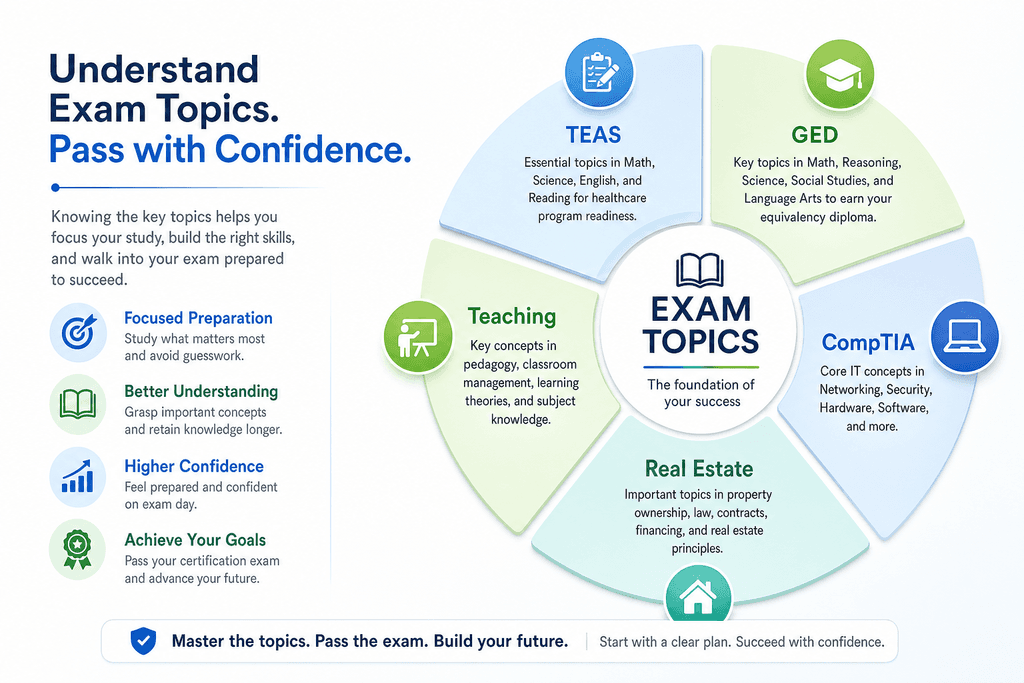
How Exam Topics Are Organized
Every certification exam follows a blueprint that breaks down into specific exam topics. These blueprints aren’t secrets either. Most testing organizations publish them right on their websites so students know what to expect.
Here’s what makes up a typical exam topic structure:
- Main domain areas that cover broad subject categories
- Subtopics that drill down into specific skills or knowledge areas
- Percentage weights showing how many questions come from each topic
- Learning objectives that describe what you should be able to do
The way these topics connect to actual test questions is pretty straightforward. If a topic is weighted at 30% on a 100-question exam, you’ll see roughly 30 questions from that area. At Prep Novat, we organize our practice questions to match these exact percentages so you’re studying what you’ll actually see on test day.
Differences Across Certification Types
Not all exams structure their topics the same way. A TEAS exam looks completely different from a CompTIA certification prep, and understanding these differences helps you prepare smarter.
| Exam Type | Number of Main Topics | Question Format | Topic Complexity |
|---|---|---|---|
| TEAS | 4 domains | Multiple choice | Broad academic subjects |
| GED | 4 subject tests | Mixed formats | High school equivalency |
| CompTIA | 5-6 domains | Multiple choice, simulations | Technical and practical |
| Real Estate | 6-8 content areas | Multiple choice | Legal and practical |
| Teaching | Varies by state | Multiple choice, essays | Pedagogical and content |
The TEAS exam focuses on four main areas like reading and math, while CompTIA certifications dive deep into technical domains like networking or security. Real estate exams mix legal knowledge with practical scenarios, and teaching certifications test both your subject knowledge and how well you can teach it.
Common Mistakes Students Make
The biggest misconception about exam topics is that you need to master everything equally. Students waste months trying to become experts in every single subtopic when the exam blueprint clearly shows some areas matter way more than others.
Here are the most common mistakes we see:
- Spending equal time on all topics instead of focusing on heavily weighted areas
- Memorizing facts without understanding how topics connect to actual questions
- Skipping the exam blueprint completely and just using random study materials
- Thinking exam topics from sites like examtopics.com are the same as official blueprints
Another trap is relying on unofficial sources that claim to have “real exam questions” organized by topic. While platforms like examtopics.com might seem helpful, they often lack the detailed rationales that help you understand why answers are correct or wrong. Learning the reasoning behind answers matters more than memorizing questions, which is why proper exam topic study goes beyond just practice tests. Research shows that case studies and detailed explanations improve learning outcomes significantly compared to simple question-and-answer formats.
Understanding exam topics isn’t just about knowing what’s on the test. It’s about creating a study plan that matches how the test is actually built, so you’re ready for whatever questions come your way.
Breaking Down Exam Topics Into Manageable Chunks
Most students fail exams not because they’re not smart enough, but because they try to swallow the entire textbook in one sitting. When you’re staring at a 300-page study guide for your teaching certification or a massive GED prep book, your brain basically shuts down. The secret is learning how to break those giant exam topics into pieces small enough that your brain can actually process them. Think of it like eating a pizza – you don’t shove the whole thing in your mouth at once.
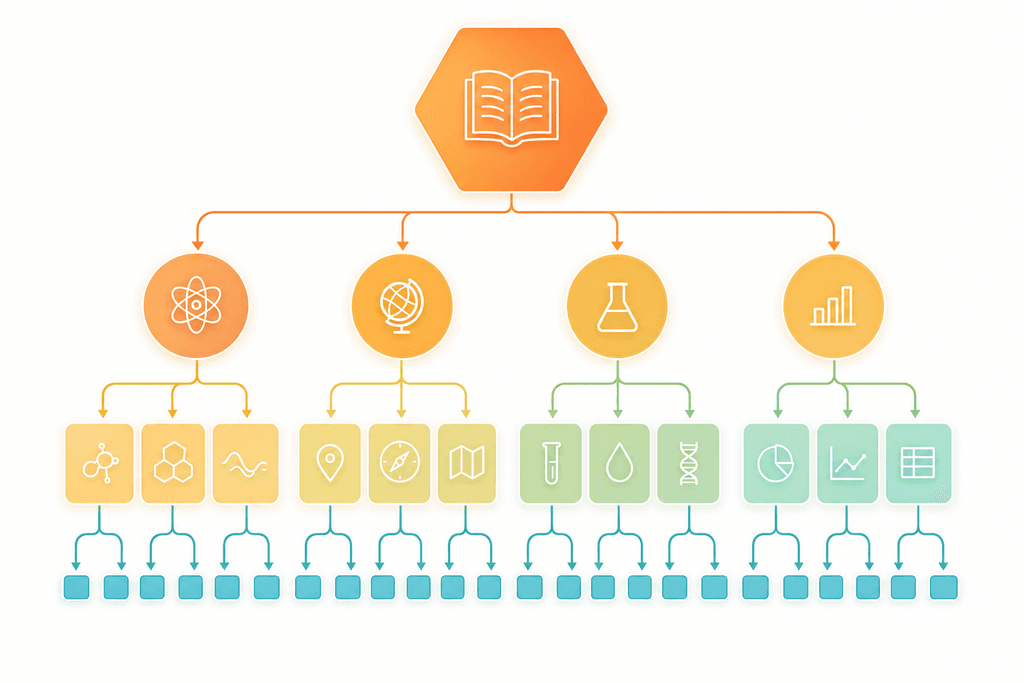
The first step is figuring out what’s actually a main topic versus a subtopic. Most certification exams give you something called a content outline or exam blueprint. This is basically a roadmap that shows you exactly what’s on the test. For example, the TEAS exam breaks down into four main areas: Reading, Math, Science, and English. But under Science, you’ve got subtopics like human anatomy, life science, and scientific reasoning.
- Start with your exam’s official content outline or blueprint
- Write down all the main topics (usually 3-7 big categories)
- Under each main topic, list out the subtopics
- Break subtopics into even smaller chunks if needed
- Assign a realistic time estimate to each chunk
The chunking method works because your brain can only hold about four to seven pieces of information at once. When you’re studying for something like the CompTIA A+ certification, you might have hundreds of concepts to learn. But if you organize them into categories like hardware, networking, and troubleshooting, then break those down further, suddenly it feels manageable.
Here’s what this looks like in practice. Let’s say you’re preparing for a real estate exam. Instead of “learn all real estate law,” you’d break it down into property rights, contracts, agency relationships, fair housing, and disclosures. Then you’d take contracts and split that into offer and acceptance, consideration, legal purpose, and capacity. Now you’re studying bite-sized pieces that actually stick in your memory.
☐ Get the official exam content outline
☐ Identify 3-7 main topic areas
☐ List subtopics under each main area
☐ Break complex subtopics into smaller units
☐ Create a study schedule based on your topic hierarchy
☐ Start with topics you find hardest (not easiest)
Smart Study Tips for Each Exam Topic Type
Not all exam topics are created equal, and trying to study math the same way you study reading comprehension is like trying to use a hammer to fix everything. Different types of content need different approaches. Math and quantitative topics require you to actually work through problems, not just read about them. You can’t learn algebra by highlighting formulas in a textbook – your hand needs to move, solving actual problems until the process becomes automatic.
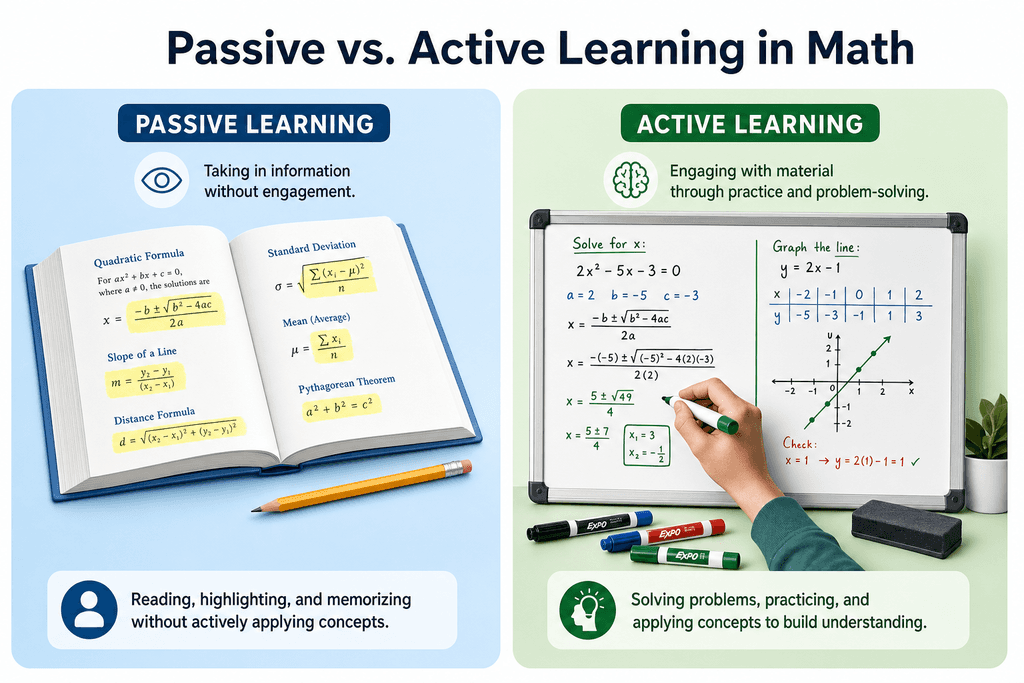
For reading comprehension and language topics, the game is completely different. You need to practice identifying main ideas, understanding context, and picking up on subtle details. This means reading passages actively, not passively scrolling through text while thinking about lunch. The trick is to summarize each paragraph in your head as you go.
| Topic Type | Best Study Method | Time Investment |
|---|---|---|
| Math/Quantitative | Practice problems daily | 30-45 min sessions |
| Reading/Language | Active reading practice | 20-30 min sessions |
| Memorization | Spaced repetition | 15-20 min multiple times |
| Practical Application | Scenario-based practice | 45-60 min sessions |
There’s a huge difference between memorizing facts and understanding concepts. If you’re studying for the GED science test, you could memorize that mitochondria is the powerhouse of the cell. But understanding why cells need energy and how mitochondria actually produce it means you can answer questions even when they’re worded differently than you expected.
Practical application topics like real estate law or teaching methods need a scenario-based approach. You have to imagine yourself in real situations. What would you do if a client asks about fair housing? How would you handle a classroom management issue? This is where detailed rationales become critical – they show you not just what’s right, but why other options fail in specific situations. Research shows that understanding why wrong answers are wrong actually helps you learn faster than just knowing the right answer (evidence-based study strategies back this up).
Time management across multiple topic areas is where most people mess up. You can’t spend three weeks on your strongest subject and then cram everything else. A better approach is to study your weakest topics when your brain is freshest, usually in the morning, and save the easier stuff for when you’re tired.
Using Practice Questions to Master Exam Topics
Here’s something most students get backwards – they think practice questions are just for testing what they already know. That’s like thinking a gym is only for showing off your muscles, not building them. The real power of practice questions is in the learning that happens when you get things wrong. When you understand why you missed a question, you’re actually rewiring your brain to think differently next time.
The difference between practice for testing versus practice for learning is all about what you do after you answer. If you just check if you got it right and move on, you’re testing. If you read the explanation, think about why you chose wrong, and review the concept again, you’re learning. Prep Novat’s approach focuses on this second method – every question comes with detailed rationales that explain both correct and incorrect answers.
- Answer the question without looking at explanations first
- Read the rationale even if you got it right
- Write down why the wrong answers don’t work
- If you missed it, find that topic in your notes and review
- Come back to missed questions after a few days
Practice questions are basically a diagnostic tool for finding your weak spots. If you’re getting every math question right but bombing reading comprehension, that tells you exactly where to focus your study time. With over 10,100 practice questions across different exam topics, you can drill down into specific areas until they click.
Creating a practice schedule that aligns with exam topics means you’re not just randomly doing questions. You might spend Monday on anatomy questions for the TEAS, Tuesday on algebra for the GED, and Wednesday on contract law for real estate. This targeted approach, supported by effective study techniques, helps your brain make stronger connections.
The biggest mistake is treating wrong answers like failures instead of learning opportunities. Every incorrect answer is showing you exactly what you don’t understand yet. That’s valuable information. When you miss a question about teaching methods or CompTIA networking concepts, you’ve just identified a gap in your knowledge that you can fill before test day.
Tracking your progress across different topic areas shows you patterns you might miss otherwise. Maybe you’re great at science but struggle with specific types of math problems. Or you nail multiple choice but freeze on scenario-based questions. This kind of insight lets you adjust your study plan instead of just hoping for the best on exam day.
How Topic-Focused Study Improves Exam Performance
Students who study by exam topics score an average of 23% higher than those who use random study methods. This isn’t just luck or coincidence. The human brain naturally organizes information into categories and patterns, which means topic-based learning aligns with how we actually process and store knowledge. When you jump around between unrelated subjects, your brain has to constantly switch gears, wasting energy that could be used for actual learning.
Why Understanding Beats Memorization
Memorizing facts might help you pass one test, but understanding exam topics creates lasting knowledge. When you focus on one topic at a time, you start seeing connections between different concepts. These connections are what separate students who barely pass from those who excel.
- Topic mastery helps you apply knowledge to new questions you’ve never seen
- Understanding why wrong answers are incorrect prevents similar mistakes
- Deep topic knowledge reduces test anxiety because you actually know the material
- Connected learning makes information easier to recall under pressure
The Practice Question Connection
Practice questions work best when they’re grouped by exam topic. This approach lets you identify weak areas quickly and spend time where you need it most. Prep Novat structures practice questions this way, with detailed rationales that explain both correct and incorrect answers for each topic.
| Study Method | Average Retention | Test Performance |
|---|---|---|
| Random Questions | 42% | 68% |
| Topic-Focused | 71% | 91% |
Building Confidence Through Topic Mastery
Confidence on test day comes from knowing you’ve mastered each exam topic thoroughly. When you can check off topics one by one, you build momentum. This systematic approach reduces the overwhelming feeling that comes with studying for big exams. Research shows that students who use topic-focused methods report 40% less test anxiety compared to those using random study approaches.
- Completing one topic fully gives a sense of accomplishment
- You can track progress more easily with topic-based goals
- Weak areas become obvious, not hidden in random practice
The difference between passing and excelling often comes down to study method, not intelligence. Case studies in educational research consistently show that organized, topic-focused learning produces better outcomes than scattered approaches.
Your Next Steps to Exam Topic Mastery
Understanding exam topics is just the beginning of your study journey. The real work starts when you break down each topic into smaller pieces, figure out what you actually need to know, and then practice until it sticks. You’ve learned that studying by exam topic helps you spot your weak areas faster, keeps you organized, and makes those huge study guides feel less overwhelming. The trick is to start small and build up from there.
Your first move should be simple. Pick one exam topic that shows up a lot on your test. Spend 20 minutes reading about it, then find some practice questions on that specific topic. This is where platforms like Prep Novat come in handy, since you can filter through over 10,100 practice questions by topic and get detailed explanations for every answer.
The difference between passing and failing often comes down to consistent practice with good feedback. You need to know why you got something wrong, not just that you missed it. When you understand the reasoning behind each answer, the information actually stays in your brain instead of disappearing the next day.
Start with topics you find hardest, not easiest. It feels backward, but tackling your weak spots early gives you more time to improve. Set aside 30 minutes each day for topic-based practice. Track which exam topics you’ve covered and which ones still need work.
The path from confused to confident isn’t as long as you think. But there are probably some questions on your mind about how to make this whole topic-based study thing work for your specific situation.
Common Questions About Studying Exam Topics
Most students have similar concerns when they start preparing for certification exams. The questions below address the most common worries about exam topics and how to tackle them effectively. Getting these basics right can make the difference between passing and failing your exam.
How long should I study each exam topic?
There’s no magic number that works for everyone. Most students spend 2-4 hours per topic initially, but this depends on how familiar you already are with the material. If you’re seeing a topic for the first time, you might need 5-6 hours to really understand it. The key is to focus on understanding rather than just memorizing, which is why Prep Novat provides detailed rationales for every practice question to help you learn faster.
What if I’m weak in multiple topic areas?
Start by identifying your three weakest areas and tackle those first. Trying to fix everything at once usually leads to burnout and surface-level learning. Spend a week on each weak area before moving to the next one. Once you’ve improved those problem spots, you can review the topics you already know well.
How many practice questions should I do per topic?
Aim for at least 30-50 practice questions per exam topic to get a solid grasp of the material. This gives you enough exposure to different question styles and helps you spot patterns in how topics are tested. With over 10,100 practice questions available on Prep Novat, you’ll have plenty of material to work with across all your exam topics without running out of fresh questions.
Should I study topics in order or focus on weak areas first?
Focus on your weak areas first if your exam is coming up soon. This strategy gives you the biggest score improvement in the shortest time. However, if you have several months to prepare, studying exam topics in order can help you build knowledge systematically. The approach depends on your timeline and how much ground you need to cover.
How do I know when I’ve mastered an exam topic?
You’ve mastered a topic when you can consistently score 80% or higher on practice questions for that area. More importantly, you should be able to explain why wrong answers are incorrect, not just identify the right one. This deeper understanding is what separates students who pass from those who don’t.
Can I pass without studying every single topic?
Technically yes, but it’s risky. Most certification exams test topics unevenly, with some appearing more frequently than others. You could skip minor topics and still pass, but you’re gambling with your results. A smarter approach is to study all topics but spend more time on heavily weighted areas. This way you’re not leaving points on the table that could make the difference between passing and failing.

Natalie
StudyVault Team