GED Essay Prompts: Practice Prompts, Scored Samples, and a 45-Minute Template

The GED Extended Response gives you 45 minutes to read two opposing passages and argue in writing which author makes the better-supported case. You do not share your personal opinion. You analyze the texts. Below are eight GED-style practice prompts you can start timing yourself on right now, followed by everything you need to score well.
Ready-to-use GED essay prompts for timed practice:
- Should the federal minimum wage be raised? (Passage A argues yes; Passage B argues no.)
- Should public schools require students to wear uniforms? (Passage A supports uniforms; Passage B opposes them.)
- Should cities ban single-use plastic bags? (Passage A favors the ban; Passage B argues against it.)
- Should the U.S. eliminate daylight saving time? (Passage A supports elimination; Passage B defends keeping it.)
- Should professional athletes’ salaries be capped? (Passage A argues for a cap; Passage B argues against.)
- Should high school students be required to complete community service to graduate? (Passage A supports the requirement; Passage B opposes it.)
- Should local governments fund public transportation over road expansion? (Passage A favors transit; Passage B favors roads.)
- Should employers be required to offer paid parental leave? (Passage A argues yes; Passage B argues no.)
Each prompt follows the same structure as the real test: two sides, evidence in the passages, and your job is to evaluate which argument holds up better under scrutiny.
Key Takeaways
The GED Extended Response rewards test-takers who analyze text-based evidence and argue which author’s case is better supported, not those who share personal opinions.
| Point | Details |
|---|---|
| Task and time | 45 minutes to analyze two opposing texts; aim for 300–500 words across 4–7 paragraphs. |
| Scoring structure | Three traits, 0–2 each, for a 6-point maximum; the raw score is doubled in RLA scoring. |
| Highest-value move | Explain why evidence is persuasive (data, logic, credibility), not just what it says. |
| Timing discipline | Reserve 6–8 minutes at the end for revision; a single trait-point gain doubles in the final score. |
| Prepnovat practice | Timed GED mock essays with rubric-based rationales and progress tracking help you target your weakest trait before test day. |
Table of Contents
- What the GED essay prompts actually ask you to do
- How the Extended Response is scored
- A step-by-step 45-minute writing template
- GED-style practice prompt bank by theme
- Three graded sample essays with annotations
- Where to practice and a 4-week plan
- What actually matters in those 45 minutes
- Prepnovat’s GED practice covers the Extended Response directly
- Sources
What the GED essay prompts actually ask you to do
The Extended Response Resource Guide for Adult Educators defines the task precisely: you read two source texts that take opposing positions, then write an essay arguing which position is better supported by evidence from those texts. The task is analytical, not persuasive in the personal sense. You are grading the authors’ arguments, not casting a vote.
The Extended Response sits inside the Reasoning Through Language Arts (RLA) test and carries significant weight, contributing approximately 20% to your RLA score. You get 45 minutes, and that clock includes reading, planning, drafting, and proofreading.
Length matters. According to official GED classroom practice materials, a complete response typically runs 4–7 paragraphs and roughly 300–500 words. Write significantly less than that and you risk a score of zero for insufficient demonstration of writing skill. Write more if the analysis demands it, but padding without substance hurts you just as much as brevity.
The single most common mistake is treating this as a personal opinion essay. Graders do not care whether you agree with the minimum wage increase or the plastic bag ban. They care whether you can identify which author uses stronger evidence, more logical reasoning, and more credible sources.
How the Extended Response is scored
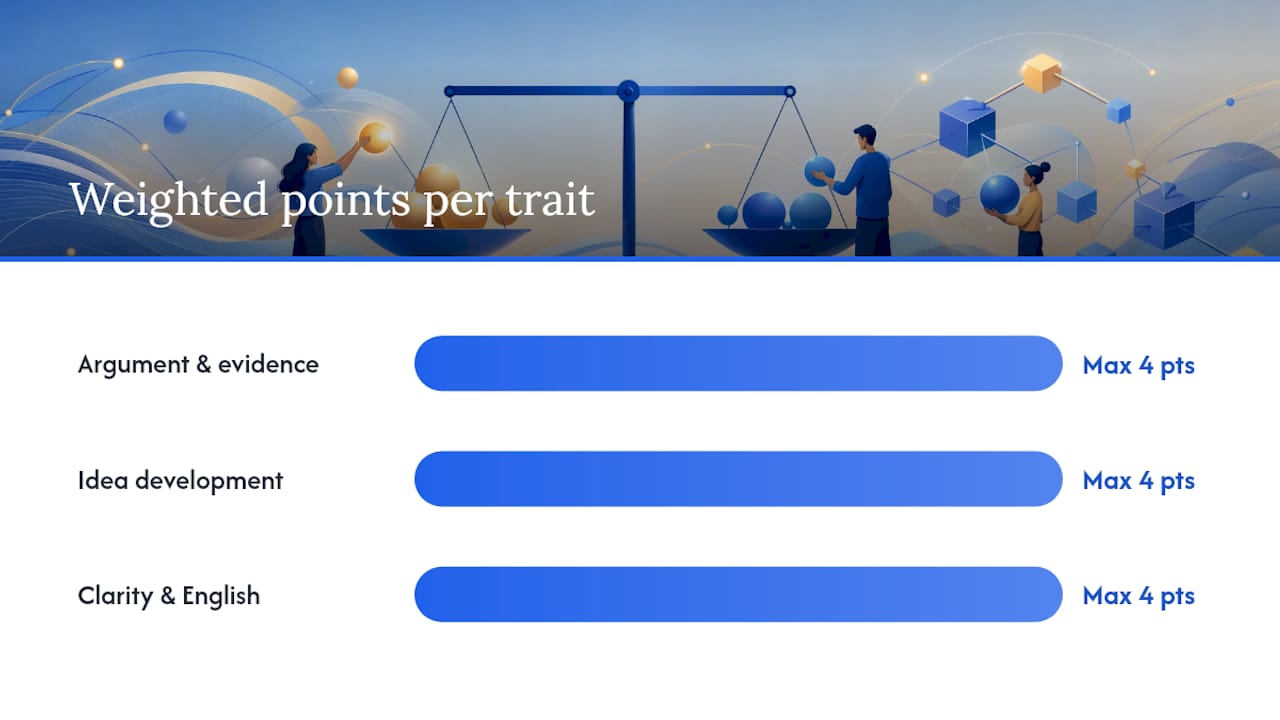
The rubric has three traits, each scored 0–2, for a maximum raw essay score of 6 points. That raw score is then doubled within the RLA scoring structure, so a 6/6 essay contributes 12 weighted points to your total.
| Trait | What graders look for | Score 0 | Score 1 | Score 2 |
|---|---|---|---|---|
| Argument creation and evidence usage | Uses text-based evidence to support a clear claim | No claim or no evidence from texts | Claim present but evidence is vague or partially text-based | Clear claim with specific, well-analyzed text evidence |
| Idea development and organization | Logical structure with developed ideas | No discernible structure | Some organization but ideas are underdeveloped or repetitive | Clear structure, developed analysis, logical progression |
| Clarity and command of English | Grammar, sentence variety, word choice | Errors make meaning unclear | Some errors but meaning is generally clear | Mostly correct with varied sentence structure |
The Extended Response Resource Guide for Adult Educators: Taxation and Revenue includes annotated sample responses that show exactly how trait-specific feedback maps to actual scores, which is worth studying before your test.
Pro Tip: Leaving 6–8 minutes at the end to revise for grammar and sentence clarity often converts a marginal 1 in the language trait to a 2. That single-point gain doubles in the RLA scoring structure, so proofreading time is never wasted.
A step-by-step 45-minute writing template
The Extended Response Resource Guide recommends a specific time breakdown. Here is how to use it with a five-paragraph structure that maps directly to the rubric.
The 45-minute timing plan:
- Minutes 1–5: Read and annotate. Read both passages once. Underline the main claim in each. Circle two or three pieces of evidence each author uses. Mark which author’s evidence seems stronger and why.
- Minutes 6–8: Outline. Write your thesis (which author is better supported and why). List two reasons with one piece of text evidence each. Note one weakness in the opposing argument.
- Minutes 9–13: Write your introduction. State your thesis clearly in the first or second sentence. Preview your two main reasons.
- Minutes 14–21: Write evidence paragraph 1. Topic sentence, specific evidence from the text, analysis of why that evidence is persuasive (logic, data, credibility, or source expertise).
- Minutes 22–29: Write evidence paragraph 2. Same structure. Use a different piece of evidence or a different type of analysis.
- Minutes 30–34: Write the counterargument paragraph. Acknowledge the opposing author’s strongest point, then explain why it is less convincing than your chosen author’s evidence.
- Minutes 35–38: Write your conclusion. Restate your thesis in different words. Summarize the key analytical point without introducing new evidence.
- Minutes 39–45: Revise and proofread. Check for run-on sentences, unclear pronoun references, and missing transitions. Fix the most obvious errors first.
Sentence starters that save time under pressure:
Thesis: “Author A presents a more convincing argument because…”
- Evidence intro: “In the passage, Author A state that…” / “According to the text…”
- Analysis move: “This evidence is persuasive because it relies on [data / expert testimony / logical reasoning]…”
- Counterargument: “While Author B argues that…, this claim is weakened by…”
- Conclusion: “For these reasons, Author A’s position is better supported by the evidence provided.”
Independent GED prep guides also recommend completing 5–10 timed practice essays before test day, using this five-paragraph structure each time until it becomes automatic.
GED-style practice prompt bank by theme
These prompts are written in GED Extended Response style. Each one pairs two opposing views on a topic that requires no specialized knowledge. Use them for timed practice: set a 45-minute timer, write a full response, then score yourself against the rubric in the section above.
Environment and public policy
- Should cities require residents to compost food waste? (Passage A supports mandatory composting; Passage B argues it places an unfair burden on households.)
- Should the federal government subsidize electric vehicles? (Passage A argues subsidies accelerate clean energy adoption; Passage B argues they distort the market.)
Education and school rules
- Should smartphones be banned in public school classrooms? (Passage A supports the ban; Passage B argues phones are learning tools.)
- Should standardized testing determine high school graduation? (Passage A defends standardized tests; Passage B argues they measure test-taking skill, not learning.)
Workplace and technology
- Should employers be allowed to monitor employees’ remote work activity? (Passage A argues monitoring protects productivity; Passage B argues it violates privacy.)
- Should a four-day workweek become the national standard? (Passage A cites productivity gains; Passage B warns of economic disruption.)
Public health and safety
- Should sugary drinks be taxed to reduce obesity rates? (Passage A supports the tax; Passage B argues it unfairly targets lower-income consumers.)
- Should the U.S. mandate vaccinations for public school enrollment? (Passage A argues for mandates; Passage B argues for parental choice.)
Local government and taxes
- Should local governments raise property taxes to fund public schools? (Passage A argues it reduces inequality; Passage B argues it burdens homeowners.)
- Should cities use tax revenue to build affordable housing rather than sports stadiums? (Passage A supports housing investment; Passage B argues stadiums generate economic activity.)
How to simulate test conditions: Write your response in a plain text editor with no spell-check. Use the 45-minute timing plan from the previous section. After writing, score each trait 0–2 using the rubric table above. Track your total score across sessions to measure improvement.
Three graded sample essays with annotations
All three responses below answer the same prompt: “Read the two passages about raising the federal minimum wage. In your response, analyze both arguments and explain which position is better supported by evidence from the texts.”
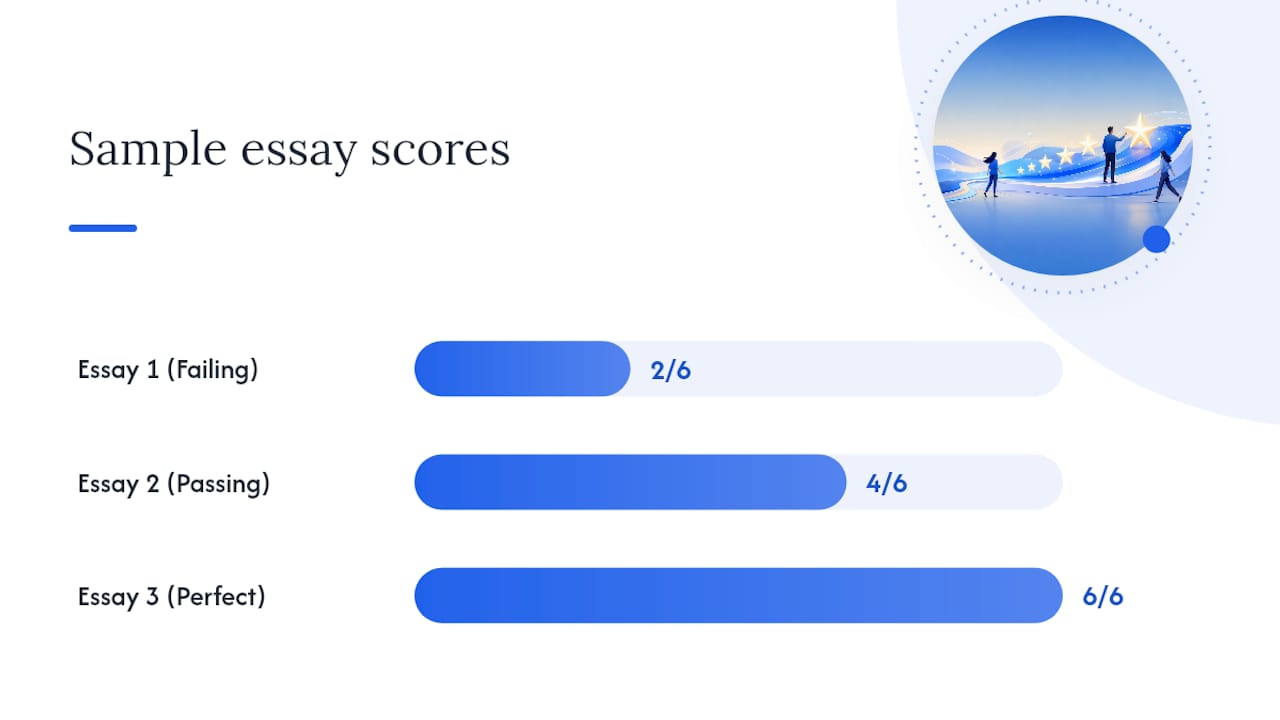
Essay 1: Score 2/6 (Failing)
“I think the minimum wage should be raised. People who work hard deserve more money. The first passage says workers can’t afford rent. That’s true because I know people who struggle. The second passage says it will hurt businesses but businesses make a lot of money anyway. Raising the minimum wage is the right thing to do and everyone should support it.”
Annotations:
- Trait 1 (Argument/Evidence): 0. The writer states a personal opinion and references the passage vaguely (“the first passage says”) without quoting or analyzing specific evidence. No evaluation of argument quality.
- Trait 2 (Organization): 1. There is a loose claim and a brief acknowledgment of the opposing view, but no developed paragraphs or logical structure.
- Trait 3 (Language): 1. Sentences are simple and repetitive. No errors make meaning unclear, but there is no sentence variety.
Quick fix: Replace “I think” with a thesis that names which author is more convincing. Replace “the first passage says” with a specific detail from the text, followed by one sentence explaining why that detail is persuasive.
Essay 2: Score 4/6 (Passing)
“Author A makes a stronger case for raising the minimum wage. The passage points out that the current federal minimum wage has not kept pace with inflation, which means workers today have less purchasing power than workers in previous decades. This is a factual, data-based claim that is difficult to dispute. Author B argues that raising the minimum wage will cause businesses to cut jobs, but this argument relies on predictions rather than documented outcomes. Author A’s evidence is more grounded in measurable economic data. For these reasons, Author A presents the more convincing argument.”
Annotations:
- Trait 1 (Argument/Evidence): 2. Clear thesis, specific text-based evidence, and a brief analysis of why the evidence type (data vs. prediction) matters.
- Trait 2 (Organization): 1. The argument is logical but compressed. There is no separate counterargument paragraph, and the second body point is underdeveloped.
- Trait 3 (Language): 1. Clear and mostly correct, but sentence structure is repetitive and transitions are minimal.
Quick fix: Expand the counterargument into its own paragraph. Add one more piece of evidence from Author A’s passage with a sentence explaining its credibility.
Essay 3: Score 6/6 (Perfect)
“Author A presents a more convincing argument for raising the federal minimum wage because the evidence is grounded in documented economic data rather than speculative projections. Author A cites the decline in real purchasing power since the 1970s, a measurable trend supported by federal wage statistics. This type of evidence is persuasive because it is verifiable and directly tied to the argument’s central claim. Author A also references studies showing that states with higher minimum wages did not experience the job losses that opponents predicted, which directly addresses the opposition’s core concern. Author B’s argument, while reasonable on its surface, relies primarily on projections about future business behavior. Projections are inherently uncertain, and Author B does not cite specific cases where minimum wage increases caused documented layoffs. This weakens the argument considerably. While Author B raises a legitimate concern about small business margins, Author A’s use of historical data and existing research makes the case more credibly. For these reasons, Author A’s position is better supported by the evidence provided in the texts.”
Annotations:
- Trait 1 (Argument/Evidence): 2. Specific evidence, clear analysis of evidence type (data vs. projection), and direct engagement with the opposing argument’s weakness.
- Trait 2 (Organization): 2. Distinct introduction, two evidence paragraphs, a counterargument paragraph, and a conclusion. Each paragraph has a clear purpose.
- Trait 3 (Language): 2. Varied sentence structure, precise word choice, and smooth transitions between ideas.
Official GED annotated samples in the Taxation and Revenue resource guide follow the same pattern: the highest-scoring responses always explain why evidence is persuasive, not just what it says.
Where to practice and a 4-week plan
Official materials to use first
The GED Ready® Extended Response source texts include stimulus passages such as “Diamond Mining” and “Are Professional Athletes Overpaid?” that you can use for timed practice. GED Testing Service allows non-commercial reuse with attribution, so you can print them, write responses, and score yourself against the rubric.
The Sample Extended Response Passages and Prompts for Classroom Practice document includes annotated responses that show what distinguishes a 2/6 from a 6/6 in concrete, line-by-line terms.
4-week practice schedule
- Week 1: Learn the rubric. Read the official scoring guide. Write one untimed practice essay using a prompt from the bank above. Score it against each trait. Identify your weakest trait.
- Week 2: Timed drafts. Write two timed essays (45 minutes each) using the five-paragraph template. Focus on evidence analysis, not word count. Compare your responses to the annotated official samples.
- Week 3: Targeted drills. If Trait 1 is weak, practice writing thesis statements and evidence analysis sentences in isolation. If Trait 3 is weak, do 15-minute grammar drills on sentence variety and transitions. Write one full timed essay.
- Week 4: Full simulation. Write two full timed essays under test conditions (no spell-check, no notes). Score each one. Review the 6/6 sample essay structure one more time before test day.
Metrics to track: total score per essay, score per trait, and whether your weakest trait improves week over week.
Prepnovat’s GED practice test course maps directly onto this plan with timed practice prompts, detailed rationales, and progress tracking across sessions. The free GED study guide is a solid starting point if you want to assess your baseline before committing to a full practice schedule.
What actually matters in those 45 minutes
The conventional wisdom says “practice more essays.” That is true, but the part most test-takers skip is scoring their own work honestly before comparing to an annotated model. Writing ten essays and never checking them against the rubric is like practicing free throws with your eyes closed.
The anxiety piece is real too. When the timer starts, some writers freeze at the blank screen. The fix is a ritual, not a pep talk. Before you type a single word, spend 90 seconds writing your thesis on scratch paper. That one sentence breaks the paralysis. Once you have a claim, the rest of the essay is just building the case for it.
One more thing most guides understate: the counterargument paragraph is where mid-range essays separate from high-scoring ones. A 4/6 essay usually acknowledges the other side in a single sentence. A 6/6 essay spends a full paragraph explaining why the opposing evidence is less convincing, which is exactly what Trait 1 rewards. Treat the counterargument as your second-best analytical move, not an afterthought.
For test anxiety specifically: take two slow breaths before reading the passages, read both fully before writing anything, and trust the template. You do not need a brilliant idea. You need a clear claim and specific evidence. The structure does the rest.
Prepnovat’s GED practice covers the Extended Response directly
The hardest part of GED prep is finding practice that actually mirrors what the test asks. Most free resources give you grammar drills or reading comprehension questions. The Extended Response needs something different: realistic prompts with opposing passages, a timed environment, and feedback that tells you why a response earns the score it does.

Prepnovat’s GED test prep course gives you timed mock essays built around the same argumentative structure the RLA section uses, plus detailed rationales that explain each scoring decision. Progress tracking shows you which rubric trait is holding your score back, so your practice time targets the right weakness. Support is available 24/7 if you get stuck between sessions. Start with the free GED practice test to see exactly where you stand before your first timed essay.
Sources
- Extended Response Resource Guide for Adult Educators
Prepnovat practice pages:
A note on reuse: GED Testing Service permits non-commercial reproduction of GED Ready® stimulus materials with proper attribution. Do not reproduce official test questions for commercial purposes or redistribute them without checking current GED Testing Service terms at ged.com.
Recommended
- GED Practice Test: Free GED Practice Test & Answers – PrepNovat
- How to Pass the GED Test Online: A Step-by-Step Guide
- GED Study Guide Online Free: Start Your Journey – PrepNovat
- best online test prep courses

Natalie
StudyVault Team