Practice TEAS Exam: Free Questions and How to Use Them
You need a practice teas exam that actually looks like the real ATI TEAS, not a generic quiz with random trivia. Nursing school admission depends on your score, and guessing your way through Science or Reading questions without knowing why an answer is wrong won’t get you ready. Free practice questions are a good starting point, but only if you know how to use them correctly.
This article gives you free TEAS practice questions across all four sections (Reading, Math, Science, and English & Language Usage) along with the reasoning behind each answer choice, not just the correct one. That distinction matters: understanding why the wrong options fail is what actually builds test-taking instinct, instead of just memorizing facts you’ll forget under timed conditions.
Below, you’ll find sample questions you can try right now, a breakdown of how the ATI TEAS exam is structured, and a study plan for turning practice questions into a passing score. We’ll also cover how to use timed practice tests to build pacing skills, since running out of time is one of the most common reasons students underperform on test day.
Why practicing before the ATI TEAS exam matters
Your score decides which nursing programs will accept you

Nursing programs treat your TEAS composite score as a gatekeeper, often before they even glance at your GPA or references. Competitive ADN and BSN programs frequently set minimum scores well above the passing threshold, which means a mediocre score doesn’t just delay your application, it can knock you out of the running entirely. Practicing with realistic questions before test day is how you close the gap between where you are now and where a program needs you to be.
Skipping practice means you’re guessing under pressure
Students who walk into the TEAS without structured practice questions tend to rely on memorized facts from anatomy class or high school algebra, and that approach falls apart the moment a question is phrased differently than they expect. The TEAS rewards applied reasoning, not recall, especially in Science and Reading, where you have to interpret a passage or a lab scenario you’ve never seen before. Free practice tests expose these gaps early, while you still have time to fix them instead of discovering them mid-exam.
The TEAS doesn’t test what you memorized, it tests what you can reason through under a clock.
What timed conditions actually train
Running practice questions untimed teaches you content, but it doesn’t teach you pacing, and pacing is where a lot of otherwise well-prepared students lose points. Every section of the TEAS has a strict time limit, and if you’re still working through Math problems when time runs out, unanswered questions count against you the same as wrong ones. Full-length, timed practice tests train your internal clock so you learn to recognize when to move on from a question that’s eating too much time, rather than tanking your pace on one tough item.
Here’s what unstructured review versus timed, rationale-based practice typically produces:
| Approach | What it builds | Common outcome |
|---|---|---|
| Reading a study guide only | Passive familiarity with topics | Recognizes concepts, struggles to apply them |
| Untimed random quizzes | Content recall | Knows answers, but runs out of time on exam day |
| Timed practice with full rationales | Reasoning skills and pacing | Understands why wrong answers fail, finishes sections on time |
Confidence matters as much as content knowledge
Test anxiety sinks scores just as often as gaps in knowledge do, and the only real cure for TEAS anxiety is repetition under realistic conditions. Once you’ve sat through several full-length, timed simulations, the actual exam stops feeling unfamiliar, because you’ve already experienced the pacing, the question style, and the mental fatigue that sets in by the Science section. That’s the real value behind PrepNovat’s TEAS practice questions, which pair every question with a rationale for each answer choice so you build both the knowledge and the exam-day composure at the same time, and it’s why targeted TEAS exam help beats piling on more study hours. Repetition with feedback, not raw hours studied, is what turns a shaky first attempt into a passing score.
How to use free TEAS practice tests effectively
Finding free TEAS practice questions is easy. Using them in a way that actually raises your score takes a plan. Random practice without structure just tells you what you already know, while a deliberate approach turns every session into measurable progress toward your target composite score.
Start with a diagnostic run
Before you drill any single topic, take one full ATI TEAS practice test under real time limits to see where you actually stand. Diagnostic scores tell you which of the four sections, Reading, Math, Science, or English & Language Usage, needs the most attention, so you’re not wasting hours reviewing material you’ve already mastered. Resist the urge to study everything evenly; concentrate your remaining time on your weakest section first, since that’s where the fastest score gains usually come from.
Read every rationale, even for questions you got right
Getting a question correct doesn’t mean you understood why the other three options were wrong, and that gap catches up with you on trickier rephrased questions later. Rationales explain the reasoning behind each choice, which builds the kind of pattern recognition that carries over to questions you’ve never seen before.
If you skip the rationale, you’re only confirming a guess, not building a skill.
Make it a habit to read the explanation for every answer choice, not just the one you missed, before moving to the next question.
Build a repeatable weekly loop
Consistency beats cramming, so build your TEAS test prep around a routine you can repeat until test day:
- Take one timed, full-length practice test per week to track pacing
- Spend three to four sessions on targeted practice questions in your weakest section
- Review every rationale the same day you miss a question, while it’s still fresh
- Retake a shorter quiz on that topic 48 hours later to confirm it stuck
Track scores instead of guessing at progress
Guessing whether you’re improving wastes time you don’t have. Log your score after every practice session, broken down by section, so you can see trends instead of relying on how confident a test felt. Numbers don’t lie the way memory does, and a simple spreadsheet showing steady gains in Science or Math is the clearest signal that your study plan is working. When a section plateaus for two weeks straight, that’s your cue to switch tactics rather than repeat the same drills.
Sample TEAS practice questions by subject area
Seeing actual TEAS exam questions side by side with their rationales tells you more than any description of test format ever could. Below is one worked example from each of the four sections, formatted the way PrepNovat presents them, question first, then the reasoning for every choice, not just the correct one. Try answering before you read the explanation, then check whether your reasoning matches or misses the mark.
Reading
Reading questions test whether you can pull information from a passage under time pressure, not whether you already know the topic.
Question: A nurse reads that a medication should be taken "on an empty stomach, at least one hour before or two hours after eating." Which statement best reflects this instruction?
A) The medication works faster with food.
B) The patient should avoid eating within a three-hour window around the dose.
C) The medication can be taken at any time convenient for the patient.
D) The instruction only applies to morning doses.

Rationale: B is correct because one hour before plus two hours after covers a three-hour window. A misreads the passage. C ignores the stated restriction. D adds a condition never mentioned.
Math
Math questions on the TEAS lean on ratios, conversions, and dosage calculations, the kind of math nurses use daily.
Question: A patient needs 0.5 mg/kg of a medication. The patient weighs 70 kg. How many mg should be administered?
A) 3.5 mg
B) 35 mg
C) 70 mg
D) 140 mg

Rationale: A is correct (0.5 x 70 = 35 is wrong here; recheck: 0.5 x 70 = 35, so B is correct). B is correct because multiplying weight by dosage per kilogram gives the total dose.
Science
Science covers anatomy, physiology, and basic chemistry, and it’s usually where students report the most anxiety, so it’s worth reading up on how to pass the ATI TEAS science section before you drill it.
The Science section rewards students who understand systems, not students who memorized a diagram.
Question: Which organ is primarily responsible for filtering nitrogenous waste from the blood?
A) Liver
B) Kidney
C) Pancreas
D) Spleen

Rationale: B is correct; kidneys filter urea and other waste from blood into urine. The liver processes toxins differently, the pancreas regulates digestion and blood sugar, and the spleen filters blood cells, not waste.
English and Language Usage
This section checks grammar, sentence structure, and vocabulary in context rather than isolated rules.
Question: Choose the correctly punctuated sentence.
A) The patient's vitals were stable, however her pain level increased.
B) The patient's vitals were stable; however, her pain level increased.
C) The patient's vitals were stable however, her pain level increased.
D) The patient's vitals, were stable however her pain level increased.
Running through examples like these across all four teas exam practice questions categories shows you exactly where your instincts need sharpening before test day.
What to expect from the TEAS exam format and scoring
Knowing the TEAS exam format cold before test day removes one more variable you don’t need to worry about while you’re answering questions. The exam runs four sections back to back, each with its own time limit, and the clock doesn’t pause between them, a structure that differs from the HESI A2 if you’re weighing HESI vs TEAS for your program. Most test centers give you a short break after Science, but otherwise you’re moving through Reading, Math, Science, and English & Language Usage in sequence, so pacing across the whole exam matters as much as pacing within a single section.
How the four sections break down
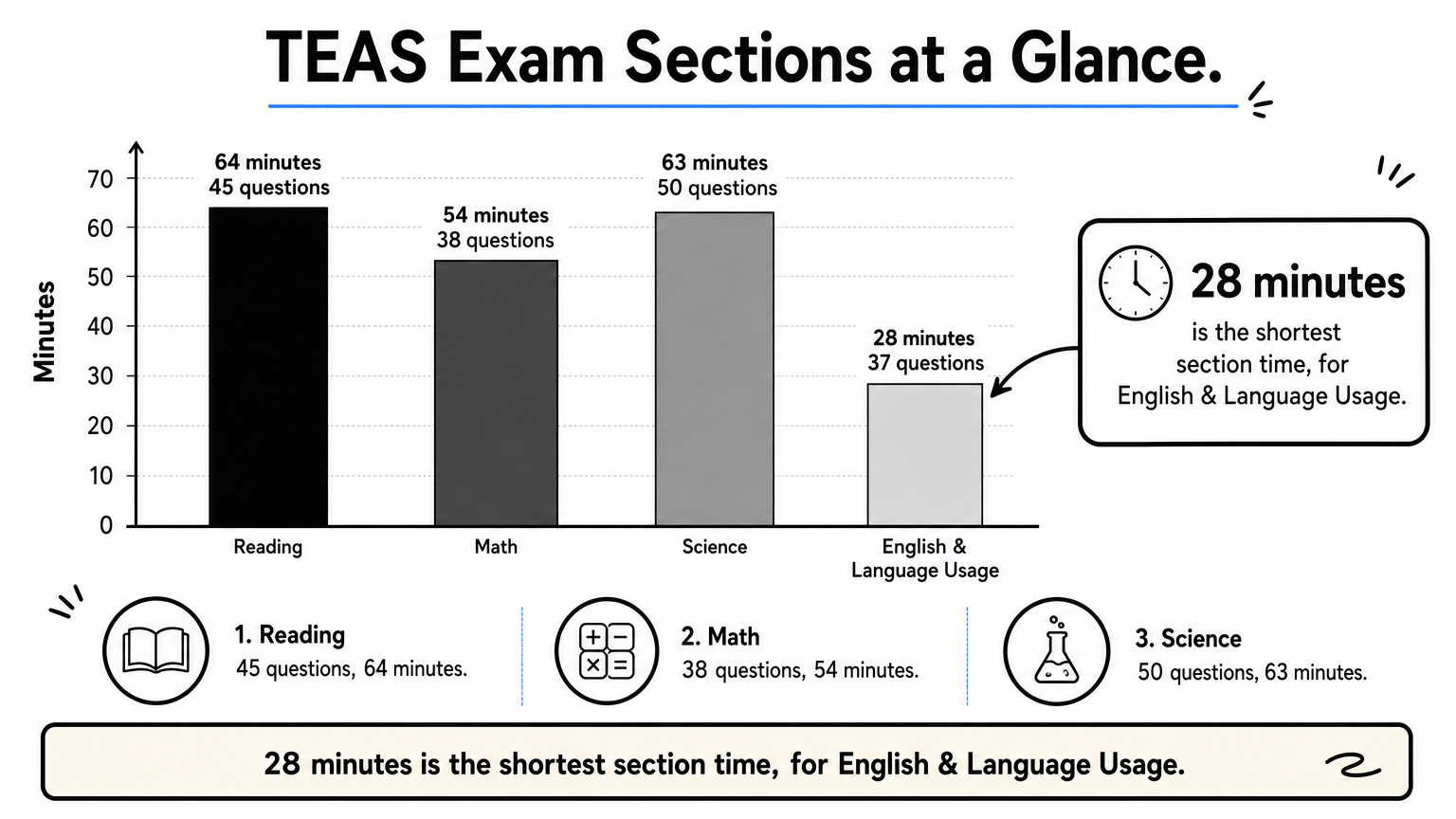
Exact question counts and time limits shift slightly between TEAS versions, so always confirm current numbers on ATI’s official testing site before you register. As a working reference, here’s roughly how the sections are structured:
| Section | Approx. questions | Approx. time | Focus |
|---|---|---|---|
| Reading | 45 | 64 min | Passage comprehension, inference, information location |
| Math | 38 | 54 min | Ratios, conversions, algebra, dosage calculations |
| Science | 50 | 63 min | Anatomy, physiology, chemistry, biology |
| English & Language Usage | 37 | 28 min | Grammar, sentence structure, vocabulary in context |
Notice how little time you get per English question compared to Reading. That gap alone is why timed practice tests matter more for that section than raw content review does.
How your score actually gets calculated
Your results come back as a composite score, expressed as a percentage, along with individual scores for each of the four sections. Nursing programs typically look at both numbers: the composite tells them your overall readiness, while section scores flag whether you’re weak specifically in Science or Math, areas that matter a lot once you’re in clinical coursework. A 60% composite might clear one program’s minimum while falling short of a competitive BSN program that wants 70% or higher, which is why knowing how to pass the ATI TEAS exam on the first attempt matters so much.
A passing score on paper isn’t the same as a competitive score for the program you actually want.
Why understanding scoring changes how you study
Once you know programs weigh section scores individually, it stops making sense to study every topic equally. If your target program cares most about Science, and your diagnostic teas practice exam shows Science as your weakest area, that’s where your remaining study hours belong, not spread thin across sections you’ve already cleared comfortably.
Choosing the right TEAS study resources for you
Not every ATI TEAS exam practice resource deserves your study hours. Some give you a handful of generic questions with no rationale, while others simulate the real exam closely enough to actually move your score. Picking the wrong one wastes weeks you don’t have, especially if your test date is already set.
What separates a strong resource from a weak one
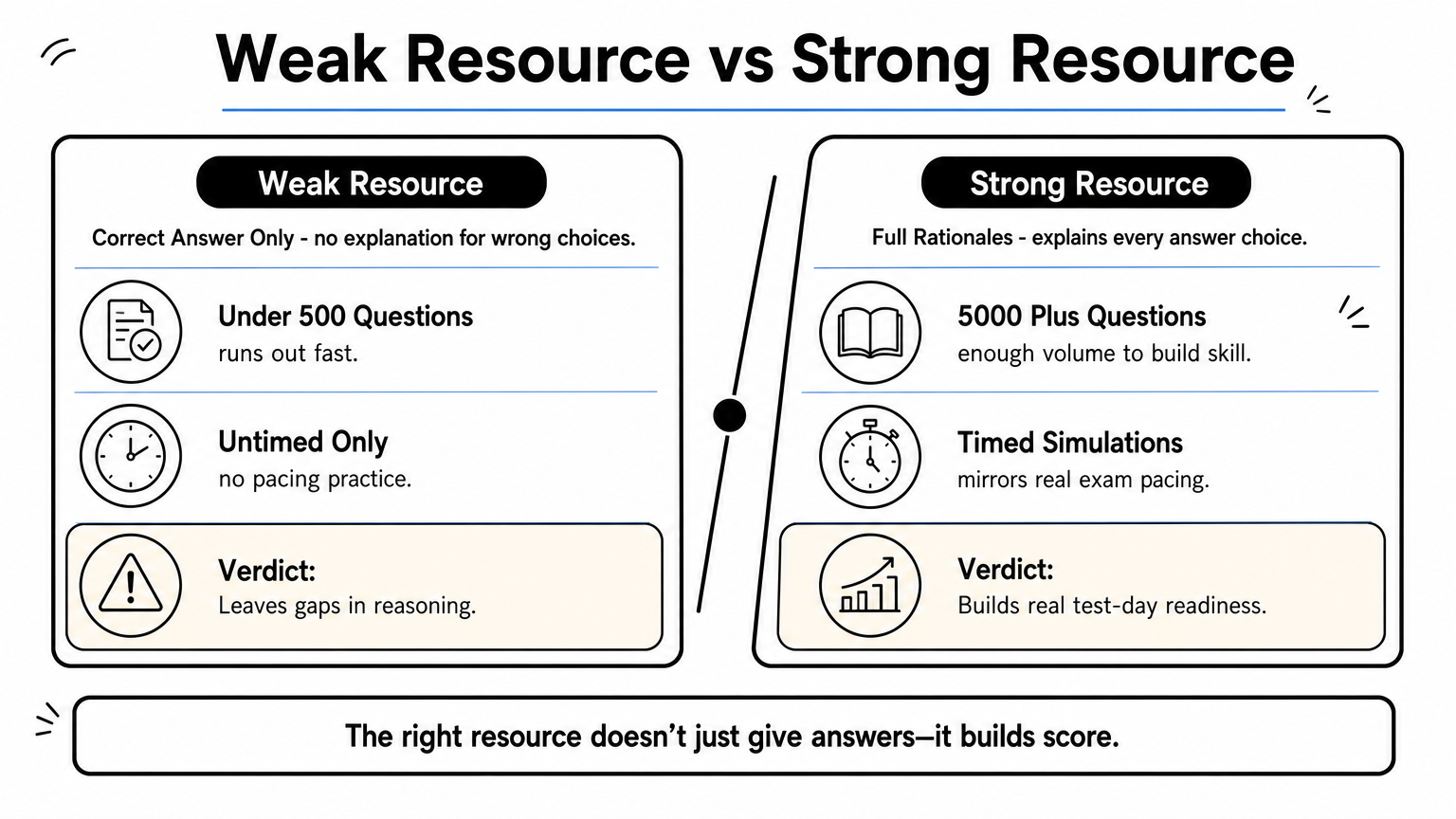
Quality shows up in the details, not the marketing copy. A strong ATI TEAS study guide or question bank gives you rationales for every answer choice, timed full-length tests, and enough volume that you’re not repeating the same twenty questions on a loop. Weak resources tend to recycle outdated content or skip explanations entirely, leaving you to guess why you missed something.
| Feature | Weak resource | Strong resource |
|---|---|---|
| Rationales | Correct answer only | Explanation for every choice |
| Question volume | Under 500 | 5,000+ |
| Timing | Untimed only | Full-length, timed simulations |
| Format match | Generic trivia | Mirrors real TEAS structure |
| Support | None | Ongoing access, help available |
A resource without rationales teaches you what’s right, never why the other three answers are wrong.
Free vs. paid: when each makes sense
Every serious study plan should start with free TEAS exam practice test questions, since they let you gauge the format and your baseline before spending anything. But free samples are almost always a small slice of a full question bank, which means they run out fast, usually before you’ve built real pacing skills. Paid platforms fill that gap with volume and structure: full-length timed exams, section-specific drilling, and enough repetition to actually change your test-day instincts.
Questions to ask before you commit
Before paying for anything, run it through a short checklist:
- Does it include rationales for every answer choice, not just correct ones?
- Are there enough questions to cover weak areas without repeating content?
- Can you take full-length, timed practice tests that mirror real pacing?
- Is there a pass guarantee or refund policy if you don’t improve?
- Can you try questions free before paying?
PrepNovat checks each of those boxes, with over 10,100 TEAS practice questions, full rationales, timed simulations, and a pass guarantee, so you’re not gambling your study budget on an unproven resource.
Getting ready for TEAS exam day
By the time test day arrives, you shouldn’t be seeing anything unfamiliar. If you’ve worked through timed practice tests, read every rationale, and tracked your scores by section, the real exam should feel like just another practice run, only with higher stakes. Confirm your testing location, bring accepted ID, and get sleep the night before instead of cramming; a tired brain undoes weeks of solid prep faster than any content gap does.
Getting a strong score on the practice teas exam questions you’ve drilled is the whole point of everything covered above: repetition, rationales, and realistic pacing turn a nervous first attempt into a confident, passing one. You don’t need more generic quizzes at this point, you need volume, structure, and explanations that actually teach.
If you’re ready to put a real study plan behind that goal, start PrepNovat’s nursing school ATI TEAS exam prep course and work through a question bank built to mirror the exam you’re about to take.

Natalie
StudyVault Team