Praxis Scoring for Educators: How to Check If You Passed

Praxis scoring produces a scaled score in a range generally spanning from 100 to 200, calculated by ETS from your raw correct answers through a process called equating and scaling. To know whether you passed, do one thing: log into your Praxis account, find your scaled score, and compare it to the qualifying score set by the state or licensing agency where you plan to teach. If your scaled score meets or exceeds that threshold, you passed for that state.
Three immediate actions:
- Log into your Praxis account at ets.org and locate your score report
- Find your state’s qualifying score using the ETS state requirements page
- Download and save your official score report PDF before the retention window closes
Table of Contents
- How does Praxis scoring turn raw answers into a scaled score?
- When and where does Praxis post your official score?
- Who sets passing scores, and how do you look up yours by state?
- Is Praxis scored out of 200? What does your number actually mean?
- Pitfalls that cost educators time and money
- What to do if your score falls short of the qualifying threshold
- Key Takeaways
- Why score reports deserve more attention than most educators give them
- Prepnovat’s Praxis practice resources map directly to your score-report gaps
- Useful sources for verifying Praxis rules and state requirements
How does Praxis scoring turn raw answers into a scaled score?
Every Praxis test starts with a raw score: the count of questions you answered correctly. From there, ETS applies a multi-step process before any number appears on your score report.
The core steps:
- Raw correct answers are tallied; no points are deducted for wrong answers on selected-response items
- ETS runs a Preliminary Item Analysis (PIA) during the administration window to flag statistically problematic items
- After the window closes, a Final Item Analysis (FIA) reviews item performance data; items that fail quality checks go through a PIN (Problematic Item Notification) process and may be removed or adjusted
- Differential Item Functioning (DIF) analyses check whether any item performs differently across demographic groups, protecting fairness
- Equating adjusts for difficulty differences between test forms so a 172 on one version means the same thing as a 172 on another
- The equated raw score is converted to the 100–200 scaled score range
The Praxis Technical Manual describes equating and scaling in full, including how statistical processes run shortly after each administration window closes, with scores typically sent to test takers and institutions two to three weeks after that window ends.
Selected-response vs. constructed-response scoring works differently. Machine scoring handles selected-response (SR) items instantly. Constructed-response (CR) items, such as written essays or short-answer tasks on tests like Praxis Core Writing, are scored by two independent human raters. Their scores are combined; when the two raters disagree beyond a set tolerance, a third adjudicator resolves the discrepancy. This is why CR tests never show an unofficial on-screen score at the end of your session.
Pro Tip: Your score report lists raw points earned and raw points available for each content category. A category where you earned 60% of available points versus one where you earned 90% tells you exactly where to focus your next study session — far more useful than your total scaled score alone.
When and where does Praxis post your official score?
Praxis posts scores on Tuesdays and Fridays, excluding holidays. The exact date depends on your test type and whether you tested at a test center or via at-home delivery.
Official vs. unofficial scores:
Selected-response-only tests may display an unofficial score on screen at the end of your session. That number is not your official score and is not sent to institutions. Tests that include constructed-response items show nothing on screen — those scores require human rater review before any result is released.
How to find your estimated posting date:
- Log into your Praxis account at ets.org
- Navigate to the “Score Reporting” section and locate the score reporting calendar
- Select your test name and the date you tested; the calendar returns an estimated posting date
- On or after that date, return to your account and check the “Score Reports” page for your official result
- Once posted, download the PDF immediately — ETS retains scores for reporting, but downloading your own copy protects you against any access gaps
Scores are sent directly to the institutions or agencies you designated when you registered. If you need to add a recipient after the fact, you can do so through your account, though additional reporting fees may apply.
Who sets passing scores, and how do you look up yours by state?
States and licensing agencies set qualifying scores, not ETS. ETS publishes the tables and provides the lookup tools, but the threshold that determines whether you’re licensed to teach in Georgia is set by Georgia’s Professional Standards Commission, not by anyone at ETS headquarters.
The practical consequence: a score that qualifies you in one state may fall short in another, even for the same test. Passing score requirements vary by state and agency, and ETS publishes a compare-qualifying-scores tool to help you check.
Workflow to verify your qualifying score:
Common special cases to watch for:
| Situation | What it means for you |
|---|---|
| Combined/total score requirement | Your individual subtest scores must sum to a minimum total (common with Praxis Core Academic Skills) |
| Target score vs. qualifying score | Some states list a “target” score as a benchmark, not a hard pass/fail cutoff |
| No qualifying score listed | The state or agency has not set a threshold; check directly with the licensing body |
| Footnote with alternate pathway | A different test version or additional requirement may apply to your license type |
For a state-by-state breakdown of which tests are required and at what score, the ETS state requirements page is the authoritative starting point. Always verify with your state’s department of education before assuming a score is sufficient.
Is Praxis scored out of 200? What does your number actually mean?
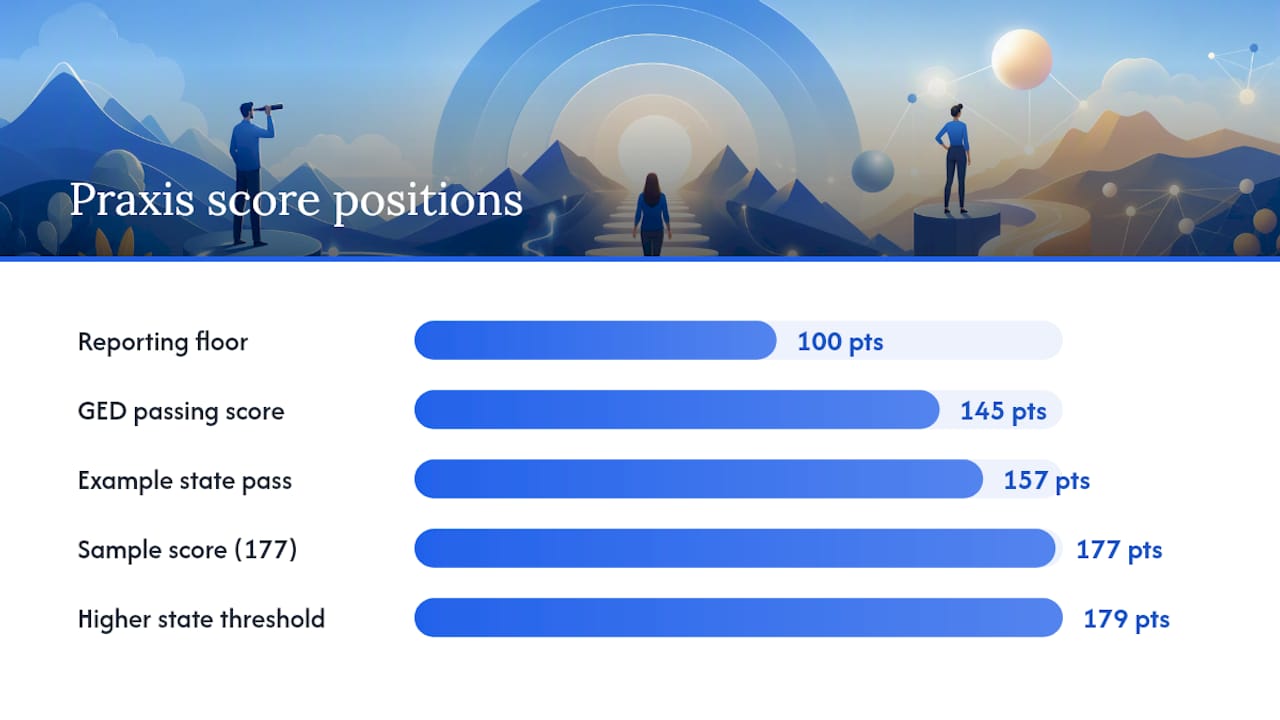
Yes. Most Praxis tests report scaled scores on a 100–200 range. The floor of 100 does not mean you answered 100 questions correctly; it is simply the bottom of the reporting scale. A score of 200 represents the highest possible scaled result.
Quick answers to common questions:
- Is 177 a good score? It depends entirely on your state’s qualifying score. In a state where the threshold is 157, a 177 is comfortably above passing. In a state where the threshold is 179, it is not. “Good” has no universal meaning in Praxis scoring.
- Is the GED scored the same way? No. The GED uses a different scoring scale (100–200 per subject, with a passing score of 145 per subject), and GED passing scores are set by GED Testing Service, not by state licensing agencies the way Praxis qualifying scores are. The GED scoring scale and Praxis scoring are separate systems entirely.
- What is the Standard Error of Measurement? The SEM quantifies normal score variability — your reported score is an estimate of your true ability, not a perfectly precise measurement. If the SEM for a test is 3 points, roughly two-thirds of test takers would score within ±3 points of their true average across multiple attempts. A score of 158 when the qualifying threshold is 160 is not a clear failure in the way a score of 140 would be.
Decision logic for your score:
- Scaled score ≥ state qualifying score → you passed for that state
- Scaled score < qualifying score → check combined-score rules first, then consider a retake
- Score is close to the threshold → factor in SEM before deciding whether to retake immediately
- No qualifying score listed for your state → contact the licensing agency directly
The Understanding Your Praxis Scores page also shows your highest scores over the last ten years for the same test, which matters if you’ve tested before and want to know whether an older result is still on record.
Pitfalls that cost educators time and money
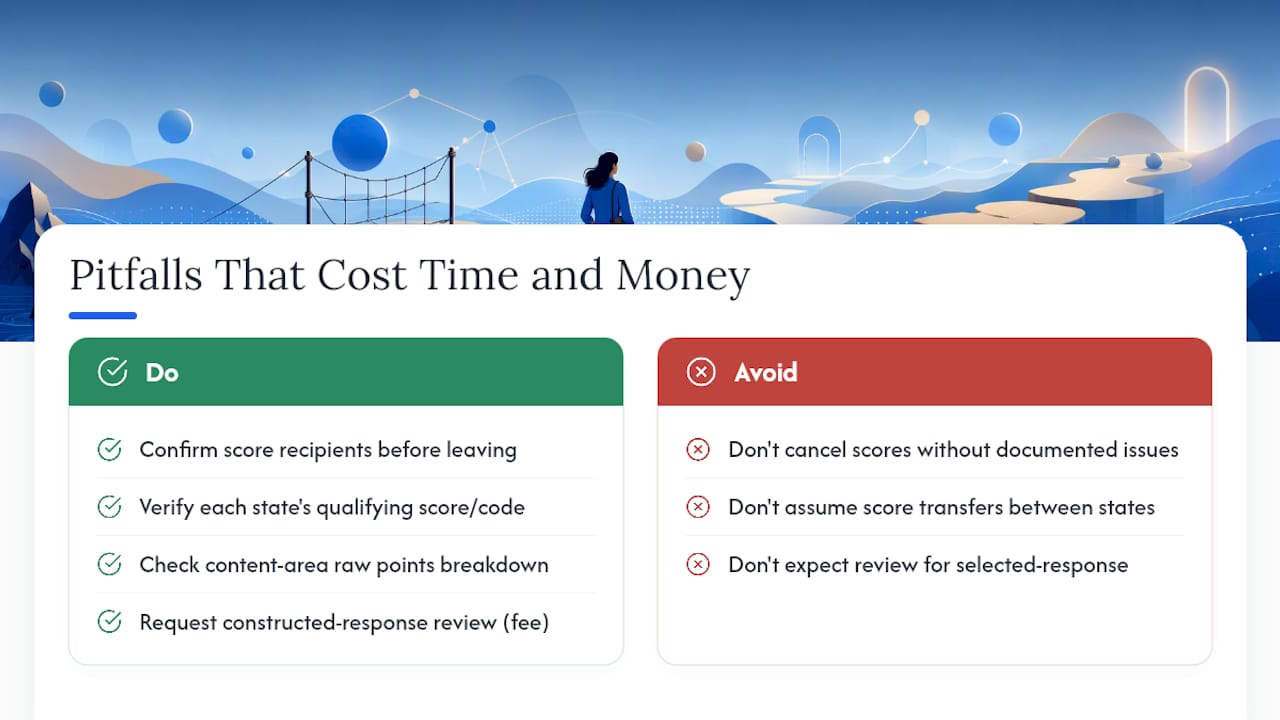
Score cancellation is permanent. At the end of some test sessions, you are offered the option to report or cancel your score before seeing it. If you cancel, the score is voided immediately and cannot be reinstated — and you forfeit the testing fee. ETS is explicit: cancellation should be reserved for documented testing irregularities, not used as a hedge against a score you fear was low. Once you see the unofficial score (on SR-only tests) or once the session ends, the decision is final.
A passing score in one state does not automatically transfer. Reciprocity between states is not guaranteed. Each state sets its own qualifying score, and some states require a specific test version or a minimum score that differs from where you originally tested. Verify the active qualifying score and required test code for every state where you seek licensure.
Misreading content-category raw points is a subtler problem. Many test takers look only at their total scaled score and miss the category breakdown. If you scored 14 out of 28 available raw points in one content area, that gap is far more diagnostic than your overall number. For constructed-response items, you can request a score review for a fee — but that option does not exist for selected-response questions.
Pro Tip: Before you leave the testing center, confirm that all intended score recipients are listed in your account. Adding recipients after the fact costs extra and delays delivery. Check the list the same day you test.
What to do if your score falls short of the qualifying threshold
Confirming your result and planning your next move takes less time than most candidates expect.
- Log into your Praxis account and verify the official scaled score on your score report page
- Download the official score report PDF and confirm that all designated recipients received it
- Check your state’s qualifying score one more time against your result — confirm you are reading the correct test code and any footnotes
- If your test included constructed-response items and your score is close to the threshold, consider requesting a score review (fee-based); selected-response items have no review option
- Pull up the content-category raw points on your report and identify the two or three categories with the largest gaps between points earned and points available
- Use those gaps to build a targeted study plan before scheduling a retake — free teacher certification practice tests can help you quickly diagnose which content areas need the most work
- Check your state’s retake policy; most states require a waiting period between attempts
- If you are far below the threshold, also review alternative licensure pathways your state may offer
Full-length simulated practice exams are particularly useful here. Testing under realistic conditions with content mapped to the same categories on your score report gives you a much cleaner read on whether you are ready to retake than reviewing notes alone.
Key Takeaways
Praxis scoring produces a scaled score in a range generally spanning from 100 to 200, which only means “passing” when it meets or exceeds the qualifying score set by your specific state or licensing agency — ETS produces the score, but states set the bar.
| Point | Details |
|---|---|
| Scaled score range | Praxis scores run 100–200; “passing” is defined by your state’s qualifying threshold, not a universal cutoff. |
| States set qualifying scores | ETS publishes the tables, but each state or licensing agency sets its own threshold — verify yours before assuming you passed. |
| Score posting cadence | Official scores post on Tuesdays and Fridays; use the Praxis score reporting calendar to find your estimated date. |
| Score cancellation is final | Canceling at the test center voids your score permanently and forfeits your fee — no reinstatement is possible. |
| Prepnovat for targeted prep | Prepnovat’s content-category practice questions and full-length mock exams map directly to the gaps shown on your score report. |
Why score reports deserve more attention than most educators give them
Most candidates check their total scaled score, feel relief or disappointment, and move on. That is the wrong read. The content-category breakdown on a Praxis score report is genuinely diagnostic data — the kind of information that, used correctly, can cut retake prep time significantly.
At Prepnovat, the approach to score-report-driven prep starts with that category breakdown. A candidate who earned 60% of available raw points in “Reading Informational Text” but 90% in “Language and Research Skills” should not study both categories equally. Prepnovat’s question bank, with over 10,100 practice questions and detailed rationales for every answer, is built to let you drill exactly the categories where your report shows the largest gaps. The 24/7 support means you are not waiting until Monday to get unstuck on a concept the night before your retake.
The SEM point from earlier matters here too. If your score is within a few points of the qualifying threshold, a well-targeted study plan focused on your weakest content categories is often more effective than a broad review of everything.
Prepnovat’s Praxis practice resources map directly to your score-report gaps
Knowing where you fell short is only useful if you have a way to close the gap before your retake. Prepnovat gives you full-length Praxis mock exams that replicate actual test conditions, content-category practice sets that align with the same breakdowns on your official score report, and answer rationales that explain the reasoning behind every correct answer — not just what the answer is.
The Praxis Core prep course at Prepnovat covers all three Core subtests with section-by-section breakdowns and progress tracking so you can see improvement in the specific categories your score report flagged. For educators who want to browse the full catalog of available Praxis-aligned modules, the Prepnovat courses page lists every available option. Start with your score report, identify your two weakest content categories, and build from there.
Useful sources for verifying Praxis rules and state requirements
These are the primary ETS and official sources to consult when checking your score, understanding how it was produced, or verifying what your state requires.
- Getting your Scores
- Passing Score Requirements | Praxis
- Praxis Teacher Certification Requirements by State | How to Get Certified
- Praxis Technical Manual
- Understanding Your Praxis Scores
- Understanding your scores (PDF)
- Sample score report (PDF) | ETS
After checking ETS sources, always verify current qualifying scores and test requirements directly with your state’s department of education or professional licensing board — state policies update, and ETS tables occasionally lag behind those changes.
Recommended
- Praxis Practice Test: Free Praxis Core & Subject Practice Questions – PrepNovat
- 10 Free Teacher Certification Practice Tests
- Comprehensive Test Prep & Simulated Practice Exams | PrepNovat
- Real Estate Exam Sample Questions With Answers and Study Tips – PrepNovat

Natalie
StudyVault Team