HESI vs TEAS: Which Nursing Entrance Exam Should You Take?

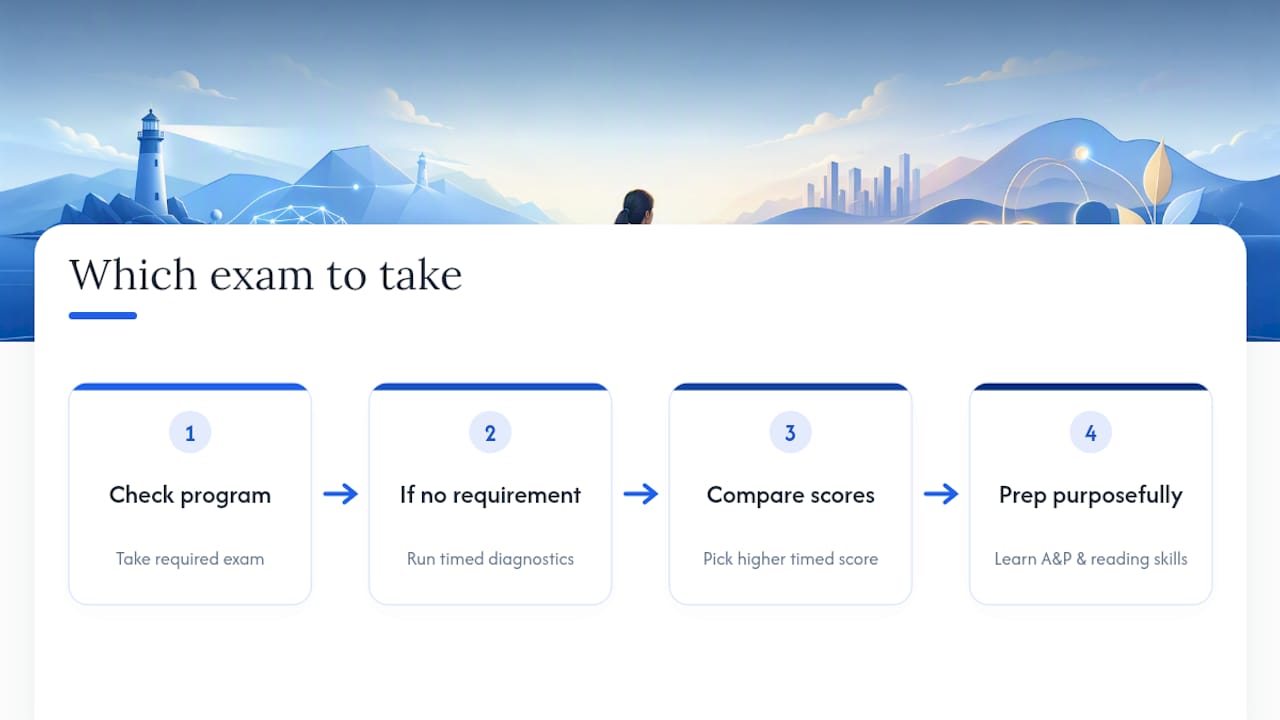
Take the exam your nursing program requires. That is the whole answer for most applicants. Schools almost always specify TEAS or HESI A2, and prepping for the wrong one is one of the most common time sinks in nursing admissions. Check your target program’s admissions page before you buy a single study guide.
If your program accepts either test, or you are applying to schools with different requirements, the choice comes down to format fit:
- TEAS (ATI TEAS Version 7): A nationally standardized test with a fixed structure, alternate item types, and remote proctoring options. Better if you prefer one consistent format across all your applications.
- HESI A2: Published by Elsevier, customizable by school. Some programs require only four sections; others require eight. Better if your target school’s required sections align with your strongest subjects.
Immediate next step: Pull up the admissions page for every program you are applying to. Note the required test, minimum composite score, any section-level cutoffs, and retake limits. Do that before anything else.
Pro Tip: If you are applying to five programs and four require TEAS, prep for TEAS first. Do not split your study time trying to cover both exams simultaneously.
Table of Contents
- How do HESI A2 and ATI TEAS Version 7 compare side by side?
- What is the HESI A2 and what should you expect?
- What is the ATI TEAS Version 7 and how does it work?
- Is one test objectively harder than the other?
- How do nursing programs actually use your scores?
- How to build an effective study plan for either exam
- Why realistic practice tests predict your actual score
- Key Takeaways
- The part most applicants get wrong about choosing between these exams
- Prepnovat gives you the practice reps that actually move your score
- Where to confirm official details and further reading
How do HESI A2 and ATI TEAS Version 7 compare side by side?
| Dimension | ATI TEAS Version 7 | HESI A2 |
|---|---|---|
| Publisher | ATI (Assessment Technologies Institute) | Elsevier (HESI) |
| Structure | Fixed nationally | Modular, customized by school |
| Sections | Reading, Math, Science, English & Language Usage | Reading, Vocabulary, Grammar, Math, Biology, A&P; Chemistry and Physics optional |
| Question count | 170 total (150 scored, 20 unscored) | Varies by school; typically 25–50 per section |
| Time limit | ~209 minutes total | Varies; roughly 25 minutes per section |
| Item types | Multiple-choice + alternate item types (multiple-select, supply answer, hot spot, ordered response) | Primarily multiple-choice |
| Scoring | Percentage (0–100%) with national performance tiers | Percentage or 0–1000 scale depending on school |
| Administration | National scheduling, remote proctoring available | Typically school-administered, in-person |
| Cost (typical) | Approximately $70–$100 | Varies by institution |
| Score validity | Commonly 2 years | Varies by school |
| Common programs | ADN, BSN, accelerated/selective programs | ADN, BSN, some LPN programs |
| Prep resources | Extensive (ATI official, third-party) | School-specific; official Elsevier materials |
What is the HESI A2 and what should you expect?
Elsevier publishes the HESI A2, and the most important thing to understand about it is that your school controls the format. Programs can require anywhere from four to eight sections, which means two students at different schools can take what is technically the same exam and face completely different tests.
Scoring and logistics
Scores are reported as percentages or on a 0–1000 scale, depending on the institution. Most programs set a minimum composite score, but many also set section-level cutoffs, particularly for A&P and Reading. A score that clears the composite minimum but misses a section cutoff can still disqualify your application.
Administration is almost always in-person at the school or a designated testing center. Cost varies by institution, so check directly with your program’s testing office.
Pro Tip: Before purchasing any HESI prep materials, confirm the exact sections your program requires. Buying a full eight-section prep course when your school only tests four sections wastes both money and study time.
What is the ATI TEAS Version 7 and how does it work?
ATI (Assessment Technologies Institute) publishes the TEAS, and unlike the HESI A2, the format is fixed. Every student takes the same four sections in the same order, which makes national score comparison possible and prep more straightforward.
Fixed sections and question counts
| Section | Scored Questions | Unscored Questions |
|---|---|---|
| Reading | 45 | 6 |
| Math | 38 | 4 |
| Science | 50 | 6 |
| English & Language Usage | 37 | 4 |
| Total | 170 | 20 |
The 20 unscored questions are embedded throughout and indistinguishable from scored ones. You cannot skip them, and they do not count toward your score.
Scoring and administration
Scores are reported as a percentage (0–100%) alongside national performance tiers: Below Basic, Basic, Proficient, Advanced, and Exemplary. Most programs look for Proficient or above, though selective BSN programs often set higher bars.
You can schedule the TEAS through ATI’s national testing network or, where available, take it via remote proctoring. The typical cost runs approximately $70–$100. ATI enforces a waiting period between retakes; check the current policy on ATI’s website since it can change.
Pro Tip: Download ATI’s free TEAS study manual excerpt and take one official practice test before committing to a full prep course. It gives you a realistic baseline and shows you exactly what the alternate item types feel like.
Is one test objectively harder than the other?
No. The “TEAS is easier” claim circulates constantly in nursing forums, and it is mostly wrong. Neither test is universally harder; your background, the sections your school requires, and how well you handle specific question formats determine which one feels more difficult.
A student with strong anatomy and physiology knowledge who struggles with timed reading passages may find HESI A2 more manageable. Someone who reads quickly and handles math well but has never seen a hot-spot question might find TEAS Version 7 more disorienting on test day.
How TEAS scoring can amplify mistakes
TEAS uses a difficulty-weighted, equated scoring method. Harder questions carry more weight, so missing a cluster of difficult items can drop your percentage score more than you would expect from a simple right-or-wrong count. That scoring behavior makes pacing and question-type familiarity more consequential than on a straightforward percentage test.
Why HESI’s structure can cut both ways
HESI’s higher per-section question counts give you more room to recover from a few wrong answers within a section. But if your school requires six or eight sections, the total content coverage is broad. Students who underestimate the vocabulary and grammar sections often lose points there that they cannot recover elsewhere.
Pro Tip: Take a timed, full-length practice test for each format before you commit to one. Score volatility under timed conditions tells you more about your actual risk than any forum comparison.
How do nursing programs actually use your scores?
Programs use entrance exam scores as early predictors of in-program success, which is why many treat them seriously even before you set foot in a classroom. The way they apply those scores varies more than most applicants realize.
A practical checklist before you schedule your exam
- Confirm the exact test and version your program accepts.
- Note the composite minimum and any section cutoffs.
- Check the score validity window against your application timeline.
- Find the retake policy for both ATI and your specific school.
- Verify whether your school accepts remote-proctored scores or requires in-person testing.
How to build an effective study plan for either exam
The structure of a good prep plan is the same regardless of which test you are taking: start with a diagnostic, build a timed weekly schedule, and run full-length mocks in the final stretch.
Resource checklist
- TEAS vs HESI A2: Which Exam Does Your School Require? | Nurse.Org
- What are the differences between the ATI TEAS 6 and the ATI TEAS Version 7 exam? | ATI
- HESI vs. TEAS: Comparing Two Common Nursing School Entrance Exams | EduMed
- HESI Vs. TEAS Exam: The Differences Explained | NurseJournal.org
- TEAS vs HESI A2: Which Test Is Right for You? | Westcliff University
- HESI Exam Solutions — Nursing | Elsevier
Pro Tip: Keep an error log. After each practice session, write down the question type, the topic, and why you missed it. After two weeks, patterns emerge. Those patterns become your next week’s drill list.
Why realistic practice tests predict your actual score
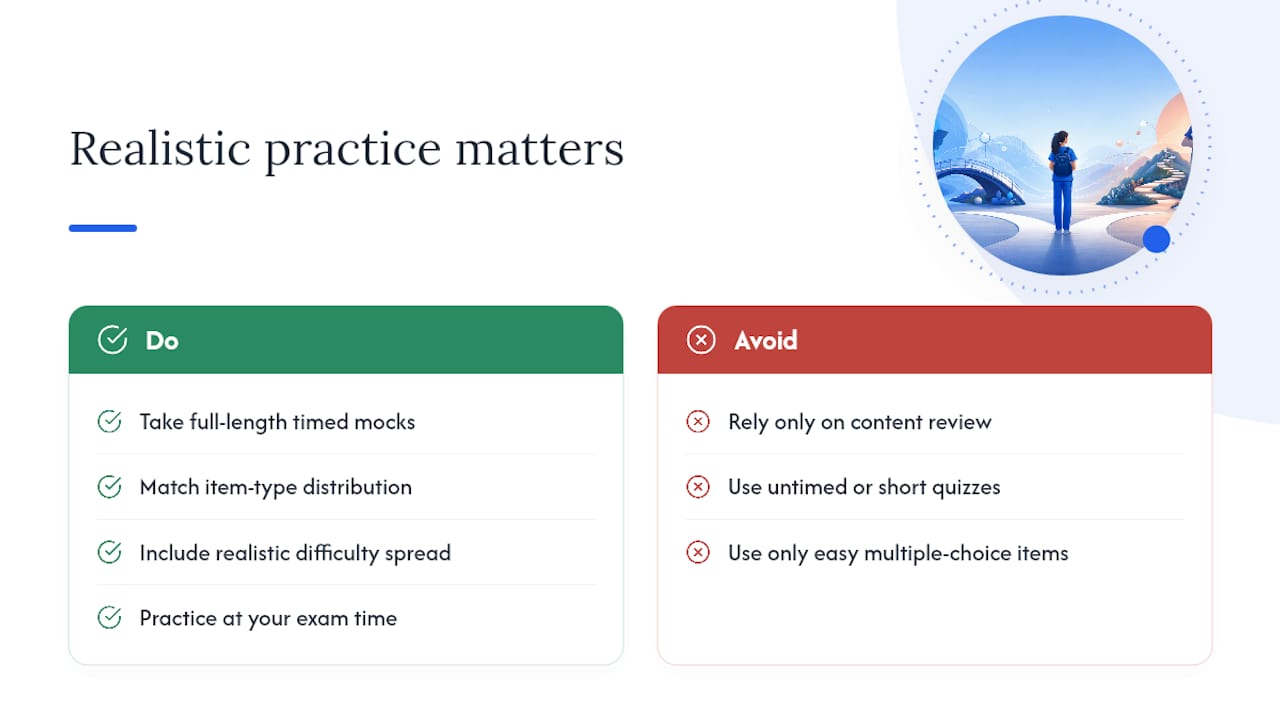
The relationship between practice test performance and test-day results is well established in standardized testing research. What matters is not just how many questions you answer but how closely the practice conditions match the real exam.
For TEAS specifically, the alternate item types introduced in Version 7 change the test experience in ways that content review alone cannot prepare you for. A student who has read every chapter of a TEAS prep book but never clicked through a hot-spot question under a countdown timer will likely lose time and composure on those items. Familiarity with the format reduces that effect.
TEAS’s difficulty-weighted scoring adds another layer. Because harder questions carry more weight, a practice test that only includes easy multiple-choice items will overestimate your readiness. Realistic mocks, with the same item-type distribution and difficulty spread as the real exam, give you a more accurate picture of where your score actually sits.
Statistic: The ATI TEAS Version 7 includes 170 questions across four sections with approximately 209 minutes of total testing time — timed practice is non-negotiable.
Pro Tip: In the two weeks before your test date, take at least two full-length, proctored-style mocks at the same time of day as your scheduled exam. Your brain performs differently at 8 AM versus 2 PM, and you want that calibration before it counts.
Key Takeaways
The single most important action you can take right now is to check your program’s admissions page and confirm which test is required before spending a dollar on prep materials.
| Point | Details |
|---|---|
| Check your program first | Most programs specify TEAS or HESI A2; confirm the required test, version, and cutoffs before prepping. |
| TEAS is fixed; HESI is modular | ATI TEAS Version 7 has a standardized national format; HESI A2 sections vary by school, affecting total time and content. |
| Difficulty is personal | Neither exam is universally harder; your subject strengths and comfort with question formats determine which feels more manageable. |
| Timed mocks are non-negotiable | Full-length, timed practice tests with rationales predict real scores better than content review alone, especially for TEAS alternate item types. |
| Prepnovat for targeted prep | Prepnovat’s TEAS practice question bank includes over 10,100 questions, full-length mocks, and detailed rationales designed to mirror the real exam format. |
The part most applicants get wrong about choosing between these exams
There is a version of this decision that nursing applicants overthink badly. They spend hours reading forum threads comparing HESI and TEAS difficulty, trying to figure out which one they can “beat,” when the real question is much simpler: which one does your program require?
The difficulty debate is not useless, but it is secondary. What actually matters is that entrance exam scores are used as early signals of how you will perform in the program itself. Admissions committees are not just gatekeeping; they are trying to predict who will make it through the first year. That reframes the whole exercise. You are not trying to find the easier test. You are trying to demonstrate that you are ready for nursing school.
The students who do best are the ones who treat exam prep as the first chapter of their nursing education, not a box to check. They learn the A&P content because it shows up again in pharmacology. They practice reading comprehension because clinical documentation requires it. The test is a preview, not a hurdle.
One practical note: if you genuinely have a choice, do not default to TEAS just because it is more widely discussed online. Run a diagnostic on both formats. The test where you score higher under timed conditions is the test you should take, full stop. Forum consensus is not your transcript.
Prepnovat gives you the practice reps that actually move your score
Most nursing applicants underestimate how much format familiarity matters on test day. Reading a content review book covers the material; it does not prepare you for a hot-spot question with a 74-second average clock ticking. That gap is exactly what Prepnovat closes.
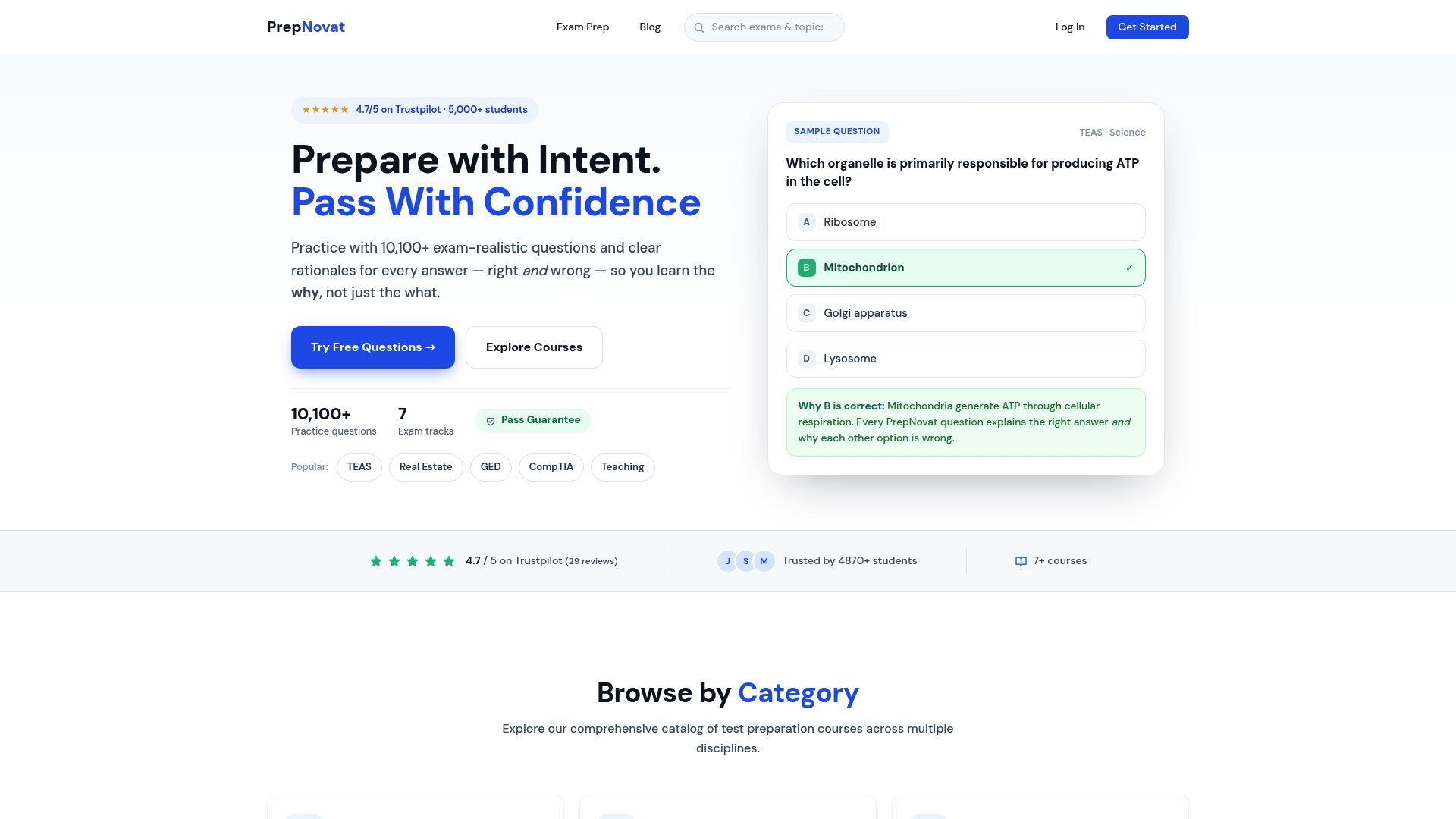
Prepnovat’s nursing exam prep course gives you over 10,100 realistic practice questions built to mirror the actual TEAS Version 7 format, including alternate item types. Every question comes with a detailed rationale so you understand why the correct answer is right, not just what it is. Full-length timed mocks, section-by-section progress tracking, and 24/7 support mean you can run a complete, structured prep schedule without piecing together resources from five different places.
The pass guarantee is not marketing language. It reflects what happens when students use realistic, rationale-driven practice consistently. If you are ready to stop reading about the exam and start scoring well on it, start your prep at Prepnovat today.
Where to confirm official details and further reading
Before you schedule your exam or purchase prep materials, verify everything against primary sources. Policies, accepted versions, and cutoffs change more often than third-party guides update.
- ATI Testing: The authoritative source for TEAS Version 7 structure, item types, scoring methodology, retake policies, and scheduling. If you read one thing about TEAS format, read it here.
- Elsevier HESI: Official vendor page for HESI A2 exam solutions, prep materials, and institutional guidance. Use this to confirm what official HESI prep looks like versus third-party alternatives.
- Nurse.org TEAS vs HESI overview: A useful secondary reference for understanding how schools typically apply each exam and what applicants commonly overlook.
- NurseJournal.org HESI vs TEAS breakdown: Covers question counts, timing, and scoring details in a format useful for side-by-side comparison.
This article provides general information about nursing entrance exams. Requirements, cutoffs, and policies vary by program and change over time. Confirm all details directly with your target school’s admissions office and the official ATI or Elsevier vendor pages before making decisions.
Recommended
- ATI TEAS Exam Prep 2026 | Practice Tests & Study Guide | PrepNovat – PrepNovat
- How to Pass the ATI TEAS 7: Study Guide for Nursing Applicants
- ATI TEAS Study Guide 2026: Pass with Confidence
- TEAS Exam Science Questions: What to Expect And Where to Find Help

Natalie
StudyVault Team