Real Estate Exam Sample Questions With Answers and Study Tips

Real estate exam sample questions with answers, study tips, and prep strategies. Pass your CA or national real estate exam with confidence.
Nearly half of all first-time test takers walk out of the real estate exam without a passing score, and the reason usually isn’t lack of intelligence. The difference between those who pass and those who don’t comes down to one thing: how they prepared. Understanding what questions are on the real estate exam and practicing with real estate exam sample questions can turn that statistic in your favor, which is exactly why platforms like Prep Novat focus on giving you access to thousands of practice questions with detailed explanations for every answer.
Table of Contents
- Understanding the Real Estate Exam Format
- Sample Questions That Actually Appear on Real Estate Exams
- Proven Study Strategies for Real Estate Exam Success
- How Practice Tests Transform Your Exam Performance
- Common Mistakes That Cost Students Their Passing Score
- Your Path to Passing Starts With the Right Preparation
- Real Estate Exam Questions Answered
Understanding the Real Estate Exam Format
About 60% of people who take the real estate exam fail on their first try, and one big reason is they don’t know what to expect when they sit down for the test. The real estate licensing exam isn’t just one test but actually two separate exams you need to pass on the same day. Understanding how these tests work and what they cover can make the difference between walking out with a passing score or having to schedule a retake.
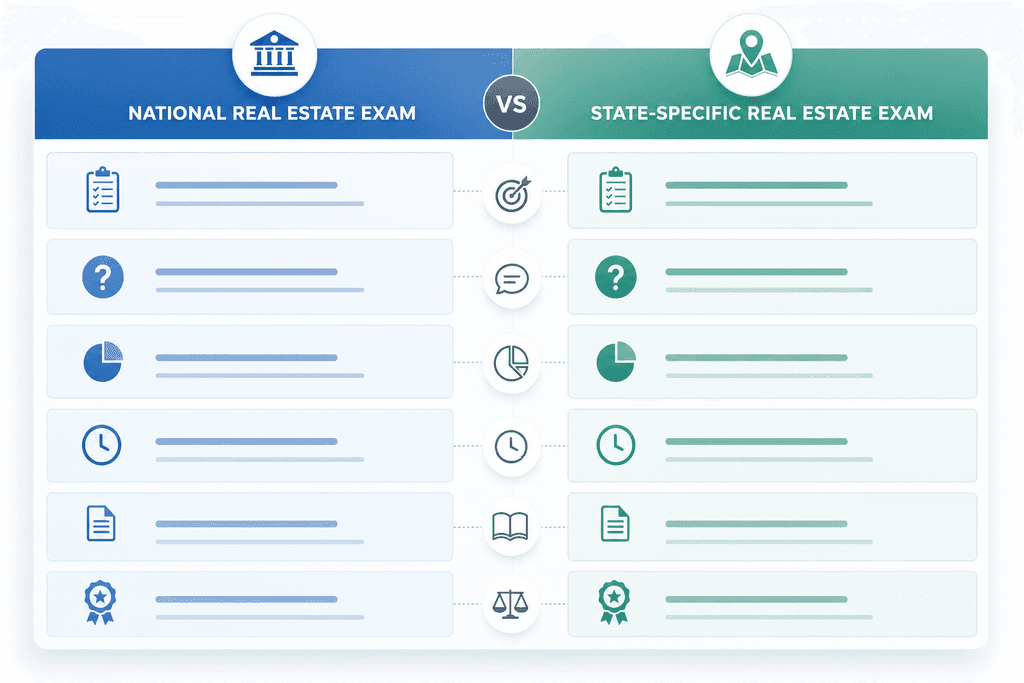
National Exam vs State Exam
When you take your real estate licensing exam, you’re actually taking two tests back to back. The national portion tests your knowledge of general real estate principles that apply everywhere in the United States. The state-specific portion focuses on the laws and regulations unique to where you want to practice.
Most states use exams created by testing companies like PSI or Pearson VUE. These companies design the national real estate exam questions to cover topics that matter no matter where you sell houses. The state exam questions and answers focus on local rules about contracts, disclosures, and agency relationships.
| Exam Component | Number of Questions | Time Allowed | Passing Score |
|---|---|---|---|
| National Portion | 80-100 questions | 2-2.5 hours | 70-75% |
| State Portion | 30-50 questions | 1-1.5 hours | 70-75% |
What the Exams Actually Test
The national real estate exam questions and answers cover seven main content areas. Property ownership and land use makes up the biggest chunk, followed by contracts and financing. You’ll also see questions about property valuation, transfer of title, practice of real estate, and legal issues.
- Property ownership and land use concepts (15-20% of questions)
- Laws of agency and fiduciary duties (15-20% of questions)
- Property valuation and market analysis (10-15% of questions)
- Financing and settlement procedures (15-20% of questions)
- Contracts and relationships (20-25% of questions)
State exams dig into local specifics. They test you on state-specific disclosure requirements, local fair housing laws, and how real estate transactions work in your state. Some states like California have longer state portions because they have more regulations to cover.
California and Other State Differences
California’s real estate exam stands out because it’s one of the toughest in the country. The CA real estate exam sample questions tend to be more detailed and the state portion is longer than most other states. California requires 150 questions total while many states only require 100-130 questions combined.
| State | Total Questions | Total Time | Pass Rate |
|---|---|---|---|
| California | 150 | 3.5 hours | 45-50% |
| Texas | 125 | 4 hours | 55-60% |
| Florida | 100 | 3.5 hours | 50-55% |
| New York | 75 | 1.5 hours | 65-70% |
The good news is that most exams are multiple choice with four answer options. You need to pass both the national and state portions to get your license. If you pass one but fail the other, you only retake the section you failed. Prep Novat offers real estate exam free practice test options that mirror the actual exam format, so you can practice with real estate exam sample questions before test day.
- All questions are multiple choice format
- You must pass both portions to get licensed
- Failed sections can be retaken separately
- Most states allow calculators for math problems
Sample Questions That Actually Appear on Real Estate Exams
About 60% of people who take the real estate exam fail on their first try, and most of them say they weren’t prepared for the actual question types. The real estate exam isn’t just about memorizing definitions. It tests your ability to apply concepts to real situations, calculate numbers under pressure, and understand the legal side of property transactions. When you know what kinds of questions to expect, you can study smarter instead of just harder.
Property ownership questions make up a big chunk of the exam. You’ll see scenarios about different types of ownership like joint tenancy, tenancy in common, and community property. The tricky part is that wrong answers often sound almost right.
Sample Question: A married couple owns property as joint tenants. If one spouse dies, what happens to their share of the property?
A) It goes to their heirs according to their will
B) It automatically transfers to the surviving spouse
C) It becomes part of the estate and goes through probate
D) The state takes ownership
Correct Answer: B. Joint tenancy includes the right of survivorship, meaning the property automatically goes to the surviving owner. This is why understanding the rationale matters more than just memorizing terms.
Contract and agency questions test whether you understand the relationships between buyers, sellers, and agents. These questions often involve scenarios where you need to identify who owes what duty to whom.
- Questions about dual agency and disclosure requirements
- Scenarios involving breach of contract and remedies
- Fiduciary duties like loyalty, confidentiality, and disclosure
- Difference between express and implied agency
The financing and mortgage calculations section trips up a lot of test-takers. You’ll need to calculate loan-to-value ratios, monthly payments, and prorations. The math isn’t super complex, but you need to know which formula to use when.
Sample Question: A property is valued at $300,000 and the buyer is getting a loan for $240,000. What is the loan-to-value ratio?
A) 60%
B) 75%
C) 80%
D) 85%
Correct Answer: C. Divide the loan amount ($240,000) by the property value ($300,000) to get 0.80 or 80%. Knowing why the other answers are wrong helps you avoid calculation errors on test day.
Fair housing and regulations questions are critical because discrimination laws are taken seriously in real estate. You’ll see questions about protected classes, exemptions, and what constitutes illegal steering or blockbusting. These aren’t just theoretical either. The exam uses real-world scenarios to test if you’d handle situations correctly.
Here’s what most people miss though. Memorizing the right answers to practice questions won’t help much if you don’t understand why the wrong answers are wrong. When you see a detailed explanation that breaks down each option, you’re actually learning the concept instead of just pattern-matching. That’s the difference between passing and failing when the exam throws you a question worded slightly differently than what you studied.
Proven Study Strategies for Real Estate Exam Success
Most people approach real estate exam prep the wrong way. They read through their course materials once or twice, highlight everything, and hope it sticks. Then test day comes and their mind goes blank. The problem isn’t that they didn’t study enough hours. It’s that they used study methods that feel productive but don’t actually work.

Creating a realistic study schedule starts with being honest about your timeline. If you have two months before your exam, that’s different from having two weeks. Break your study time into focused sessions instead of marathon cramming.
- Figure out how many weeks you have until test day
- List all the topics you need to cover
- Assign specific topics to specific days
- Build in review days every week
- Leave the last week for practice tests only
The difference between active recall and passive reading is huge. Passive reading is when you go through your notes or textbook and everything makes sense in the moment. Active recall is when you close the book and try to explain the concept out loud or write it down from memory. It feels harder because it is harder, but that struggle is what makes the information stick.
You need to identify your weak areas early and spend more time there. Most people do the opposite. They keep reviewing what they already know because it feels good to get questions right. But your score improves when you fix your weaknesses, not when you polish your strengths.
- Take a diagnostic practice test in week one
- Track which categories you score lowest in
- Spend 60% of your study time on weak areas
- Spend 40% on review and practice tests
The spacing effect is backed by decades of research. Your brain remembers information better when you review it multiple times over several days instead of all at once. Cramming the night before might work for a high school quiz, but the real estate exam covers too much material. When you space out your study sessions, you’re working with your brain’s natural learning process instead of against it.
Using practice tests strategically means more than just taking them at the end. Start with a baseline test to see where you stand. Then use shorter quizzes on specific topics as you study each section. Save full-length practice exams for the final two weeks. This approach from our real estate test study guide helps you build confidence gradually instead of getting overwhelmed.
How Practice Tests Transform Your Exam Performance
There’s actual science behind why practice tests work better than re-reading your notes. When you retrieve information from memory, you strengthen the neural pathways that store that information. It’s like the difference between watching someone else lift weights and lifting them yourself. Reading feels easier, but testing yourself builds the mental muscle you need on exam day.
Practice tests are more effective than re-reading because they force your brain to work. Studies show that students who test themselves remember about 50% more information long-term compared to students who just review their materials. The act of trying to remember something makes that memory stronger, even when you get the answer wrong at first.
| Study Method | Retention Rate |
|---|---|
| Re-reading notes | 30-40% |
| Practice testing | 60-70% |
| Spaced practice tests | 75-85% |
To simulate real exam conditions at home, you need to recreate the pressure and environment. Set a timer for the actual exam length. Sit at a desk with no distractions. Don’t look up answers or take breaks. This might sound extreme, but test anxiety is real, and the only way to reduce it is by getting comfortable with the testing experience itself.
Detailed answer explanations are where the real learning happens. When you get a question wrong, you need to know why. But even when you get one right, understanding why the other options were incorrect helps you spot similar traps on the actual exam. Prep Novat provides explanations for every answer choice, not just the correct one, which helps you learn the concepts deeply instead of just memorizing patterns.
- Read explanations for questions you got right too
- Write down why you chose wrong answers
- Look for patterns in your mistakes
- Review explanations before moving to new topics
Tracking your progress shows you whether your study plan is working. Keep a simple spreadsheet or notebook with your practice test scores by category. If your contracts score isn’t improving after a week of study, you need to change your approach for that topic. The data tells you where to focus your limited study time.
When it comes to free practice tests versus comprehensive platforms, you get what you pay for. Free resources like this practice exam or this question bank can give you a taste of what to expect. But they usually don’t explain wrong answers or track your weak areas. A platform like Prep Novat offers over 10,100 practice questions with detailed rationales for every answer choice, plus 24/7 support when you get stuck on a concept. That level of depth makes the difference between barely passing and passing confidently.
The real estate exam tests whether you can apply knowledge under pressure, not just whether you read the textbook. Practice questions prepare you for that reality in a way that passive studying never will. Check out our real estate license prep course to see how structured practice with detailed explanations can change your approach to studying.
Common Mistakes That Cost Students Their Passing Score
About 40% of first-time test takers fail their real estate exam, and the reasons are surprisingly predictable. Most students don’t fail because the material is too hard. They fail because they prepare the wrong way. Understanding these common pitfalls can mean the difference between passing on your first try and having to retake the exam. The mistakes happen during both the study phase and on test day itself, but the good news is that every single one of them can be avoided with the right approach.
The Memorization Trap
Cramming definitions and terms might work for some tests, but not for real estate exam questions and answers. The exam tests whether you can apply concepts to real situations, not just recite facts. When you only memorize, you’ll struggle with scenario-based questions that require actual understanding.
- Students who memorize can’t adapt when questions are worded differently
- Real-world scenarios on the exam require connecting multiple concepts together
- Understanding the “why” behind rules helps you remember them naturally
- Prep Novat provides detailed rationales that explain concepts instead of just listing correct answers
Ignoring State-Specific Requirements
National real estate exam questions cover federal laws and general principles, but your state portion can make or break your score. Many students spend all their time on national content and barely glance at state-specific regulations. This is especially critical for ca real estate exam sample questions and other state exams that have unique disclosure requirements or contract laws.
| Study Approach | Pass Rate Impact | Time Investment |
|---|---|---|
| National focus only | Lower by 25% | Wasted effort |
| Balanced national and state | Optimal results | Strategic distribution |
| State-specific emphasis | Strong state score | Targeted preparation |
Poor Exam Day Time Management
You might know every answer, but if you run out of time, it doesn’t matter. Students often spend too long on difficult questions early in the exam and then rush through easier ones at the end. The average real estate exam allows about 90 seconds per question, but some questions take 30 seconds while others need three minutes.
- Skip tough questions and return to them later with fresh eyes
- Math problems typically need more time than definition questions
- Practice with timed real estate exam free practice tests to build pacing skills
Not Learning From Mistakes
Taking practice tests is great, but most students just check their score and move on. The real learning happens when you review why you got questions wrong. This is where understanding how to study for real estate exam material really matters.
- Review every incorrect answer, not just the ones you barely missed
- Identify patterns in the types of questions you struggle with
- Understanding why wrong answers are incorrect prevents similar mistakes
- Our platform at Prep Novat explains both correct answers and why other options don’t work
Effective vs Ineffective Study Approaches
The difference between passing and failing often comes down to study methods. Some approaches feel productive but don’t actually prepare you for real estate exam test prep success. Others might seem harder but deliver much better results when it counts.
| Ineffective Approach | Why It Fails | Effective Alternative |
|---|---|---|
| Reading textbooks cover to cover | Passive learning, poor retention | Active practice with sample questions |
| Studying the same material repeatedly | False confidence, no weak spot improvement | Focus on areas where you score lowest |
| Cramming the week before | Information doesn’t stick long-term | Consistent study over several weeks |
| Only using free scattered resources | Incomplete coverage, no structure | Comprehensive question banks with rationales |
Underestimating Math Questions
Math problems make up about 10-15% of most real estate exams, but they cause anxiety for way more students than that. The calculations aren’t complex, but they require precision and understanding of real estate formulas. Many test takers skip practicing these questions because they’re uncomfortable with numbers.
Commission splits, prorations, and loan calculations appear on nearly every exam. Missing these questions is like throwing away easy points because the math itself is straightforward once you know the formulas. When learning how to prepare for real estate exam math sections, focus on understanding when to use each formula rather than just memorizing them.
- Practice the same formula types until they become automatic
- Write out your work even on scratch paper to avoid careless errors
- Double-check your decimal placement on percentage problems
- Know which formulas your state allows you to reference during the exam
Your Path to Passing Starts With the Right Preparation
Getting ready for the real estate exam doesn’t have to feel overwhelming if you break it down into manageable steps. The key things to remember are starting early, using quality practice questions, and making sure you understand why answers are right or wrong. Most people who fail their real estate exam do so because they memorized facts without really understanding the concepts behind them.
Practice questions are your best friend when studying for any real estate exam, whether it’s the national real estate exam or state-specific tests. But not all practice tests are created equal. You need questions that come with detailed explanations that break down each answer choice. That’s where platforms like Prep Novat’s real estate license prep come in, offering over 10,100 practice questions with rationales that explain both correct and incorrect answers.
The strategies we covered about active studying, spaced repetition, and focusing on your weak areas will only work if you put them into practice consistently. Cramming the night before might have worked in high school, but real estate exams test your ability to apply knowledge in real situations. Check out our real estate test study guide for more detailed preparation strategies.
Remember that understanding the material deeply matters more than memorizing thousands of facts. When you know why something is the correct answer, you can figure out similar questions even if they’re worded differently. For more resources on exam preparation across different fields, browse our exam success strategies section.
Now let’s address some common questions people have when preparing for their real estate exam.
Real Estate Exam Questions Answered
Getting ready for your real estate exam means dealing with a lot of unknowns, and that uncertainty can make studying harder than it needs to be. Most students have the same questions about what to expect on test day, how long they should prepare, and whether their study methods will actually work. These answers will help you understand exactly what you’re up against and how to prepare the right way.
How many questions are on the real estate exam?
The number varies by state, but most real estate exams have between 100 and 150 questions total. The national portion typically includes 80-100 questions, while the state-specific section adds another 30-50 questions. You’ll usually have 3-4 hours to complete the entire exam, which gives you plenty of time if you’ve prepared properly.
What is the passing score for the real estate exam?
Most states require a score of 70% or higher to pass, though some states set the bar at 75%. You need to pass both the national and state portions separately, so scoring well on one section won’t make up for failing the other. Check your specific state requirements since they can differ slightly.
How long should I study for the real estate exam?
Plan on studying for 6-8 weeks if you’re putting in consistent effort each day. Some people pass with less time, but rushing through the material usually backfires. The key is regular practice with real estate exam sample questions rather than cramming everything the week before your test date.
Are free practice tests enough to pass?
Free practice tests can help you get started, but they usually don’t provide the depth you need to actually pass. Most real estate exam free practice test options lack detailed explanations for wrong answers, which means you’re not learning from your mistakes. Prep Novat offers over 10,100 practice questions with detailed rationales that explain both correct and incorrect answers, helping you understand the material instead of just memorizing it.
What topics are most heavily tested?
Property ownership and land use concepts make up about 15-20% of most exams, followed closely by contracts and agency relationships. You’ll also see heavy emphasis on financing, property valuation, and federal laws like fair housing. The national real estate exam questions focus more on general principles, while state sections test local laws and regulations.
Can I use a calculator on the real estate exam?
Yes, testing centers provide a basic calculator for the math questions you’ll encounter. You can’t bring your own calculator, but the one provided handles all the calculations you’ll need for commission splits, prorations, and area measurements. Practice doing real estate math problems so the calculations become second nature before test day.

Natalie
StudyVault Team