TEAS Exam Science Questions: What to Expect
TEAS Exam Science Questions: What to Expect
If you’re searching for clear, realistic guidance on TEAS exam science questions, you’re probably trying to answer three big questions fast: What’s actually on the test, what do the questions look like, and how should I study so I can score well the first time?
The good news: the science section is absolutely manageable when you prepare the right way. The challenge is that many students study too broadly, memorize disconnected facts, or rely on weak question banks that don’t feel like the real exam. What works better is targeted practice, strong content review, and repeated exposure to exam-style questions under timed conditions.
At PrepNovat, we’ve seen that students improve fastest when they combine exam-realistic practice, full-length timed tests, and detailed answer rationales that explain both right and wrong choices. That’s why our platform gives learners access to 10,100+ practice questions, adaptive online prep, professor-crafted content, 24/7 support, and a pass guarantee designed to turn uncertainty into confident action.
What the TEAS Science Section Actually Covers
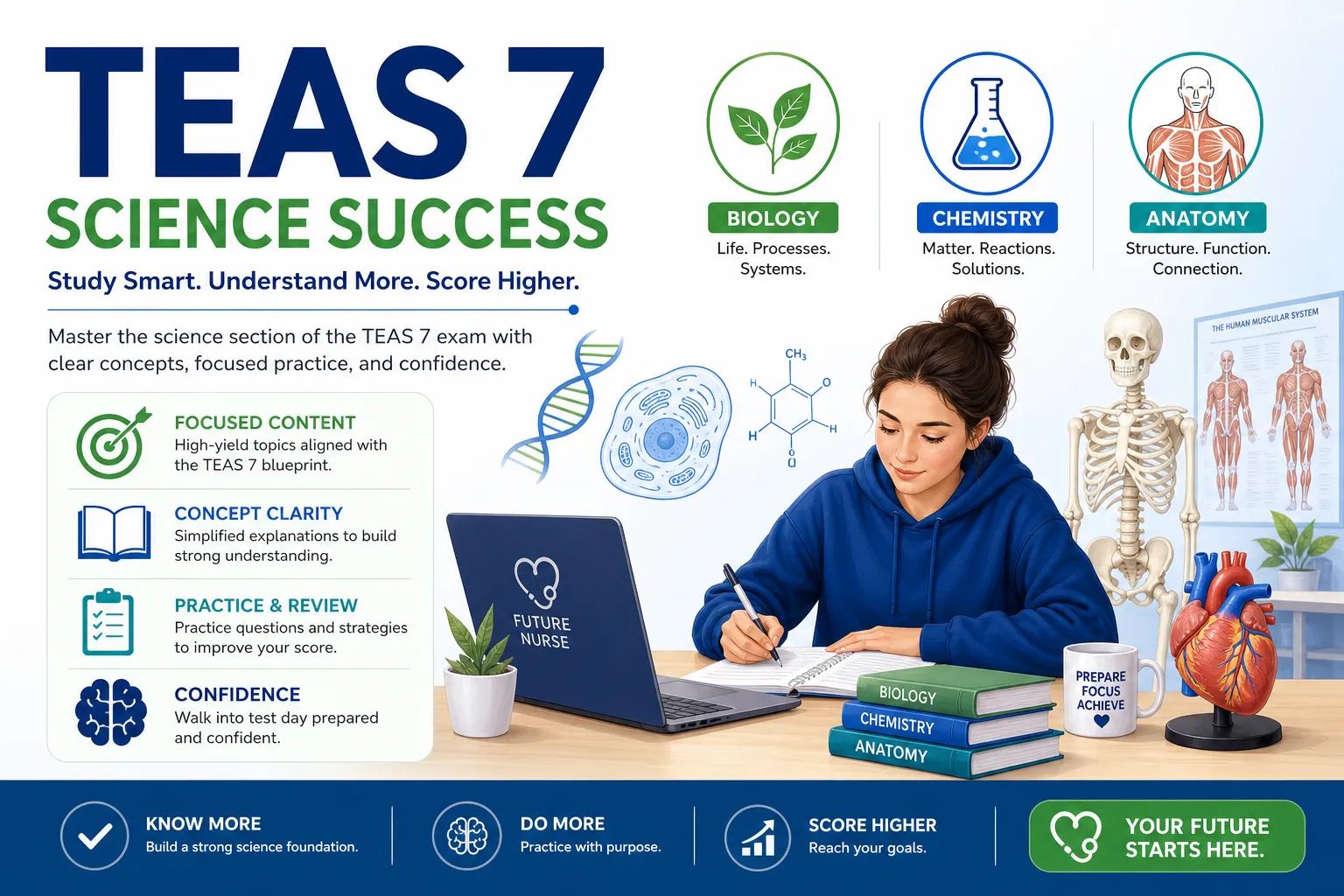
The TEAS science test is designed to measure whether you understand the foundational science concepts needed for nursing and allied health study. It is not just a memorization test. Many items ask you to identify structures, connect processes, interpret basic scientific relationships, or apply what you know in a new way.
“The ATI TEAS Version 7 exam’s science section comprises 50 questions to be completed in 60 minutes.” – ATI Testing
That means pacing matters almost as much as content knowledge.
TEAS Science at a Glance
| Category | What to Expect |
|---|---|
| Total questions | 50 |
| Scored questions | 44 |
| Unscored pretest questions | 6 |
| Time limit | 60 minutes |
| Main content areas | Anatomy & Physiology, Biology, Chemistry, Scientific Reasoning |
| Common formats | Multiple choice, multiple select, fill-in-the-blank, ordered response, hotspot |
A lot of students focus only on anatomy and physiology because it feels the most “nursing-related.” That’s important, but it’s also a mistake. Strong teas science practice questions should expose you to all four domains consistently.
The 4 Science Areas You Should Expect to See Most Often
Competitor pages usually mention the content categories, but often stop short of showing what they feel like in practice. Here’s the practical breakdown.
1. Human Anatomy and Physiology
This is usually the biggest source of anxiety, and for good reason. Questions often test your understanding of body systems, organ functions, homeostasis, and system interactions.
Expect topics like:
- Cardiovascular system
- Respiratory system
- Digestive system
- Nervous system
- Endocrine system
- Reproductive system
- Immune and lymphatic systems
- Skeletal and muscular systems
- Urinary system
- Integumentary system
What makes these teas science questions tricky is that they often go beyond naming parts. You may need to identify function, sequence, regulation, or cause-and-effect relationships.
2. Biology
Biology questions tend to center on cellular structure, genetics, heredity, biomolecules, reproduction, microorganisms, and protein synthesis.
Common question angles include:
- DNA vs. RNA
- Mitosis vs. meiosis
- Mendelian inheritance
- Macromolecules
- Cell organelles and transport
- Microorganisms and disease
These items reward understanding over memorization. If you know why a process happens, you’ll handle unfamiliar wording much better.
3. Chemistry
Chemistry on the TEAS is foundational, not advanced, but students often lose points here because they haven’t practiced enough.
You may see:
- Atomic structure
- Chemical bonds
- Chemical reactions
- States of matter
- Physical vs. chemical change
- pH, acids, and bases
- Solutions and concentration
- Periodic table trends
A good teas science practice exam should help you recognize patterns quickly instead of re-learning chemistry from scratch on test day.
4. Scientific Reasoning
This category is easy to underestimate. These questions may involve:
- Basic lab tools
- Scientific measurements
- Interpreting simple data
- Evaluating evidence
- Understanding variables and procedures
This section often rewards careful reading. Students who rush can miss easy points.
What TEAS Exam Science Questions Look Like
Knowing content is one thing. Recognizing the style of teas test questions is another.
Here are the most common ways the science section tests you:
Recall Questions
These ask for a direct concept, definition, structure, or function.
Example: Which organelle is primarily responsible for producing ATP?
These are the fastest questions to answer if you’ve reviewed core facts well.
Application Questions
These ask you to use knowledge in context.
Example: If insulin secretion decreases, what effect would most likely occur in the bloodstream?
These are more realistic and often more important than pure recall.
Comparison Questions
These ask you to distinguish between similar concepts.
Example: Which statement correctly compares mitosis and meiosis?
These can be tricky because every answer choice sounds partly familiar.
Sequence or Process Questions
These test whether you understand order and progression.
Example: Place the phases of mitosis in the correct order.
Multi-Select Questions
These require you to identify all correct choices, not just one.
Example: Which structures are part of the endocrine system? Select all that apply.
These can be high-risk if you guess carelessly.
10 Realistic Sample TEAS Science Question Types
One major content gap in many competitor articles is that they provide only a few examples. Students benefit more from a broader picture of the types of teas exam sample questions they are likely to face. Below are 10 realistic examples based on common TEAS science patterns.
1. Anatomy Function Question
Question: Which structure is primarily responsible for filtering blood and forming urine?
Answer: The kidneys
This tests organ function, not just anatomy labels.
2. Endocrine Regulation Question
Question: Which hormone lowers blood glucose levels?
Answer: Insulin
A classic TEAS pattern: hormone plus physiological effect.
3. Cell Structure Question
Question: Which organelle packages and modifies proteins before transport?
Answer: Golgi apparatus
Cell organelle questions show up often in teas science test practice materials.
4. Genetics Question
Question: Which nucleic acid contains uracil instead of thymine?
Answer: RNA
Students often confuse DNA and RNA unless they practice comparison questions repeatedly.
5. Inheritance Question
Question: If two heterozygous parents cross for a recessive trait, what is the probability of an affected child?
Answer: 25%
This is a common Punnett square setup.
6. Chemistry Reaction Question
Question: What type of reaction occurs when one element replaces another in a compound?
Answer: Single replacement reaction
This is a frequent format in teas exam questions and chemistry review sets.
7. pH Question
Question: A solution with a pH of 3 is best described as what?
Answer: Acidic
You don’t need advanced chemistry, but you do need strong fundamentals.
8. Scientific Method Question
Question: In an experiment, what is the variable being measured called?
Answer: Dependent variable
Scientific reasoning questions often test terminology in practical context.
9. Homeostasis Question
Question: What body process helps maintain stable internal conditions?
Answer: Homeostasis
This concept connects many body systems and appears often in teas science test questions.
10. Microbiology Question
Question: Which type of microorganism requires a host cell to reproduce?
Answer: Virus
Expect disease and microorganism items to appear in biology-related question sets.
Why Students Miss TEAS Science Questions
Many students assume they need “more studying,” when what they really need is better studying.
Common Mistake #1: Memorizing Without Understanding
If you only memorize definitions, you may struggle when the wording changes. The TEAS often tests relationships, functions, and outcomes.
Common Mistake #2: Ignoring Timing
A student may know the content but still underperform because they spend too long on difficult items. A full teas exam practice test helps you build decision speed.
Common Mistake #3: Overstudying One Area
Many learners spend most of their time on anatomy and neglect chemistry or scientific reasoning. That creates avoidable score loss.
Common Mistake #4: Using Weak Practice Materials
Not all teas practice questions are created equally. If the wording is unrealistic or the answer explanations are thin, your prep may feel productive without actually building exam readiness.
That’s where PrepNovat stands out. Our exam-realistic practice questions, detailed rationales, and full-length simulations are designed to feel close to the actual testing experience, so practice transfers to performance.
How to Tell If a TEAS Science Practice Resource Is Actually Good
When comparing a teas science practice test or teas practice exams, use this checklist.
Look for These Features
| Feature | Why It Matters |
|---|---|
| Exam-realistic wording | Prepares you for actual test style |
| Detailed answer rationales | Teaches concepts, not just answers |
| Coverage across all science domains | Prevents blind spots |
| Timed full-length practice tests | Builds endurance and pacing |
| Performance tracking | Shows where to focus next |
| Flexible online access | Makes consistent prep easier |
| Instructor-backed content | Improves trust and accuracy |
PrepNovat was built around these exact principles. Students get access to 10,100+ practice questions, adaptive learning support, realistic mock exams, and guidance from seasoned professors who understand how high-stakes tests are passed.
The Smartest Way to Study for TEAS Science
The best teas exam study plan is not the one with the most hours. It’s the one with the best structure.
Step 1: Start With a Diagnostic
Before reviewing every topic, take a baseline teas science practice exam. This tells you whether your weak spots are really anatomy, chemistry, biology, or timing.
Step 2: Study by Domain
Break your prep into the four tested science areas. Review one content cluster at a time, then immediately follow it with teas test practice questions on that exact topic.
Step 3: Review Explanations Deeply
This is where real score improvement happens. Don’t just check whether you got a question right. Ask:
- Why is this answer correct?
- Why are the other options wrong?
- Did I miss content, logic, or wording?
- Would I get this right again tomorrow?
PrepNovat’s rationales are especially useful here because they explain both correct and incorrect options, helping you build durable understanding rather than short-term recall.
Step 4: Mix Topics After Targeted Review
Once you’ve studied topics individually, switch to mixed sets of teas exam practice questions. This trains your brain to identify the topic on its own, just like on test day.
Step 5: Use Full-Length Timed Tests
A strong teas exam test prep routine should always include full exam simulation. This helps with:
- pacing
- endurance
- stress control
- question selection strategy
- confidence under time pressure
Step 6: Repeat Weak Areas Intentionally
Don’t keep redoing only what feels comfortable. Return to the topics that keep costing you points.
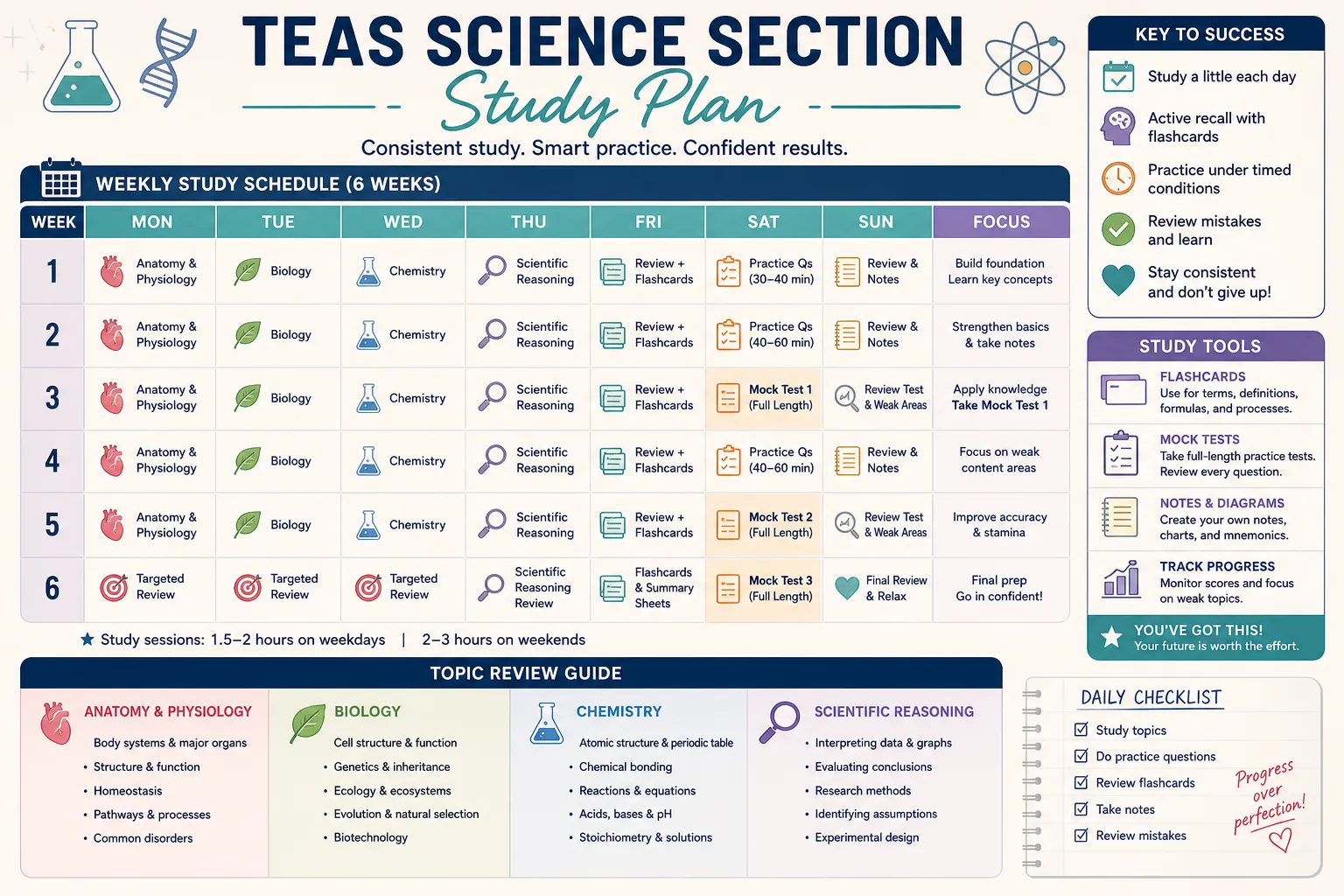
A 4-Week TEAS Science Study Plan
A content gap in many competitor articles is that they describe what to study but not how to organize it. Here’s a practical four-week plan.
Week 1: Diagnose and Build Foundations
- Take a timed diagnostic
- Review anatomy and physiology basics
- Practice 20–40 targeted questions daily
- Track error patterns
Week 2: Biology and Chemistry Focus
- Review cells, genetics, biomolecules, and heredity
- Review atomic structure, reactions, pH, and solutions
- Complete mixed teas 7 practice questions
- Rework missed items without looking at answers first
Week 3: Scientific Reasoning and Mixed Review
- Study measurement tools, variables, and simple data interpretation
- Begin mixed science sets daily
- Complete one timed science-only practice section
Week 4: Simulation and Final Weak-Spot Repair
- Take 2–3 timed practice tests
- Review every missed question in depth
- Drill your weakest categories
- Lightly review formulas, hormones, organ systems, and cell structures
How Competitive TEAS Prep Fits Into Nursing School Reality
For many students, the TEAS is not just another test. It is a gatekeeper for nursing school admission, which is why strategic preparation matters.
“In 2025, baccalaureate nursing programs in the United States did not accept 76,321 qualified applications.” – ATI Testing
That number is a powerful reminder: even qualified applicants face real competition. Strong scores won’t solve every admissions variable, but better preparation can absolutely improve your position.
TEAS Science Practice: Free vs Paid Resources
Students often start with a teas exam practice test free option, and that can be useful for orientation. But there’s a difference between trying a few questions and building a full score-improvement system.
Free Resources Can Help You:
- understand the general format
- sample question difficulty
- identify broad weaknesses
- reduce first-time test anxiety
Paid Prep Usually Matters More When You Need To:
- raise your score meaningfully
- access more realistic test banks
- get detailed rationales
- practice under timed conditions
- follow a structured prep path
If you’re serious about improving on the first attempt, a platform like PrepNovat gives you more than scattered teas free practice questions. It gives you a full system: adaptive prep, realistic testing conditions, deep explanations, expert support, and self-paced online access that fits busy schedules.
What to Prioritize in the Final Days Before Test Day
If your exam is close, don’t panic and don’t try to relead an entire textbook.
Focus on High-Value Review
In the final stretch, prioritize:
- major body systems and their functions
- hormones and homeostasis
- cell organelles and transport
- DNA, RNA, mitosis, meiosis
- basic chemistry and pH
- scientific method and lab tools
- mixed timed question sets
Avoid These Last-Minute Mistakes
- starting brand-new advanced topics
- taking untimed practice only
- skipping answer review
- cramming instead of sleeping
- obsessing over one weak area and ignoring the rest
PrepNovat’s Advantage for TEAS Science Prep
Students preparing for the teas exam need more than motivational advice. They need a study platform that makes performance improvement measurable.
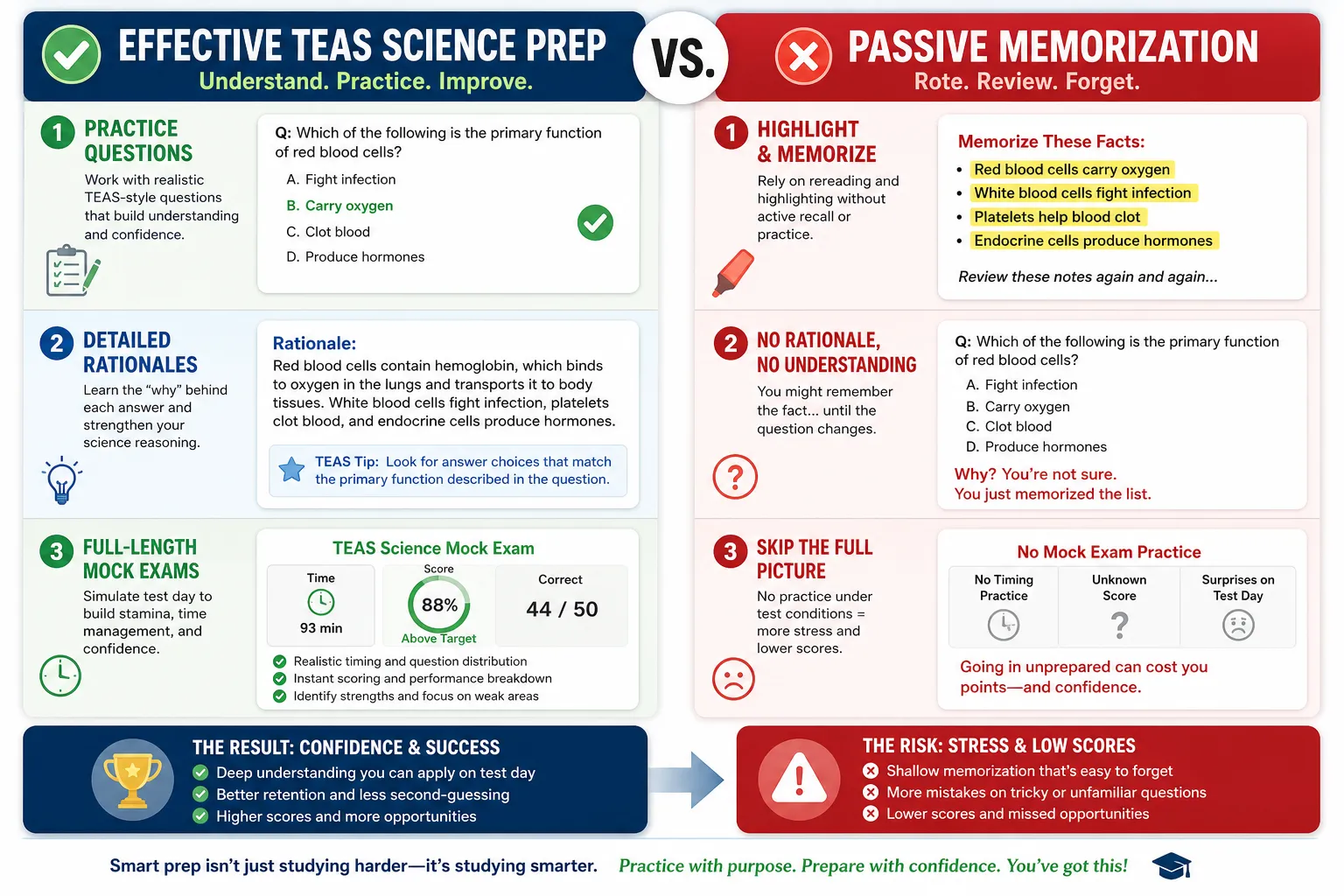
Why PrepNovat Works
- 10,100+ exam-realistic practice questions across multiple exam tracks
- Detailed rationales for correct and incorrect answers
- Full-length timed practice tests that simulate real exam conditions
- Adaptive online test prep that helps you focus where you need it most
- Professor-crafted content built for clarity and retention
- 24/7 support when you need help
- Self-paced access that fits busy student schedules
- Pass guarantee for added confidence
- Trusted by thousands of students preparing for nursing, GED, real estate, CompTIA, and teaching exams
For TEAS students specifically, that means less guessing, less wasted study time, and more deliberate progress.
Final Verdict
The science section doesn’t have to feel overwhelming. Once you understand the structure of teas exam science questions, the test becomes much more predictable: core anatomy and physiology, essential biology, foundational chemistry, and straightforward scientific reasoning delivered in timed, exam-style formats.
The smartest path is not random studying. It’s targeted review, realistic practice, and deep answer analysis. If you want a preparation system built for real score improvement, PrepNovat gives you the tools to do exactly that – with realistic question banks, timed exams, adaptive learning, expert support, and the confidence that comes from practicing the right way.
If your goal is to walk into test day ready, start building that confidence now with PrepNovat.
FAQ
What kind of science questions are on the TEAS test?
The TEAS science section includes anatomy and physiology, biology, chemistry, and scientific reasoning. You can expect multiple-choice, multi-select, and process-based questions that test both recall and application.
How hard is the science part of the TEAS test?
The science section is challenging for many students because it covers several subjects in just 60 minutes. It becomes much more manageable when you use realistic practice questions, timed tests, and detailed answer review.
How to pass the science part of the TEA test?
To pass, focus on high-yield topics, take a diagnostic test, and practice with exam-style questions across all four science domains. The best results usually come from combining content review with timed practice and strong rationales.
Is 70% on TEAS good?
A 70% score may meet the minimum for some programs, but competitiveness varies by school. Because nursing admissions can be selective, many students aim higher to strengthen their application.
How hard is the science part of the TEAS test?
It is often considered one of the tougher TEAS sections because it blends content knowledge with reasoning under time pressure. However, students usually improve significantly when they practice with realistic science question sets and full-length timed sections.
What are the top 10 science quiz questions?
Common high-yield question types involve organ functions, hormones, cell organelles, DNA vs. RNA, Punnett squares, reaction types, pH, scientific variables, homeostasis, and microorganisms. These topics appear often because they reflect the core science foundations tested on the TEAS.

Natalie
StudyVault Team